Clear Sky Science · en
Small RNA genomics of Aedes aegypti mosquitoes discovers infectious viruses that trigger an RNA interference response
Why mosquito viruses matter to all of us
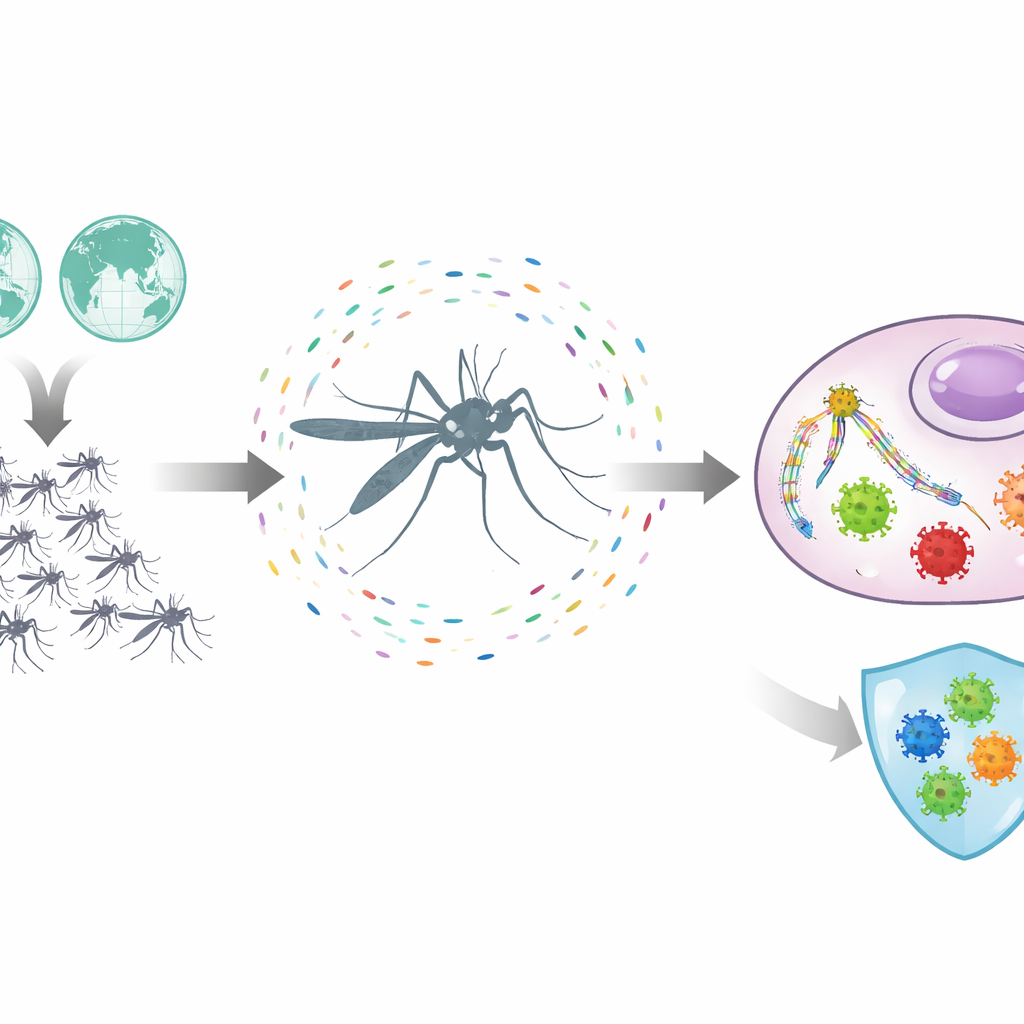
Mosquitoes are infamous for spreading dengue, Zika, and other human diseases, but the insects themselves are packed with many other viruses that never make the news. This study asks a timely question: what hidden viruses live inside the globally invasive yellow fever mosquito, Aedes aegypti, and how does the mosquito’s own defenses keep them in check? By reading the tiniest scraps of genetic material inside more than 200 mosquito samples from around the world, the authors uncover a rich, largely invisible viral world that may shape if, when, and how mosquitoes pass dangerous pathogens to people.
Looking for viral fingerprints in tiny RNA pieces
Instead of hunting directly for whole viral genomes, the researchers focused on “small RNAs” – short genetic fragments that mosquito cells naturally cut from invading viruses. These small pieces act like molecular mugshots, guiding the insect’s immune machinery to recognize and slice up viral material. The team compiled over 280 sequencing datasets from mosquitoes collected in the Americas, Asia, and Africa, as well as from long‑standing laboratory strains. Using an upgraded analysis pipeline, they stitched small fragments together, matched them against curated virus databases, and carefully filtered out misleading signals from viral remnants embedded in the mosquito’s own DNA. This approach allowed them to spot which viruses were not just present but actively provoking an immune response.
Hidden viral neighbors around the globe
The survey revealed that Aedes aegypti carries a surprising variety of insect‑specific viruses that do not infect humans but may influence how human viruses behave. Some, like Phasi Charoen‑like virus and Humaita‑Tubiacanga virus, appeared across large swaths of the Americas and into Asia, while another virus called Aedes aegypti Anphevirus was more common in northern parts of the Americas. A striking find was a form of dengue viral small RNAs in a wild mosquito from Singapore – the first time these immune fingerprints of dengue have been seen in a field‑caught Aedes aegypti, highlighting how rare and fleeting detectable dengue infections can be in routine surveillance. In Africa, a distinct virus dubbed Formosus virus turned up again and again in local colonies, suggesting it is stably passed from parent mosquitoes to their offspring.
Laboratory mosquitoes and plant‑like viruses
Academic laboratory mosquito strains, which are workhorses in research, were mostly free of persistent viruses. In contrast, two commercial colonies raised for pesticide testing carried extraordinarily heavy infections of a tombus‑like virus, a relative of plant viruses. Viral material and defensive small RNAs were found not only in adults but also in eggs, implying efficient vertical transmission from mothers to their progeny. The study also identified several mosquito viruses related to plant pathogens, such as partitiviruses and additional tombus‑like viruses. Their patterns in mosquito guts suggest they may have jumped from plants into insects as mosquitoes fed on sugary plant fluids, hinting at a broader ecological web connecting plants, mosquitoes, and their viruses.

From wild mosquitoes to virus‑infected cells
To prove that the genetic traces they saw corresponded to real, infectious agents and not just leftover fragments, the authors used homogenized mosquito tissues to infect mosquito cell lines in culture. Several viruses, including the African Formosus virus and the tombus‑like virus from commercial strains, successfully established long‑term infections in these cells. Once settled, the viruses triggered abundant small RNA production, often mirroring the patterns seen in whole mosquitoes. By also sequencing longer viral RNA molecules from the same samples, the team could compare how actively each virus replicated versus how strongly it aroused the RNA‑based defense system, revealing cases where viruses replicated with little immune reaction and others where small RNAs persisted even as full‑length viral RNAs faded away.
Small RNAs that actively silence genes
The most direct test of function came from cleverly designed reporter experiments. The researchers built artificial genes encoding a light‑producing enzyme and attached segments of viral sequence to their tails. When these reporters were introduced into mosquito cells chronically infected with Formosus or tombus‑like viruses, reporters carrying viral segments in the orientation that could pair with the cell’s own viral small RNAs were strongly silenced, while those aligned in the same direction as the viral RNAs were not. This shows that the small RNAs generated during infection are not just passive markers; they actively guide gene‑silencing machinery to matching sequences, offering a concrete mechanism for how mosquitoes can restrain long‑term viral guests.
What this means for disease and mosquito control
Together, these results paint a picture of Aedes aegypti as a moving ecosystem of insect‑specific viruses, constantly monitored and partially tamed by a powerful small‑RNA defense system. Because these resident viruses can influence how dengue, Zika, and other human pathogens replicate and spread, mapping them with small RNA genomics could greatly strengthen mosquito surveillance beyond traditional tests that search only for known threats. In the long run, harnessing viral small RNAs or the viruses that produce them might offer new tools to blunt mosquito‑borne diseases or even to deliver targeted gene silencing into mosquito populations, adding an unexpected ally in the fight against future outbreaks.
Citation: Gupta, S., Sharma, R., Williams, A.E. et al. Small RNA genomics of Aedes aegypti mosquitoes discovers infectious viruses that trigger an RNA interference response. Nat Commun 17, 3658 (2026). https://doi.org/10.1038/s41467-026-71964-1
Keywords: Aedes aegypti, mosquito virome, small RNA, RNA interference, vector surveillance