Clear Sky Science · en
Fault-mediated magma propagation and triggered seismicity revealed by the 2022 São Jorge Azores unrest
A Quiet Volcano with a Hidden Drama
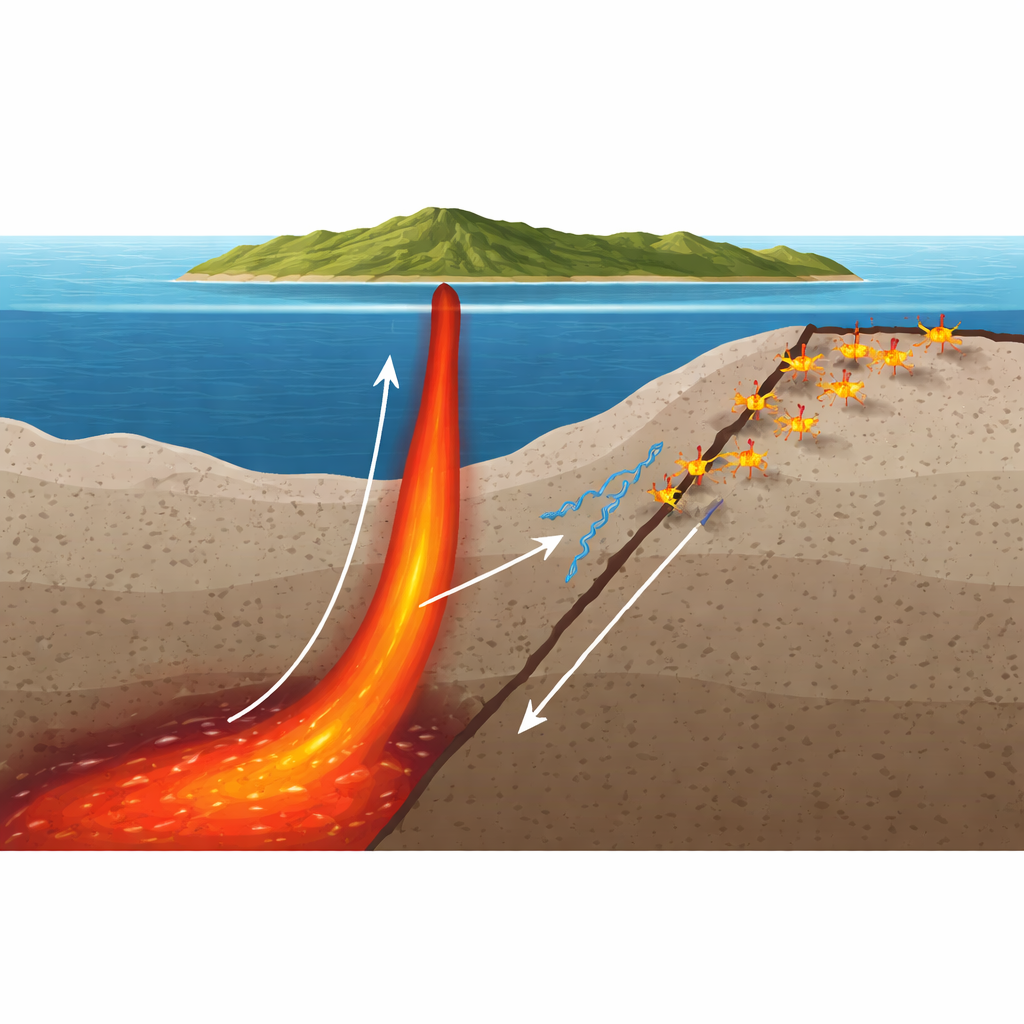
In early 2022, the people living on São Jorge, a slender volcanic island in Portugal’s Azores, faced a frightening question: was a major eruption on the way? The ground was shaking with thousands of small earthquakes, and the island subtly rose and stretched. Yet no lava ever appeared at the surface. This study unpacks that mystery, revealing how rising molten rock (magma) raced upward from deep inside the Earth, only to be diverted and stopped by a large underground fault. The work shows how such “failed eruptions” can still pose serious seismic hazards—and how carefully combining multiple types of data can help scientists understand what is happening out of sight.
Where Plates Meet and Islands Grow
The Azores sit at a complex junction where two of Earth’s tectonic plates slowly pull apart. São Jorge is a long, narrow island built by repeated fissure eruptions along zones of weakness in the crust. It lies near major faults that can both generate large earthquakes and guide rising magma. In March 2022, instruments recorded a sudden burst of ground shaking beneath the island and a short-lived pulse of ground deformation, hinting that fresh magma was on the move. Because the Azores combine active faults with active volcanoes, they offer a rare natural laboratory for watching how tectonic fractures and molten rock influence each other.
Tracking Magma with Subtle Ground Movements
The research team used satellite radar (InSAR) and a network of GPS-like receivers to measure how the ground shifted millimeter by millimeter. These data revealed that, over just a few days, the island’s central-western region was gently lifted and pulled apart in a pattern best explained by a tall, thin sheet of magma—called a dike—forcing its way upward. Modeling showed this dike stretched roughly 6 kilometers long and up to about 25 kilometers deep, rising from the upper mantle and stopping around 1.6 kilometers below the surface. Interestingly, there was no clear sign of earlier inflation from a shallow magma chamber; instead, the ascent appears to have been rapid and largely “stealthy,” with most of the movement happening aseismically, without generating many earthquakes along the dike itself.
An Earthquake Swarm Along a Hidden Fault
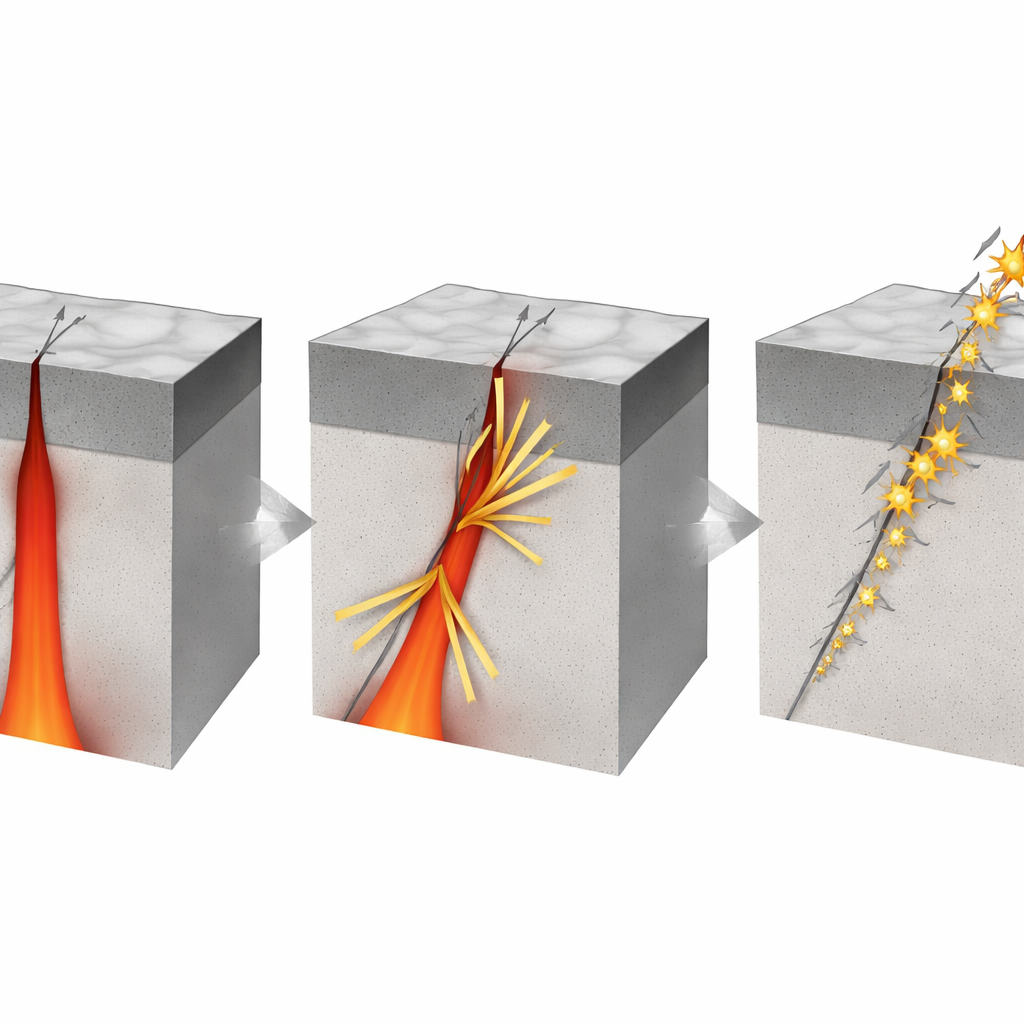
At the same time, seismologists recorded an intense swarm of about 18,000 earthquakes over several months. By deploying extra seismometers on land and on the seafloor, and using advanced methods to sharpen earthquake locations, the team found that these quakes did not cluster around the dike in the classic “dogbone” pattern seen at many volcanoes. Instead, they lined up in narrow streaks along one side of the dike, coinciding with a major crustal fault zone beneath western São Jorge. The earliest deep earthquakes, months before the crisis, migrated upward from about 30 kilometers depth, matching the lower end of the modeled dike. Once the main unrest began, seismicity shot upward to mid-crustal depths, then rapidly spread westward and downward along the fault, forming filament-like clusters that crept slowly upward over weeks—consistent with fluids moving through fractures rather than just solid rock breaking.
Fault as Highway, Fault as Roadblock
Putting the geodetic, seismic, and noise-based imaging results together, the authors propose that the fault acted first as a highway, then as a roadblock for the magma. As the near-vertical dike rose alongside the Pico do Carvão fault zone, some magma and its dissolved gases branched off laterally into the fault’s damaged, permeable rocks. This sideways escape of hot fluids raised pressures within the fault, triggering an unusually vigorous swarm of small earthquakes with rotated slip directions, while at the same time bleeding pressure from the main dike. The loss of pressure, coupled with the increasing weight and strength of the overlying rocks near the island’s base, caused the intrusion to stall before it could erupt. The swarm released only a modest amount of seismic energy compared with the stress that the fault can store, meaning the long-term risk of a large tectonic earthquake remains.
What a Failed Eruption Teaches Us
To a non-specialist, the key message is that not every dramatic burst of shaking and uplift on a volcano ends in an eruption. In São Jorge’s case, magma rose rapidly from deep within the Earth but was diverted into an existing fault, where it lost pressure and solidified instead of reaching the surface. That interaction still produced months of earthquakes and could have had serious consequences if a larger fault segment had failed. By showing that faults can both help magma rise and cause it to stall, this study improves our picture of how volcanoes behave in complex tectonic settings. It also highlights the importance of dense monitoring networks and rapid data analysis to distinguish between an eruption in the making and a powerful, but ultimately “failed,” intrusion beneath vulnerable island communities.
Citation: Hicks, S.P., Gonzalez, P.J., Lomax, A. et al. Fault-mediated magma propagation and triggered seismicity revealed by the 2022 São Jorge Azores unrest. Nat Commun 17, 3531 (2026). https://doi.org/10.1038/s41467-026-71668-6
Keywords: volcanic unrest, magma intrusion, earthquake swarm, Azores, tectonic faults