Clear Sky Science · en
The accelerating loss and shifting dynamics of US tidal wetlands
Why these coastal wetlands matter to you
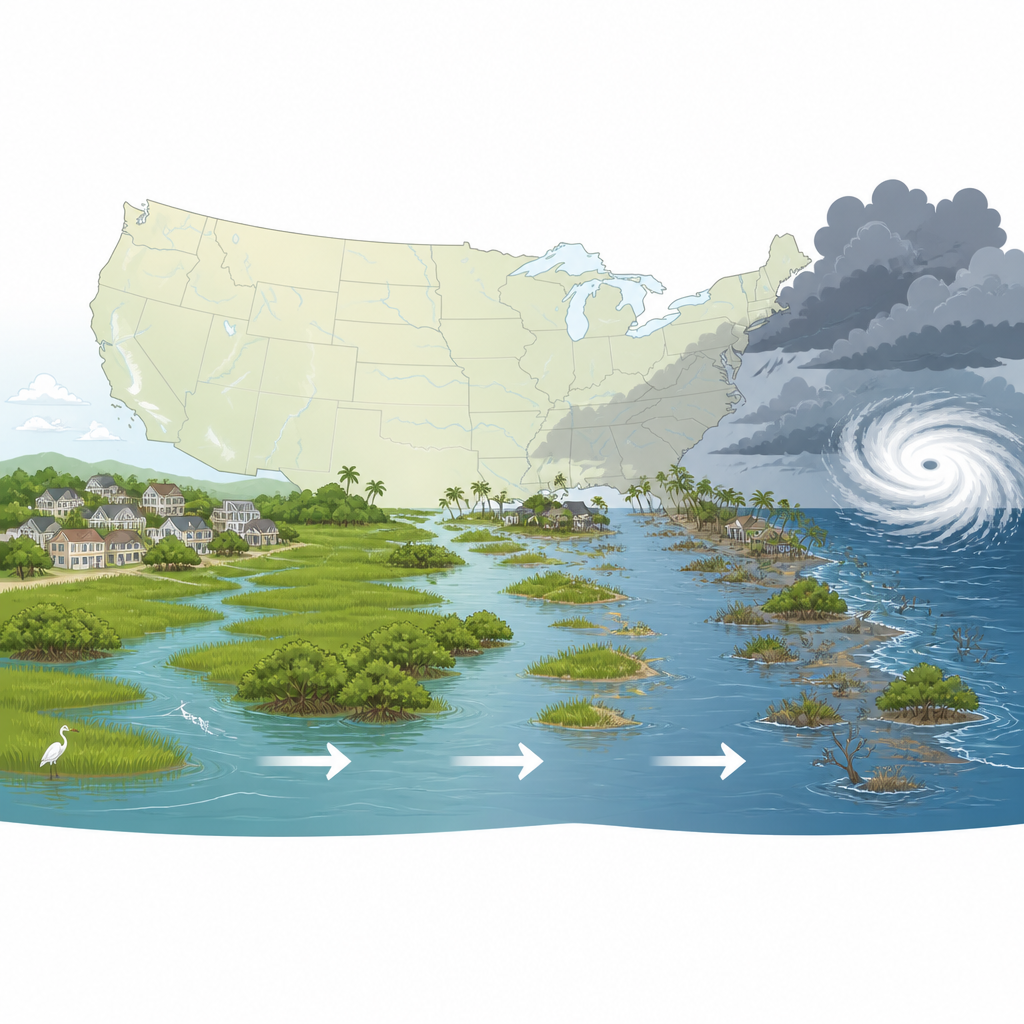
Tidal wetlands sit where land meets the sea, quietly protecting coastal towns from floods, filtering water, nurturing fish and birds, and locking away carbon. This study asks a pressing question: after decades of legal protection in the United States, are these wetlands actually safe in a warming world of rising seas and stronger storms? By tracking every stretch of tidal shoreline in the lower 48 states over nearly forty years, the authors uncover a troubling pattern of accelerating loss and shifting threats with real consequences for people, property, and wildlife.
A coastwide health check over four decades
The researchers built an annual record of tidal marshes, mangroves, and tidal flats across the contiguous United States from 1985 to 2023 using more than 176,000 Landsat satellite images. Instead of relying on occasional snapshots, they followed each coastal pixel through time, correcting for the natural rise and fall of tides that usually confuses satellite readings. This dense time series allowed them to move from static maps to something like a coastal heart monitor, capturing not just how much wetland has vanished or grown, but whether the pace of change is speeding up or slowing down.
Losses are growing faster, not just larger
The national picture is sobering. Over the 39-year record, the United States lost a net 1,640 square kilometers of tidal wetlands, about 8 percent of the area present in 1985. The yearly net loss averages more than 40 square kilometers and is itself accelerating, meaning the coast is bleeding habitat faster with time. Tidal marshes account for most of this decline, shrinking by about 1,567 square kilometers, while mangrove forests and tidal flats show little net change in total area. Yet that overall balance hides sharp regional contrasts: Pacific coast wetlands, helped by major restoration in places like San Francisco Bay and a gentler rate of sea level rise, have grown, while the Gulf of Mexico and Atlantic coasts show widespread and, in many areas, accelerating losses.
Slow squeeze from rising seas and sudden hits from storms
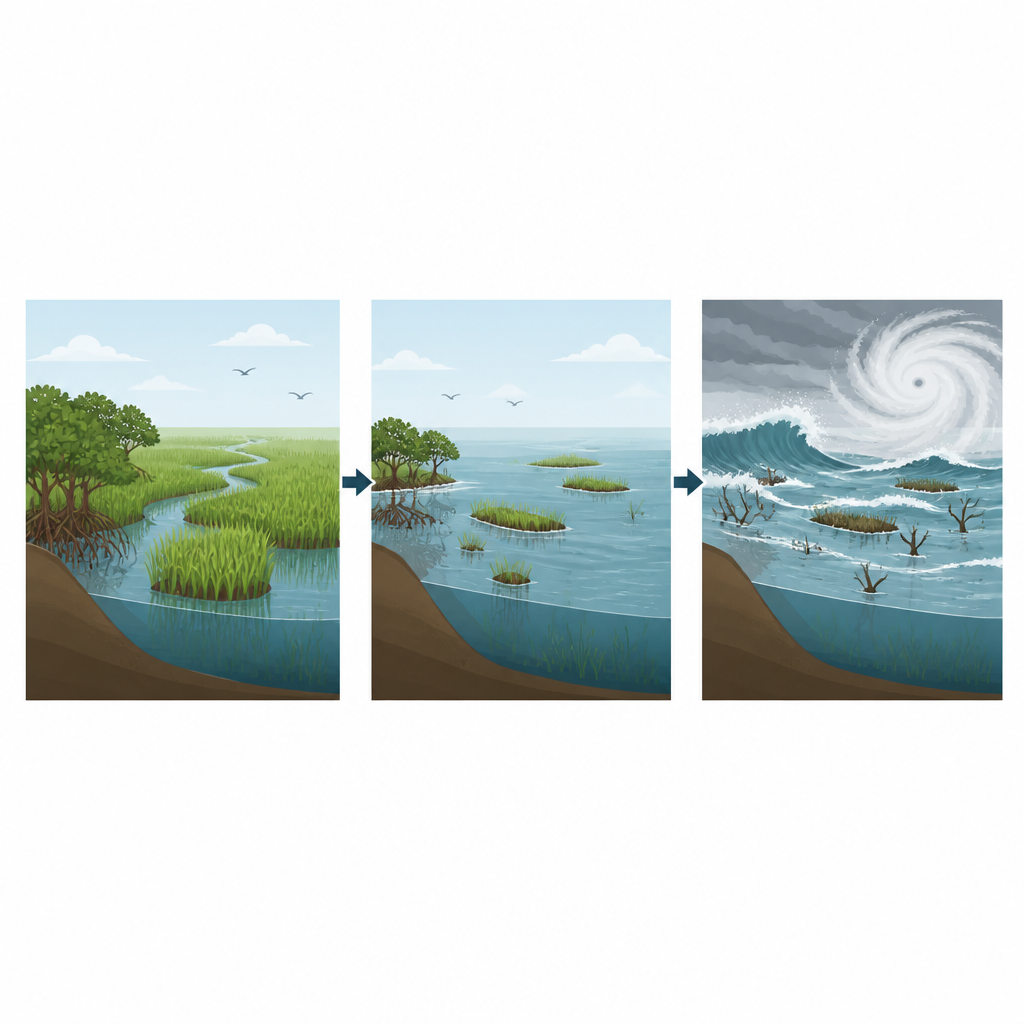
To understand why wetlands are disappearing, the team combined their maps with detailed case studies and climate records. They found that long term pressures such as sea level rise, altered river flows, and pollution are responsible for roughly 60 percent of the total area lost. Marshes at low elevations are drowning without being able to shift inland, often blocked by roads, development, or resistant forests. At the same time, the character of the threat is changing. When the researchers looked at what drives the recent speedup in loss, sudden shocks from extreme weather events now dominate, contributing about one and a half times more to the acceleration than the chronic pressures. Major hurricanes, freezes, and droughts repeatedly show up as sharp spikes of wetland loss from which many areas never fully recover.
A tale of retreating marshes and stressed mangroves
Tidal marshes, which make up around four fifths of US tidal wetlands, are the main source of net loss. Along the Gulf of Mexico, their cumulative decline has already been large, while the Atlantic coast, though losing marsh more slowly, now shows some of the strongest acceleration. By tracking marsh area along elevation bands, the authors see heavy losses near the sea with little evidence of matching gains upslope, signaling that marshes are not migrating inland fast enough to keep pace. Mangroves tell a different but equally fragile story. Their total area has stayed roughly constant because climate driven expansion into higher latitudes and former marsh zones is almost exactly offset by severe dieback from hurricanes and hard winter freezes, especially in South Florida. Many of these damaged stands have not recovered years after storms passed, revealing hidden vulnerability behind the apparently stable numbers.
Human hands: less direct damage, not enough repair
One surprising result is that direct human conversion of tidal wetlands in recent decades explains only about 4 percent of total losses in the United States, a stark contrast with many parts of Asia where farming and construction erase wetlands outright. American regulations have largely succeeded in curbing new destruction. However, the same study shows that human led restoration, while crucial, is not yet keeping up. In several heavily exposed bays on the Gulf Coast, modest restoration projects are overwhelmed by far larger climate driven losses. By contrast, larger, coordinated restoration efforts on the Pacific coast have produced clear net gains, but in a region with slower sea level rise and fewer tropical storms. This suggests that restoration scale and local climate hazards together determine whether projects can genuinely tip the balance.
What this means for coasts and communities
For a general reader, the key message is that protected does not mean safe. US tidal wetlands are still shrinking, and the rate of loss is increasing even as laws limit direct destruction. Long term sea level rise is quietly weakening these ecosystems, while stronger and more frequent extreme weather events deliver sudden blows that many wetlands can no longer bounce back from. The study argues that coastal adaptation must move beyond simply drawing lines on maps to actively restoring lost tidal areas, reopening former wetlands to the tides, and planning for recovery after storms. In short, if society wants these natural buffers to keep defending coasts, policies and restoration efforts will need to match the speed and punch of the changing climate.
Citation: Yang, X., Qiu, S., Kroeger, K.D. et al. The accelerating loss and shifting dynamics of US tidal wetlands. Nat Commun 17, 4332 (2026). https://doi.org/10.1038/s41467-026-71464-2
Keywords: tidal wetlands, sea level rise, coastal resilience, hurricanes, salt marsh