Clear Sky Science · en
Glacial dysoxia in the deep subpolar North Atlantic during the Mid-Pleistocene Transition
Why ancient oceans matter today
Long before humans began burning fossil fuels, Earth’s climate rhythm abruptly changed. Around one million years ago, the planet shifted from frequent, smaller ice ages to fewer but much larger ones lasting about 100,000 years. This study asks a deceptively simple question with big implications: what changed in the oceans to help flip Earth into this new climate mode, and what does that history tell us about how oceans might store carbon and lose oxygen in the future?
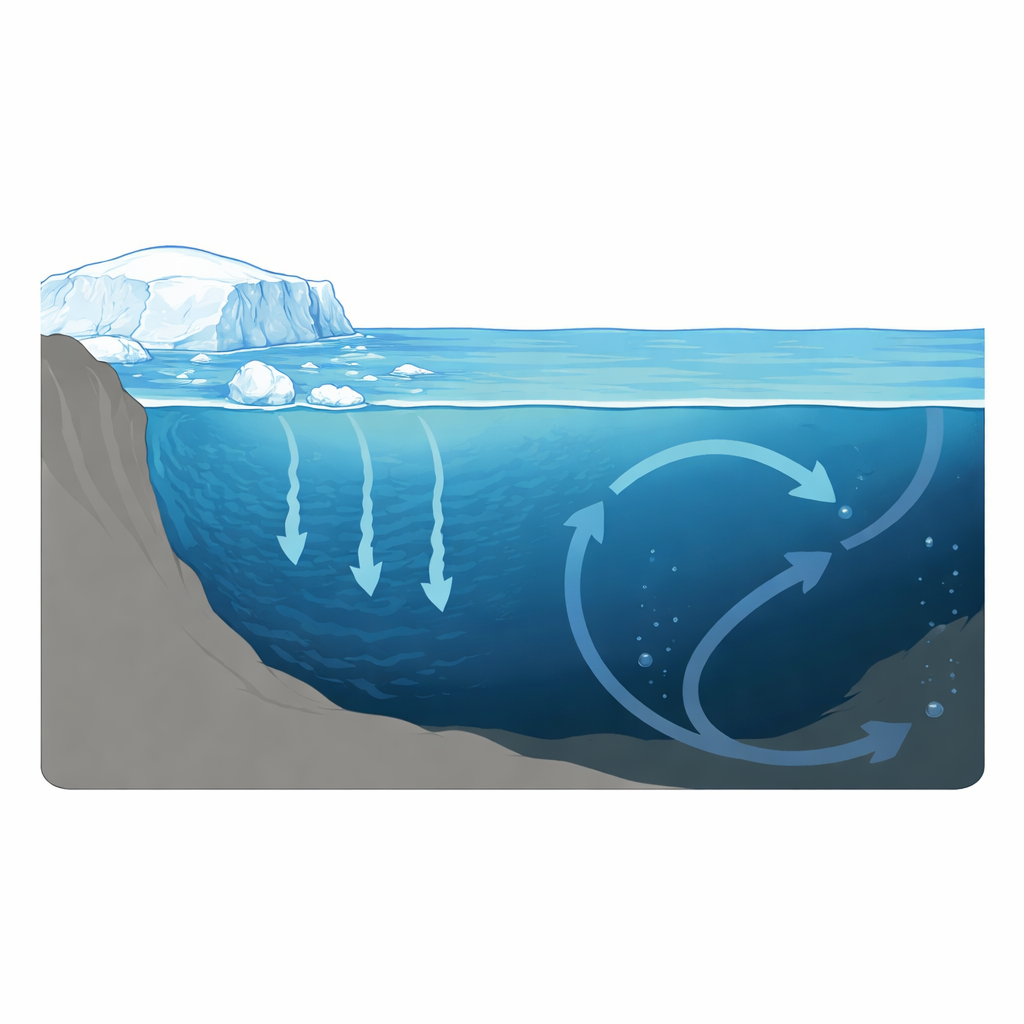
A quiet revolution in the ice age cycles
During the Mid-Pleistocene Transition, between about 1.25 and 0.7 million years ago, the timing of ice ages changed even though the pattern of sunlight reaching Earth from orbital cycles stayed roughly the same. At the same time, atmospheric carbon dioxide dropped by roughly 30 parts per million, and climate records show that the deep ocean became a more important storage place for carbon. Many earlier studies pointed to the Southern Ocean around Antarctica as the main driver of this change. There, thicker sea ice, stronger stratification, and shifts in winds appear to have helped trap more carbon-rich, low-oxygen waters at depth.
Listening to the mud on the Atlantic seafloor
The new work focuses on the other end of the global conveyor belt: the subpolar North Atlantic, where modern deep waters form today. The authors examined sediments from a drill site on the Gardar Drift south of Iceland, a key downstream pathway for recently formed deep water. Within these layers of mud they measured chemical signals tied to oxygen levels, such as manganese and different forms of phosphorus, and counted species of tiny bottom-dwelling organisms called benthic foraminifera that thrive only in well-oxygenated conditions. Together, these independent lines of evidence allow them to reconstruct how much oxygen reached the deep seafloor through time.
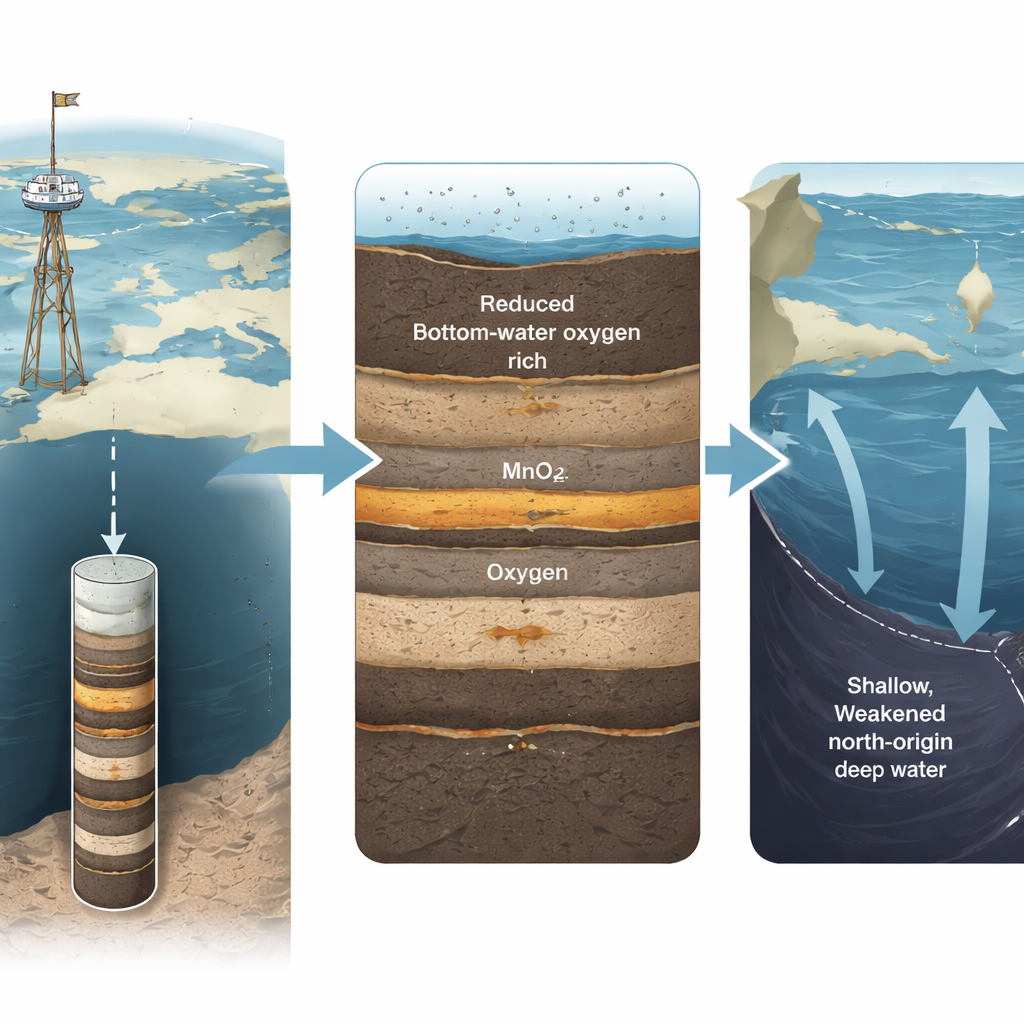
Fresh meltwater, sluggish currents, and stuffy deep seas
The cores reveal that between about 940,000 and 870,000 years ago, and again during nearby glacial periods, the deep subpolar North Atlantic repeatedly slipped into “dysoxic” conditions—oxygen levels low enough to stress many seafloor organisms. Minerals that usually build up under oxygen-rich conditions declined by more than half, and species that prefer well-ventilated waters nearly vanished. These low-oxygen intervals line up with times of intense ice-rafted debris, when armadas of icebergs delivered large amounts of freshwater to the region. That freshening of the surface ocean reduced its density, weakened deep winter mixing, and cut off the supply of newly formed deep water, leaving older, carbon-rich, oxygen-poor waters to accumulate in the deep basin.
A north–south partnership in carbon storage
When the North Atlantic records are compared with similar chemical clues from the South Atlantic and the waters near Antarctica, a coordinated picture emerges. Both polar regions show stronger surface freshening, expanded sea ice, and reduced deep-ocean oxygen during key glacial stages of the Mid-Pleistocene Transition. In the North, the overturning circulation that today exports well-oxygenated deep water appears to have weakened and become shallower. In the South, dense Antarctic bottom waters spread more widely, filling the deepest parts of the ocean with low-oxygen, nutrient-rich water. This combination effectively enlarged the global deep-ocean reservoir where respired carbon could be stored away from the atmosphere, helping to maintain lower atmospheric carbon dioxide and support the shift to larger, longer ice ages.
Lessons from an oxygen-poor past
To a non-specialist, the central message is straightforward: when large ice sheets spilled freshwater into the North Atlantic, they disrupted deep-water formation, allowed the deep ocean to grow short on oxygen, and helped lock more carbon away in the abyss. This process, working in tandem with similar changes around Antarctica, likely played a major role in reshaping Earth’s ice age cycle. Modern climate models predict that continued warming and ice melt could again weaken the Atlantic overturning and reduce deep-ocean oxygen. By showing how sensitive past deep waters were to meltwater and circulation changes, this study underscores that the ocean’s role as a carbon storehouse and its ability to supply oxygen to the deep sea are closely intertwined—and vulnerable—parts of the climate system.
Citation: Hernández-Almeida, I., Sierro, F.J., Filippelli, G.M. et al. Glacial dysoxia in the deep subpolar North Atlantic during the Mid-Pleistocene Transition. Nat Commun 17, 3748 (2026). https://doi.org/10.1038/s41467-026-71268-4
Keywords: Mid-Pleistocene Transition, Atlantic overturning circulation, ocean oxygen, deep ocean carbon storage, ice sheet meltwater