Clear Sky Science · en
Conformational gating mechanism for processive catalysis of β(1,3)-glucans
How nature’s sugar cutters power future green tech
Many microbes survive by nibbling away at tough natural sugars that make up cell walls in fungi, algae and plants. These sugars are also promising raw materials for biofuels and health products. This study reveals how a newly found microbial enzyme grips and chews through a common sugar called β(1,3)-glucan in a highly efficient, stepwise way, opening doors to better biomass conversion and a deeper understanding of how our own gut microbes handle fiber.
A closer look at stubborn natural sugars
β(1,3)-glucans are long chains of glucose that help fungi and algae keep their cell walls strong and allow plants to send signals and respond to stress. They are also interesting to humans because some forms act on the immune system and others can be turned into biofuels and fine chemicals. To tap into these benefits, scientists must understand how enzymes chop these chains into smaller pieces. Unlike better-known cellulose, whose breakdown is already well studied, β(1,3)-glucans have been thought to be handled mostly by enzymes that cut in a scattered, stop-and-go fashion.
Finding an enzyme that ‘walks’ along the chain
In this work, researchers mined DNA from a microbial community that excels at digesting complex plant material and identified a previously uncharacterized member of the GH158 enzyme family, here called GH158(Pro). They found that this enzyme prefers β(1,3)-glucans with few side branches and can also act on some mixed chains that contain both β(1,3) and β(1,4) links. Careful product analysis showed that it releases almost exclusively tiny two-sugar units, rather than a mixture of fragments. This pattern is a hallmark of a processive mode: the enzyme latches on once and then walks along the chain, cutting off one small piece after another instead of letting go after each cut. 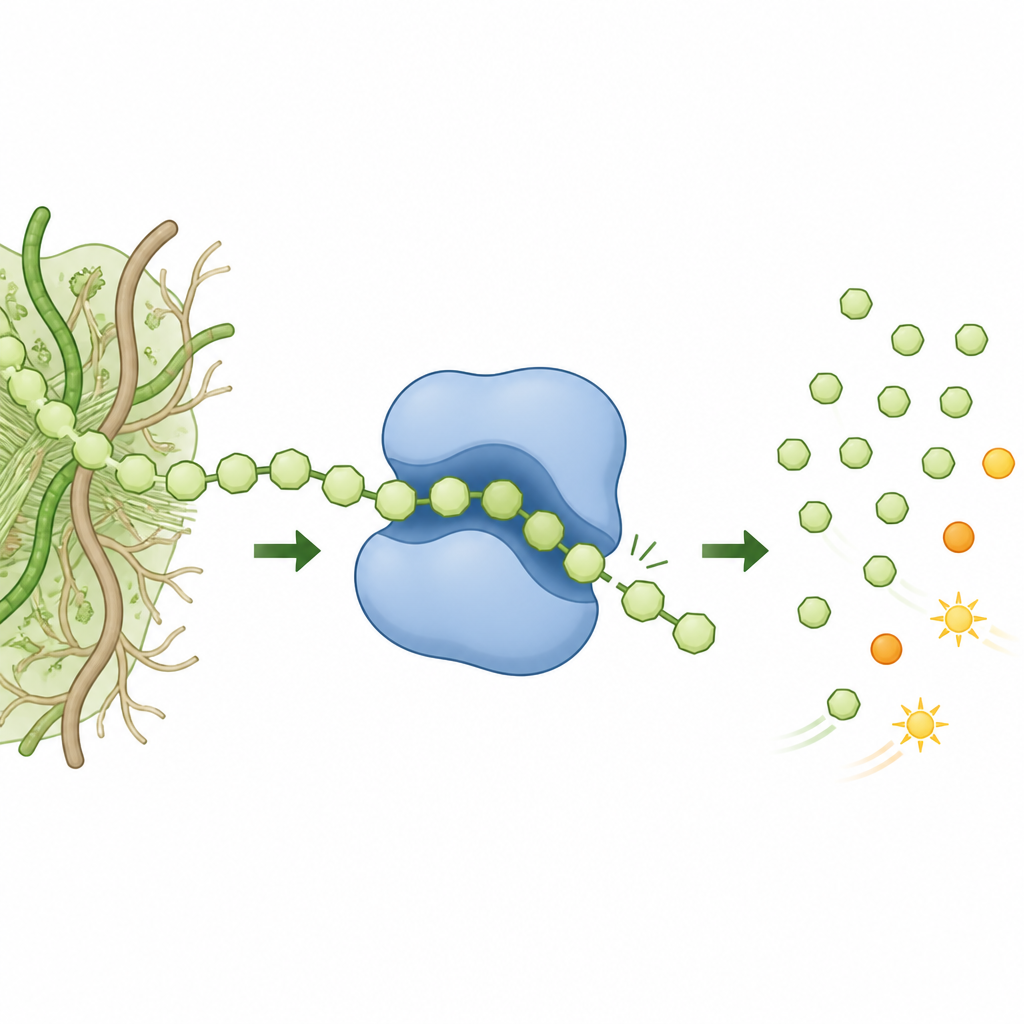
A moving tunnel that grips and guides the sugar
To uncover how this walking motion works, the team solved nineteen ultra-detailed 3D structures of the enzyme with and without bound sugar fragments, using advanced X-ray methods. These snapshots revealed that, when substrate binds, part of the enzyme folds over to form a short tunnel that wraps around the sugar chain. Two key regions, one from the main body and one from an attached Ig-like domain, come together and are locked by a salt bridge between a positively and a negatively charged amino acid. Inside this tunnel, aromatic side chains stack against the curved sugar backbone, selecting β(1,3) connections at specific positions but tolerating either β(1,3) or β(1,4) further out. Mutating residues that hold the tunnel together weakened activity and changed the product mixture, making the enzyme behave more like a conventional, non-processive cutter.
How opening and closing drives stepwise cutting
Computer simulations showed that the tunnel is not rigid. In the free enzyme, the tunnel tends to open, while bound sugar stabilizes the closed form. After a cut has been made, simulations of long sugar fragments revealed that the freshly released two-sugar product quickly exits the positive end of the tunnel. Then, breaking the salt bridge allows the tunnel to open, letting the remaining chain slide forward by one or two sugar units. As the tunnel recloses, other residues reposition to hold the chain in a new, ready-to-cut configuration. Quantum–mechanical calculations further showed that the sugar being cut follows a “cyclic” shape change during the reaction, starting and ending in the same relaxed form, a behavior previously seen mainly in enzymes that trim chains from their ends. 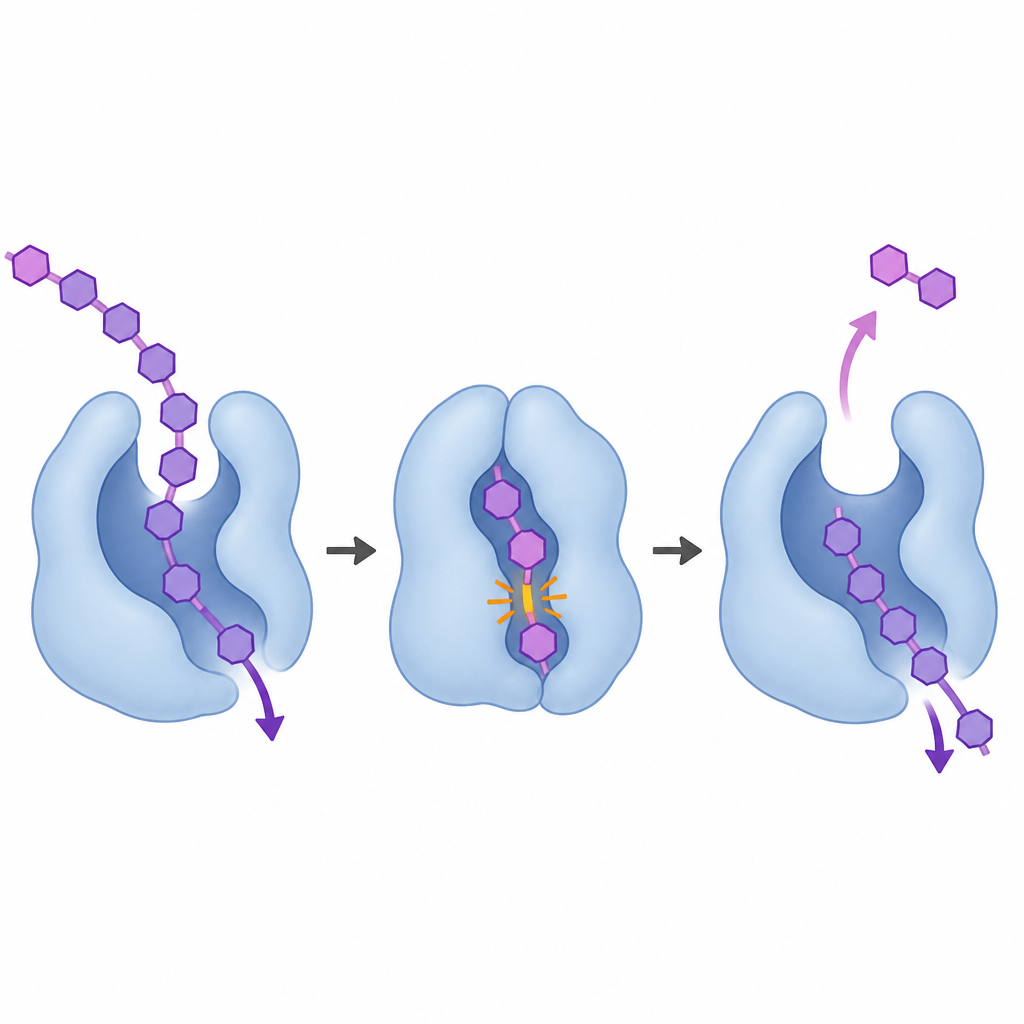
Why this moving gate matters
This study shows that a dynamic “gating” tunnel in GH158(Pro) enables a rare endo-processive strategy for breaking down β(1,3)-glucans. By cycling between open and closed states, the enzyme can both grip the chain firmly for efficient cutting and then shift it forward without letting go. The authors also find that key tunnel-forming residues are conserved in many related enzymes, suggesting that this strategy is widespread. For a lay reader, the upshot is that nature uses a clever moving gate to turn stubborn cell wall sugars into neat, uniform bites, knowledge that could be harnessed to design better enzymes for sustainable fuels, green chemistry and perhaps tailored dietary fibers that interact with our microbiota in specific ways.
Citation: Gimenis, G.H.B., Spadeto, J.P.M., Colombari, F.M. et al. Conformational gating mechanism for processive catalysis of β(1,3)-glucans. Nat Commun 17, 4527 (2026). https://doi.org/10.1038/s41467-026-71224-2
Keywords: beta glucan, processive enzyme, biomass degradation, glycoside hydrolase, biofuel enzymes