Clear Sky Science · en
The structure of the Vibrio alginolyticus flagellar filament suggests molecular mechanism for the rotation of sheathed flagella
Hidden propellers of harmful microbes
Many disease-causing bacteria rely on tiny spinning propellers, called flagella, to swim through liquid and reach our cells. In some species, including Vibrio alginolyticus, these propellers are wrapped in a soft outer covering made from the cell’s own membrane. This study uncovers how these covered “sheathed” propellers are built and how they can spin at high speed without grinding against their sheath, a question that matters for understanding both bacterial motion and how these microbes evade our immune system. 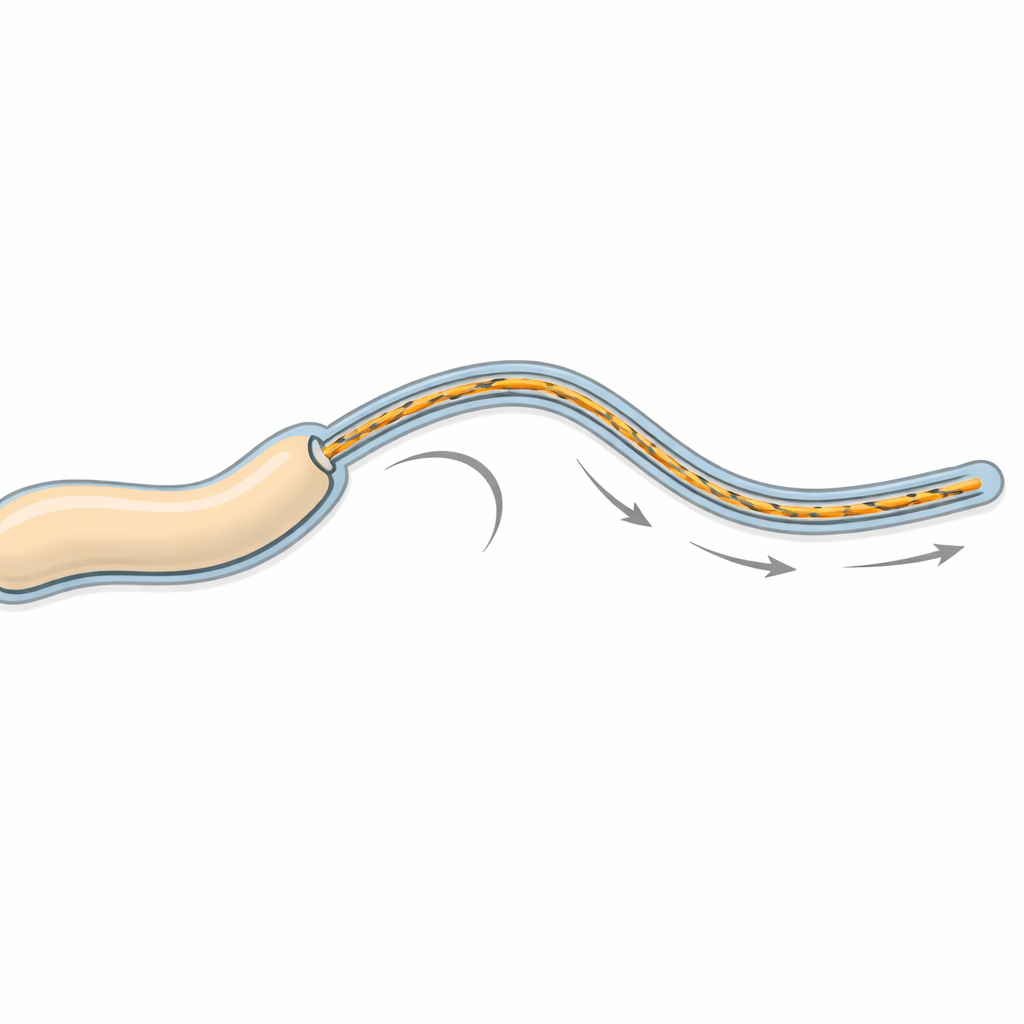
A propeller wrapped in its own coat
The researchers focused on Vibrio alginolyticus, a marine bacterium that can infect fish, shellfish, and humans. Like its relative Vibrio cholerae, it has a single powerful flagellum at one pole of the cell that is wrapped in a sheath made from the outer membrane, the same envelope that faces the outside world. Using advanced electron microscopy, they captured high-resolution three-dimensional images of these sheathed filaments. The pictures show that the core of the flagellum forms a familiar spiral bundle of 11 strands, much like unsheathed flagella in other bacteria, but here this bundle is neatly surrounded by a double-layered membrane tube that continues seamlessly from the cell surface.
The main building block of the propeller
Vibrio alginolyticus carries six closely related genes that could, in principle, provide the building blocks of its polar flagellum. To find out which one truly matters, the team combined structural clues from their images with genetic tests. By deleting these genes one at a time and measuring how well the bacteria could still swim, they discovered that one protein, called FlaD2, is essential: cells lacking FlaD2 became almost completely non-motile, while loss of the others had little effect. The detailed structures of both sheathed and unsheathed filaments match the shape of FlaD2, confirming that this single protein forms the main shaft of the propeller, stacked tens of thousands of times to create a long supercoiled filament.
How to spin fast without scraping the sheath
A key puzzle was how the inner filament can rotate rapidly inside its membrane coat without tearing or slowing down. By calculating the electrical charge on the surface of the FlaD2 filament, the scientists found something striking: unlike most bacterial flagella, which are fairly neutral, the Vibrio filament is strongly negative all over. The inner surface of the surrounding membrane sheath is also expected to be negatively charged because of its fatty head groups. Like two magnets with the same pole facing each other, these surfaces repel. The team proposes that this electrostatic repulsion keeps the filament from touching the sheath, creating a thin lubricating gap that lets the core spin freely at high speed with very little friction, even while the flexible sheath can bend and deform as the bacterium swims. 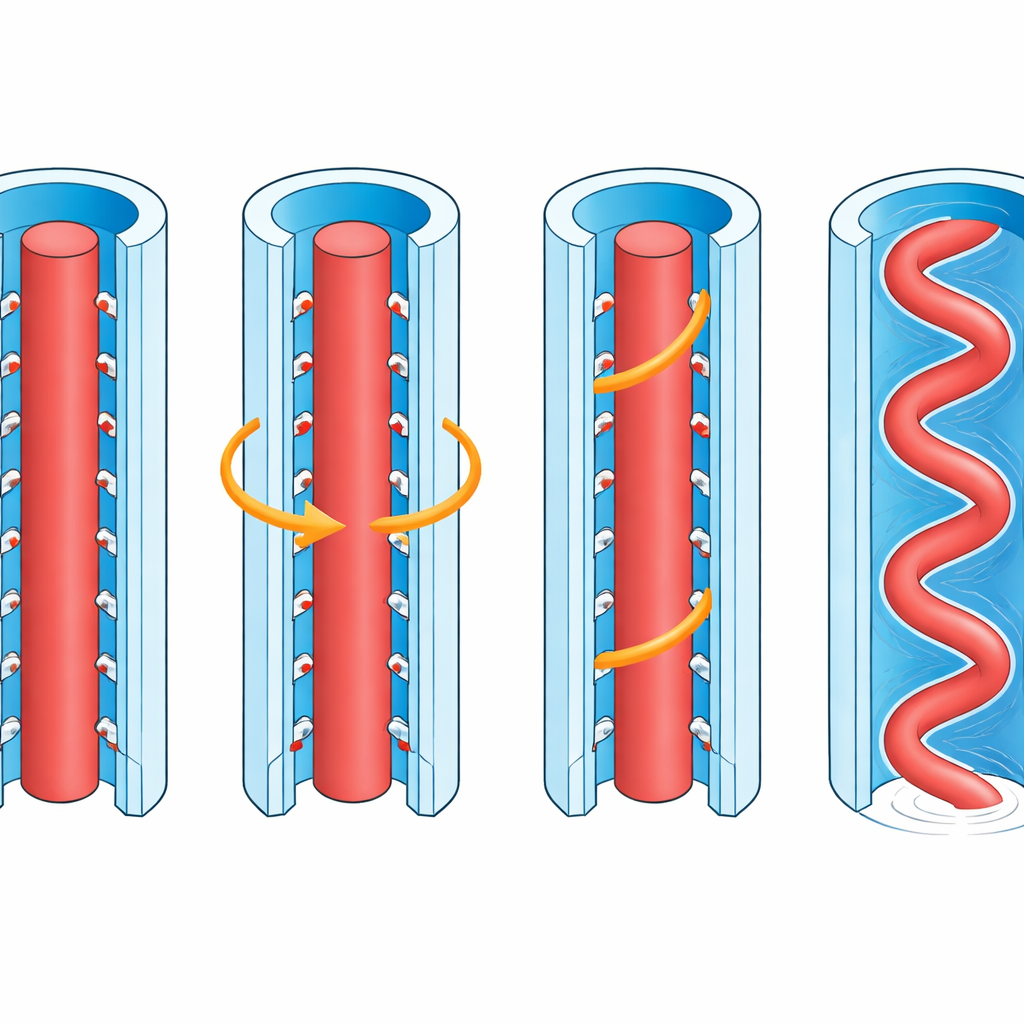
A special tip that keeps growth in step
At the far end of every flagellum sits a cap made of a protein called FliD, which helps new building blocks add to the growing filament. In Vibrio and some other sheathed bacteria, this cap carries an extra domain not present in most species. Structural models suggest that this extra piece, dubbed D4, sits like a wide skirt at the top of the filament and is just about the same width as the inner layer of the sheath. When the researchers removed this domain from the cap, bacteria still managed to build working flagella and swim, but electron microscopy sometimes revealed empty sheath tubes extending beyond the filament tip. This implies that the D4 domain normally helps keep the growth of the solid filament and the surrounding sheath synchronized, preventing the sheath from outgrowing its spinning core.
What this means for infection and future studies
Together, these findings support a simple physical picture: in sheathed flagella, the membrane coat does not rotate as a rigid unit with the filament. Instead, the filament spins freely inside a flexible tube, held away from the walls by charge-based repulsion, while a specialized tip helps the sheath and filament grow together. This arrangement may allow Vibrio bacteria to move rapidly, shed small membrane bubbles that can deliver virulence factors, and hide key flagellar parts from immune sensors. By revealing how nature builds a high-speed, low-friction motor in a soft sleeve, the study provides a framework for understanding similar structures in other pathogens and may inspire new strategies to disrupt bacterial movement during infection.
Citation: Qin, K., Einenkel, R., Zhao, W. et al. The structure of the Vibrio alginolyticus flagellar filament suggests molecular mechanism for the rotation of sheathed flagella. Nat Commun 17, 3532 (2026). https://doi.org/10.1038/s41467-026-71203-7
Keywords: bacterial motility, sheathed flagella, Vibrio alginolyticus, cryo electron microscopy, electrostatic repulsion