Clear Sky Science · en
Asymmetric histone inheritance regulates olfactory stem cell fates during regeneration
Why our sense of smell can bounce back
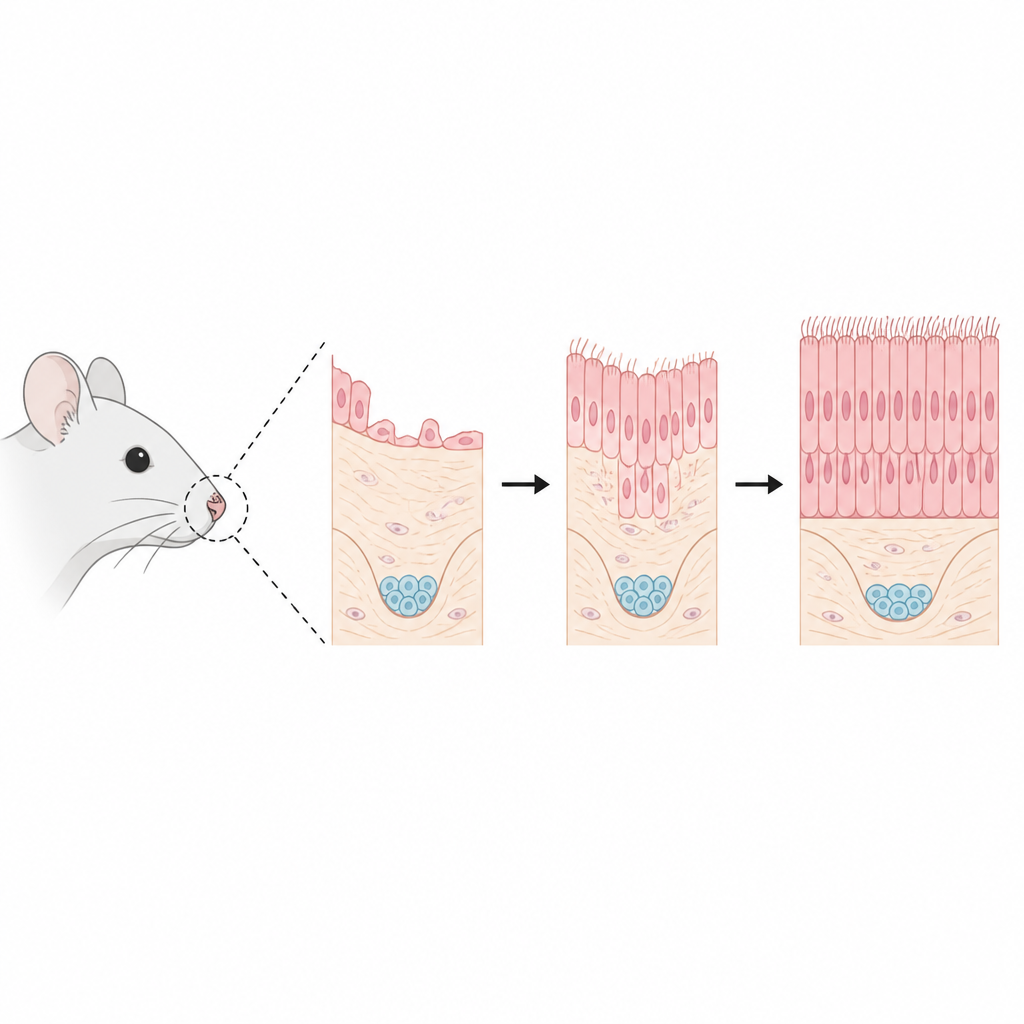
The lining high inside the nose is one of the few places in the adult body where nerve cells are replaced throughout life. After a bad infection or chemical exposure, this tissue can be badly damaged, yet many people regain their sense of smell. This study explores how a hidden pool of stem cells in the nose helps rebuild this delicate surface and what happens inside their DNA-packaging system when they divide to repair the tissue.
A quiet backup system in the nose
The olfactory epithelium is the thin sheet of tissue that lets us detect odors. Because it sits directly in the path of inhaled air, it is easily harmed by viruses, pollutants, and toxic chemicals. To cope with this constant risk, the tissue contains horizontal basal cells, a reserve population of stem cells that normally lie dormant along the bottom layer. When severe injury wipes out most other cells, these basal cells wake up, start dividing, and produce all of the main cell types needed to rebuild the smell-sensing surface, including new sensory neurons and their supporting neighbors.
Unequal sharing of DNA wrappers
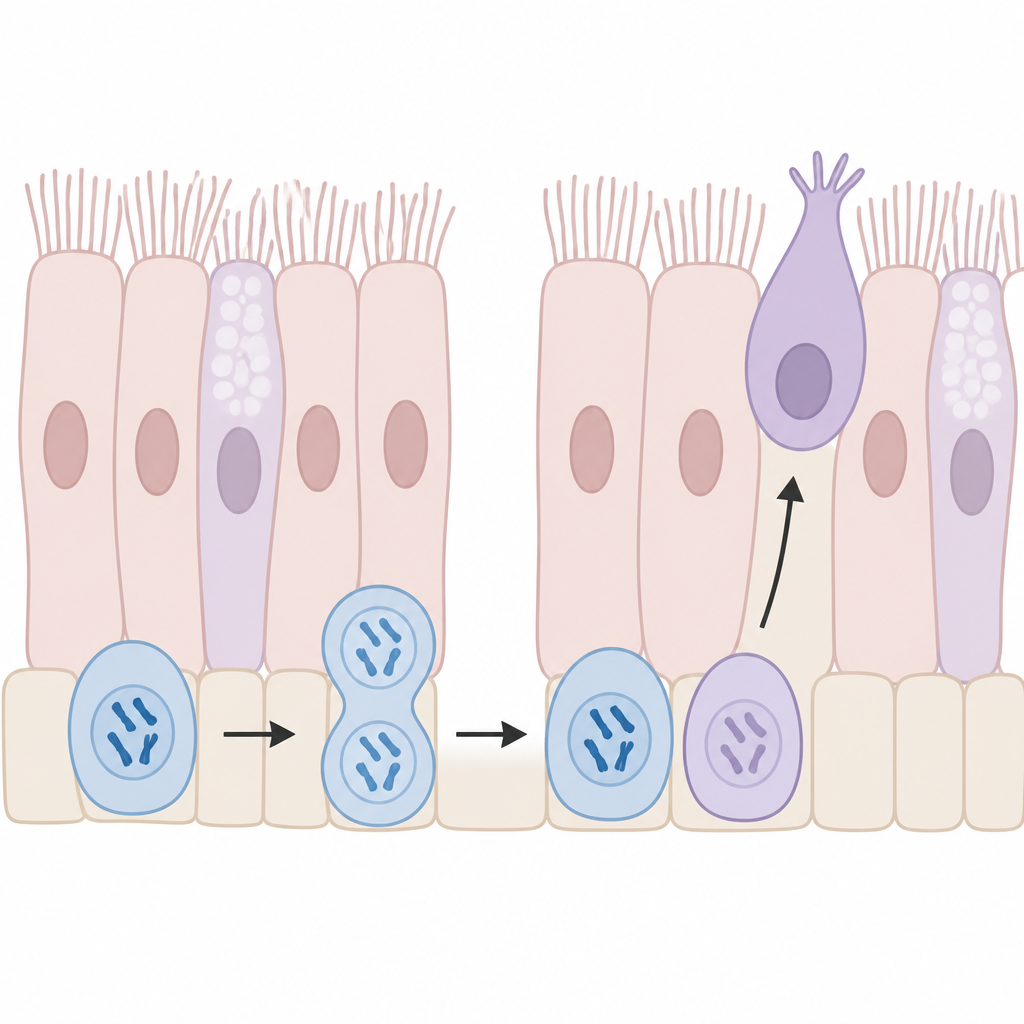
Inside every cell, DNA is wrapped around proteins called histones, which help control which genes are active. The researchers asked whether these histones are shared equally when basal stem cells divide during repair. Working in mice, they followed a specific histone, H4, by tagging it with a fluorescent marker, and combined this with markers for cell division and for p63, a protein that helps decide whether a basal cell stays a stem cell or begins to specialize. They discovered that in about one third of dividing basal cells, H4 and related histones H3 and H3.3 were inherited unevenly by the two daughter cells, while another histone pair, H2A–H2B, remained evenly split. The daughter that received more of these key histones also held more p63, hinting that unequal histone inheritance might guide the two cells toward different futures.
Timing gene activity in sister cells
During cell division, most gene activity shuts down and must be restarted afterward. The team examined markers of active RNA polymerase II, the enzyme that copies DNA into RNA, and measured newly made RNA in dividing basal cells. They found that in cells with uneven histone inheritance, one daughter cell restarted transcription sooner and more strongly than its sister. This early-activating nucleus tended to be the one with more H3.3 and p63. Single-cell RNA sequencing of carefully tracked daughter cell pairs in culture supported this view: some pairs showed very similar gene profiles, but roughly one third displayed clear differences, with one daughter primed for further activation or differentiation toward various nasal cell types, and the other biased toward slower change or self-renewal.
What happens when the balance is disturbed
To test whether this unequal histone sharing is important for real tissue repair, the researchers disrupted the process in two ways. First, they used nocodazole, a drug that briefly breaks down microtubules, the structures that guide chromosome movement during division. This treatment forced histones to be split more evenly between sister chromatids and erased the usual differences in p63 and transcription restart between daughters. Second, they introduced a mutant form of histone H3 that is known to interfere with asymmetric histone inheritance. This mutant also reduced histone and p63 differences and made transcription restart more uniform in dividing basal cells.
Links to tissue repair and smell recovery
When mice were given the microtubule-blocking drug during the early days after nasal injury, their basal cells proliferated more but divided in a more uniform way, with fewer divisions biased toward producing distinct daughter fates. Weeks later, these animals had a thinner olfactory lining, fewer mature smell neurons, and slower recovery in food-finding and odor preference tests compared with untreated injured mice. Together, the results suggest that a controlled amount of unequal histone inheritance in nasal stem cells helps produce just the right mix of self-renewing and differentiating daughters, supporting both rapid repair and long-term maintenance of the sense of smell.
Citation: Ma, B., Yang, G., Yao, J. et al. Asymmetric histone inheritance regulates olfactory stem cell fates during regeneration. Nat Commun 17, 4361 (2026). https://doi.org/10.1038/s41467-026-70987-y
Keywords: olfactory stem cells, histone inheritance, tissue regeneration, asymmetric cell division, sense of smell