Clear Sky Science · en
Archaeal and eukaryotic MCM rings sequentially melt DNA for replication initiation
How our cells start copying DNA
Every time a cell divides, it must copy its entire genetic instruction book with extraordinary accuracy. That copying process begins with a delicate first move: a small stretch of the DNA double helix has to open so that the copying machinery can get in. This study reveals, in molecular detail, how a key ring-shaped protein machine in both simple and complex organisms performs that first tiny act of opening, setting the stage for faithful DNA replication.
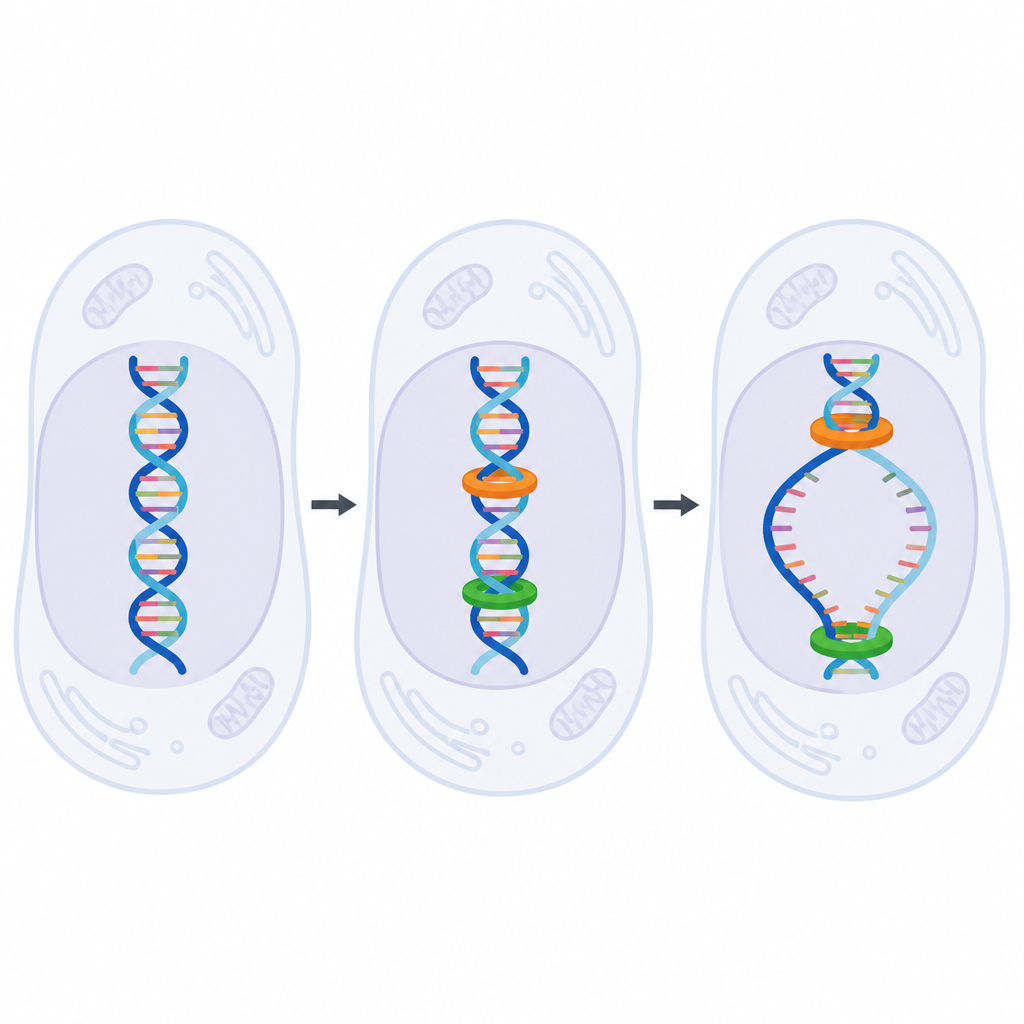
The DNA copying engine in all domains of life
DNA replication relies on enzymes called helicases that separate the two strands of the double helix, creating templates for new DNA. In bacteria, one protein complex first pries open the DNA and a separate ring-shaped helicase is then loaded. In contrast, in archaea and eukaryotes, a helicase known as the MCM complex is loaded onto intact double-stranded DNA and only later becomes active. This ring-shaped complex, built from six related protein subunits, must somehow turn a fully paired helix into a partially opened structure that other enzymes can extend into a full replication fork.
Snapshots of DNA just beginning to open
The researchers used high-resolution cryo-electron microscopy to capture many snapshots of an archaeal MCM ring encircling a short piece of DNA. They saw two main arrangements. In one, the ring forms two aligned tiers and loosely surrounds perfectly paired DNA, touching it only lightly. In the other, the tiers are rotated relative to each other and the lower tier grips one DNA strand much more tightly. In this staggered form, part of the DNA near one end is no longer base paired but has melted into single strands, even though the starting DNA was fully double stranded.
A tiny aromatic wedge that pries DNA apart
Closer inspection showed that three neighboring subunits in the active ring use small projecting loops to contact one of the DNA strands. Each loop carries a special flat-sided chemical group called an aromatic ring that stacks against the sugar and base of the DNA like a wedge. When one or two of the gaps between neighboring subunits tighten, these wedges press into the minor groove of the DNA and peel apart two base pairs. When a third gap tightens, four base pairs are melted. These tightening steps are linked to binding of ATP molecules at specific sites between subunits, suggesting a sequence where ATP binding drives discrete increases in local DNA opening.
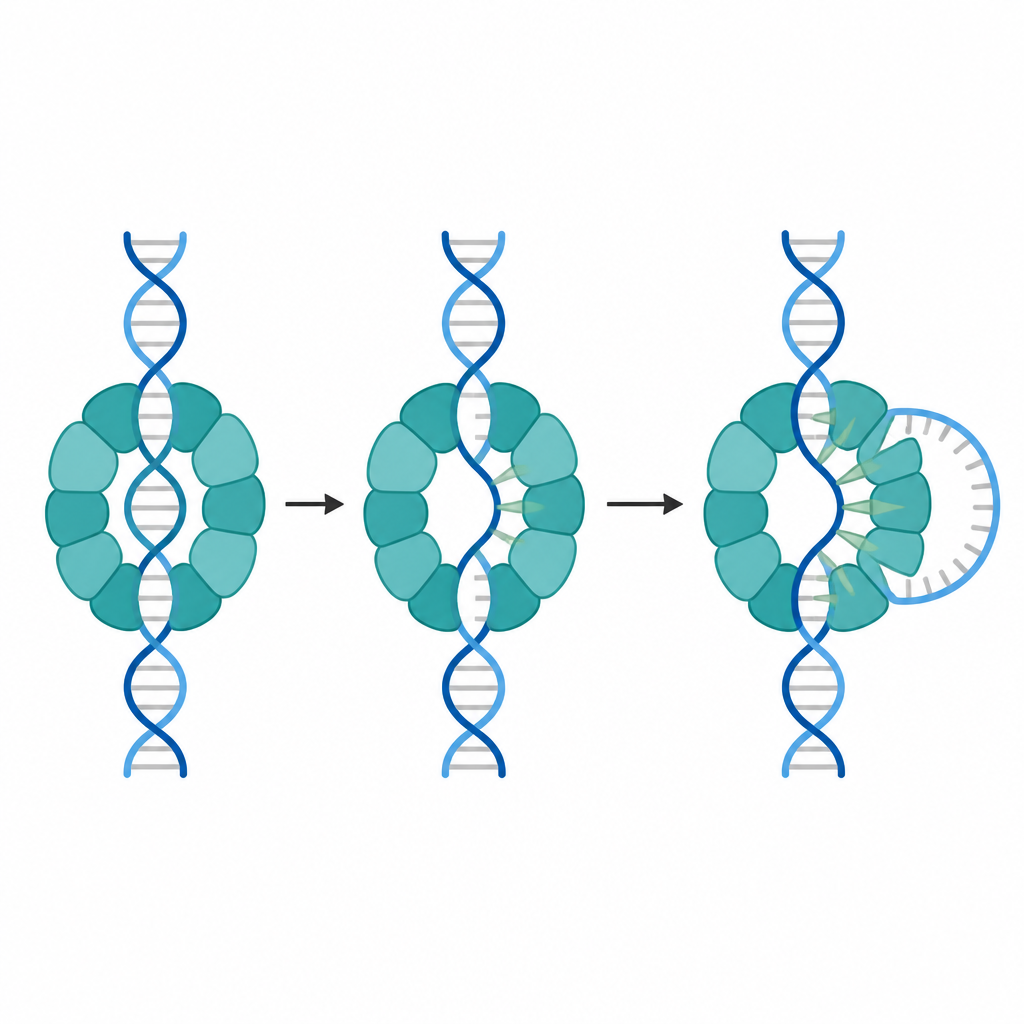
A universal opening move shared across species and viruses
To test whether this mechanism is a peculiarity of the archaeal system or a general rule, the team compared their structures with dozens of previously solved helicase structures from yeast, humans, and DNA tumor viruses. They found that eukaryotic MCM rings also adopt two stable overall shapes: one that holds fully paired DNA and another that positions three equivalent aromatic wedges for melting. Viral helicases from papillomavirus and SV40 use closely related aromatic groups in similar positions to open origin DNA. This conservation suggests that an aromatic wedge-based melting mechanism is shared by archaea, eukaryotes, and several DNA viruses.
From first melted base pairs to full replication forks
The work supports a picture in which ATP binding converts a relaxed MCM ring into an active form that pries open just a few base pairs of DNA using its aromatic wedges. Additional cellular factors can then pull DNA past this fixed wedge, extending the melted region until the two strands are fully separated and the helicase encircles just one of them. In simple terms, the study explains how a molecular ring gently cracks open the DNA zipper at exactly the right time and place, launching the complex process of genome duplication.
Citation: Rasouli, S., Myasnikov, A. & Enemark, E.J. Archaeal and eukaryotic MCM rings sequentially melt DNA for replication initiation. Nat Commun 17, 4681 (2026). https://doi.org/10.1038/s41467-026-70961-8
Keywords: DNA replication initiation, MCM helicase, aromatic wedge, cryo electron microscopy, origin melting