Clear Sky Science · en
Desert dust exerts twice the longwave radiative heating estimated by climate models
Dust That Warms the Planet
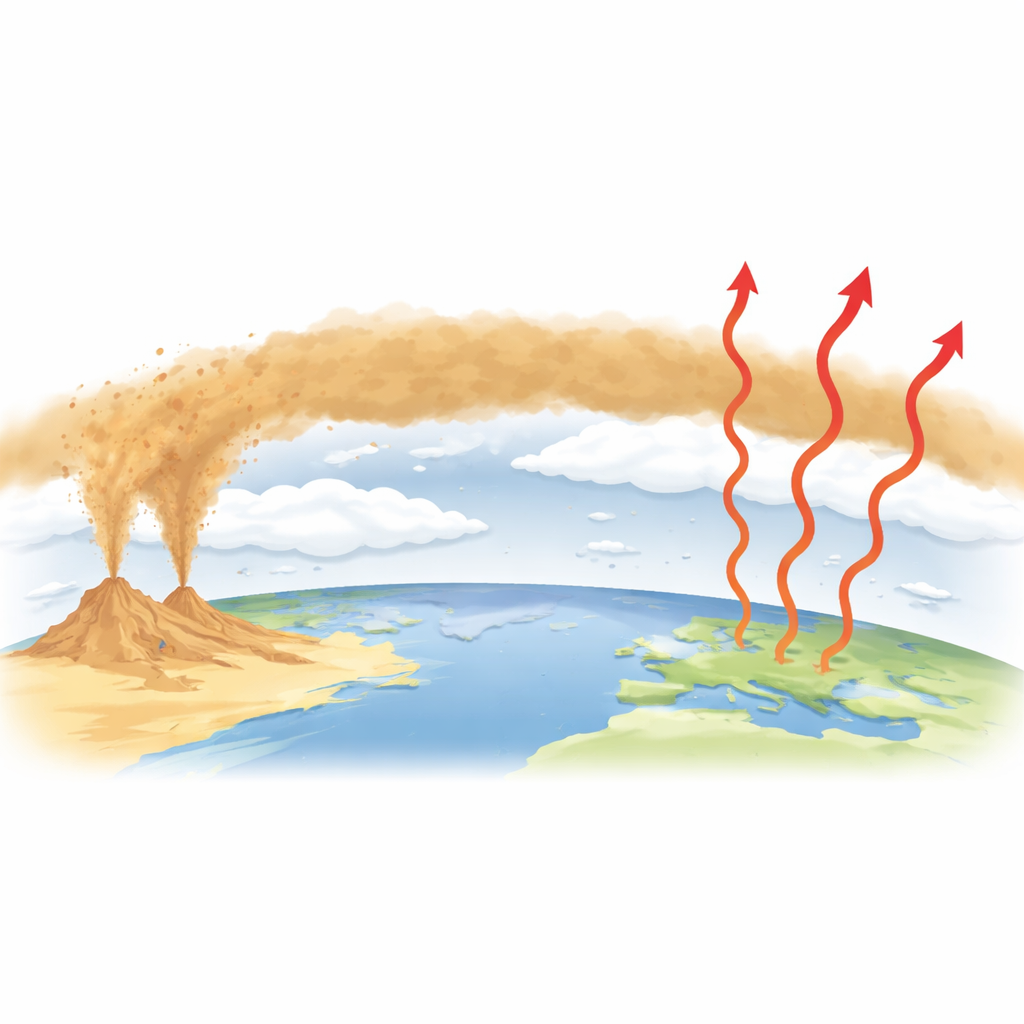
When most people think about air pollution and climate change, they picture smokestacks, car exhaust, and greenhouse gases like carbon dioxide. But much of the tiny material floating in the air actually comes from deserts: swirling clouds of mineral dust swept up by the wind. This study shows that these natural dust particles are doing far more to trap Earth’s heat than today’s climate models recognize—about twice as much in a key part of the infrared spectrum—meaning we have been underestimating an invisible source of planetary warming.
Invisible Veil Over Deserts and Oceans
Desert dust is the most plentiful type of aerosol in the atmosphere by mass. Once lofted by winds from regions like the Sahara or Australian outback, dust can travel thousands of kilometers, forming hazy layers that hang above continents and oceans. These particles interact with sunlight, which we can see as a whitish haze, but they also interact with heat radiation that we cannot see—thermal energy emitted by Earth’s surface and lower atmosphere. That heat mostly escapes to space through a “window” in the infrared spectrum, a range of wavelengths where water vapor and other gases absorb relatively little. Dust floating in this window changes how much energy leaves the planet.
How Dust Turns Heat Around
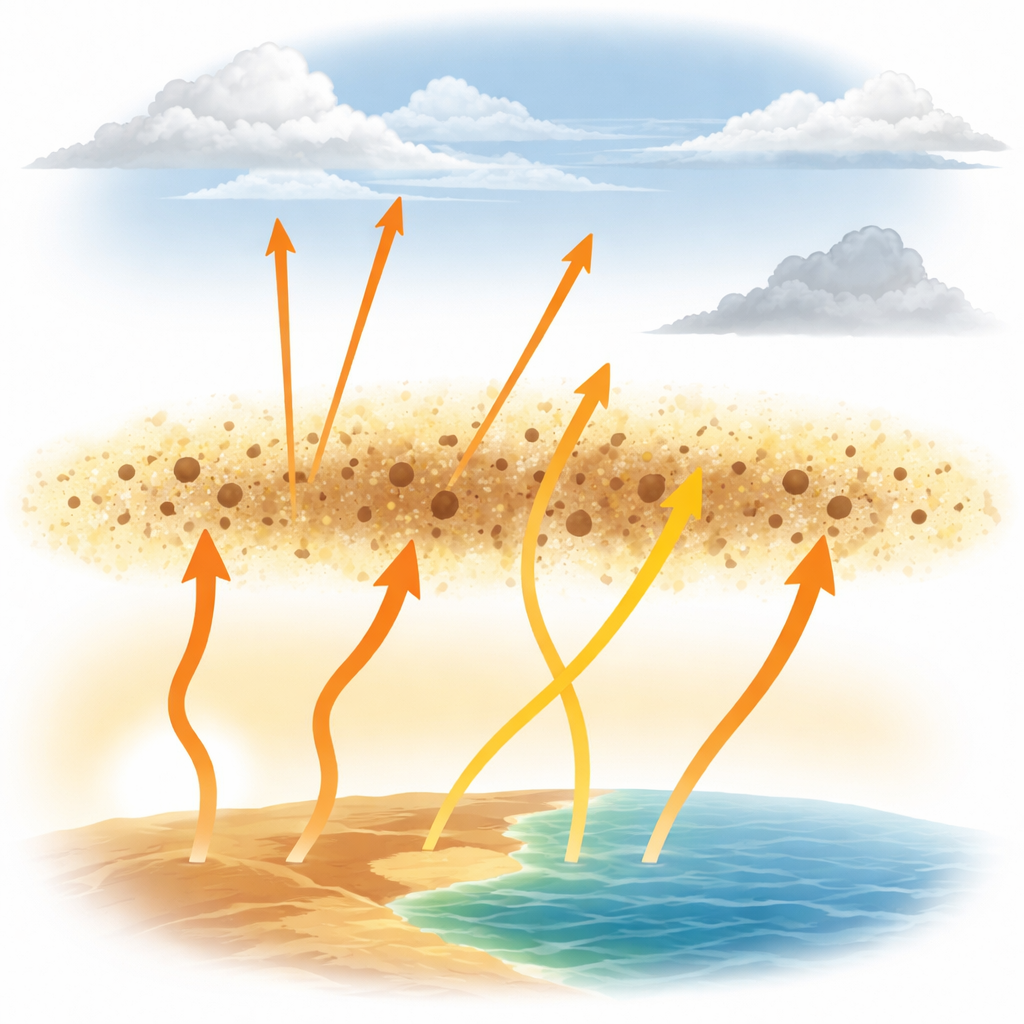
Dust affects heat in two main ways: by absorbing it and by scattering it. Because dust layers sit high in the atmosphere and are colder than the ground, absorbed heat is re-emitted at a lower temperature, which means less energy escapes to space. Scattering adds another twist: a significant share of upward-traveling heat is redirected back downward toward the surface. The authors build a simple but carefully constrained analytical model that combines satellite and ground-based observations of how much dust there is, how big the particles are—including rarely modeled extra-large grains—and how strongly they interact with infrared radiation. They find that coarse and super-coarse particles, larger than a few micrometers across, dominate dust’s impact on heat, and that scattering is responsible for more than half of the overall warming effect.
Putting Models to the Test
To check their calculations, the researchers compare their model’s estimates of how efficiently dust changes outgoing heat—per unit of haziness—to measurements from satellites and field campaigns across dusty regions and seasons. Their approach reproduces both the average strength and the seasonal swings of dust’s heating signal, matching observations within reported uncertainties. In contrast, 24 current global climate models systematically underestimate this effect by about a factor of two. The main reasons are that many models entirely ignore infrared scattering by dust, and most underrepresent the largest dust particles or leave them out altogether. These shortcomings mean climate models misplace where and when dust heats the atmosphere and surface.
Shifting Weather and Clouds
Because dust’s extra heating is fairly steady over the day and night, getting it wrong has consequences for weather and regional climate. If models underestimate how much dust traps heat, they tend to overstate dust’s cooling at the surface during the day and understate its warming at night. That can distort how strongly dust feeds back on its own emissions, how much water evaporates from oceans and land, and how much rain falls downwind of deserts. Dust floating above low clouds can also change how those clouds form and persist by altering the temperature structure of the air. Missing or misplacing the infrared heating from dust therefore ripples through predictions of cloud cover, storm tracks, monsoons, and tropical cyclones.
What This Means for Climate Change
The study concludes that longwave heat trapped by desert dust warms the planet by about +0.25 watts per square meter, with a tight uncertainty range. That is comparable in size to some greenhouse gas effects and about twice what climate models currently simulate. At the same time, dust also reflects sunlight and cools the planet, especially over dark surfaces like oceans, and that cooling is still very uncertain. As a result, scientists still do not know whether human-driven changes in dust over the past century have, on balance, warmed or cooled the climate. Nonetheless, this work makes clear that any effort to project future climate or improve weather forecasts must treat desert dust more realistically—especially its infrared scattering and its largest grains—if we are to fully understand how this natural haze shapes Earth’s energy balance.
Citation: Kok, J.F., K. Gupta, A., Evan, A.T. et al. Desert dust exerts twice the longwave radiative heating estimated by climate models. Nat Commun 17, 3191 (2026). https://doi.org/10.1038/s41467-026-70952-9
Keywords: desert dust, radiative heating, climate models, aerosols, Earth energy balance