Clear Sky Science · en
Increased hailstorms in cities through cell merger mechanism across North America and East Asia
Why city hailstorms matter
Hailstorms are more than just noisy disruptions on a summer afternoon. They shatter windows, dent cars, flatten crops and can seriously injure people caught outdoors. As cities grow larger and the climate warms, many communities have noticed that violent hail seems to be striking more often and doing more damage. This study asks a simple but important question: are modern cities helping to create more dangerous hailstorms, and if so, how?
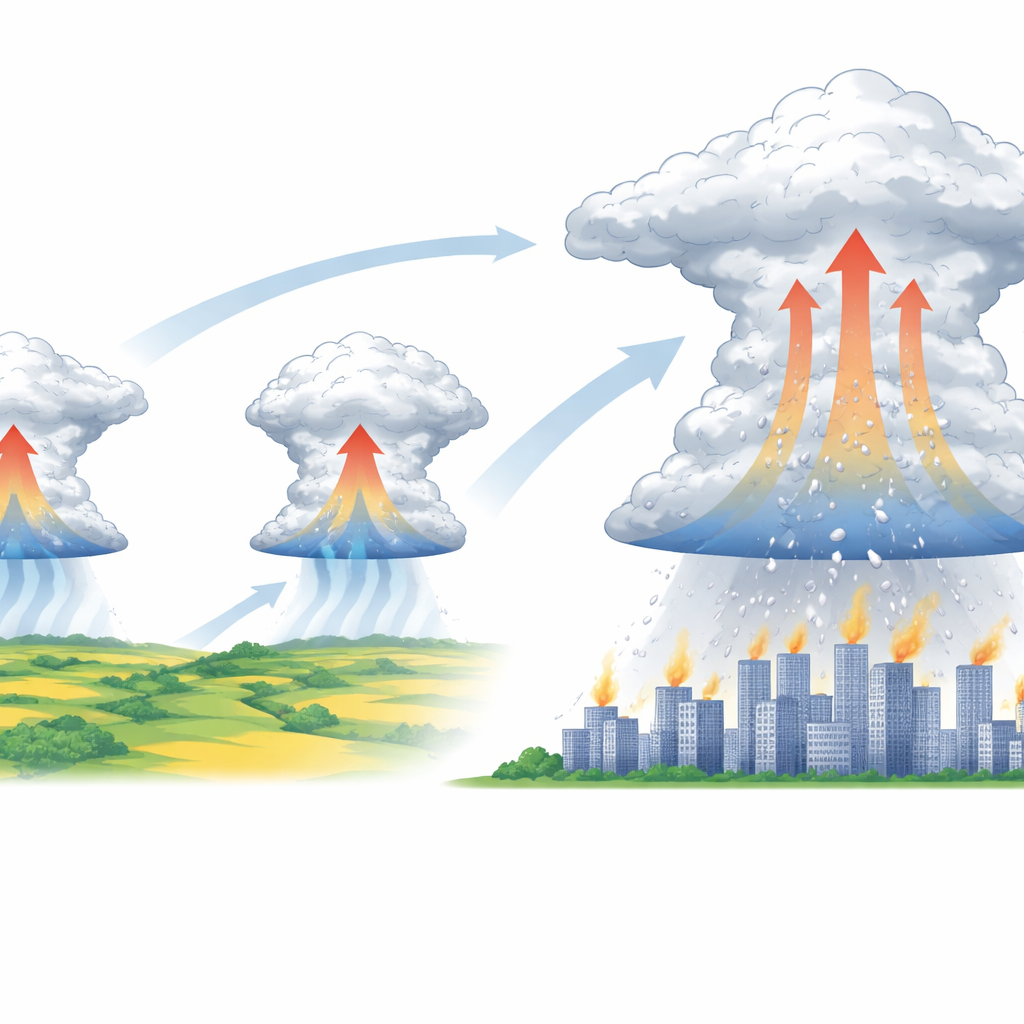
Two kinds of hailstorms
The researchers examined thousands of storms across North America and East Asia and discovered that not all hailstorms are born the same way. One familiar type forms inside a single, isolated thunderstorm, which they call a normal hailstorm. The second type, which turns out to be more common and more damaging, occurs when two or more storm cells come together and merge. These merger hailstorms are triggered when separate pockets of rising air and rain clouds collide and grow into a larger, more powerful system. Using long-term weather radar records and ground reports of hail, the team identified over 1,100 hail events, making this one of the most comprehensive hailstorm surveys to date.
Cities as storm boosters
When the scientists mapped where hailstorms occurred, a clear pattern appeared: merger hailstorms were concentrated near large urban areas. Around big city clusters such as the New York region in the United States and the Yangtze and Pearl River Deltas in China, these merged storms struck more often than over nearby rural land. Overall, merger hailstorms happened about twice as frequently as normal hailstorms and produced hail-covered areas nearly 80% larger on average. In cities, their frequency was 25–95% higher than in the countryside, and the most extreme cases were much more common near urban centers. This means that the very places with the most people, buildings and economic activity are also where the most destructive hailstorms tend to form.
How urban heat feeds storm mergers
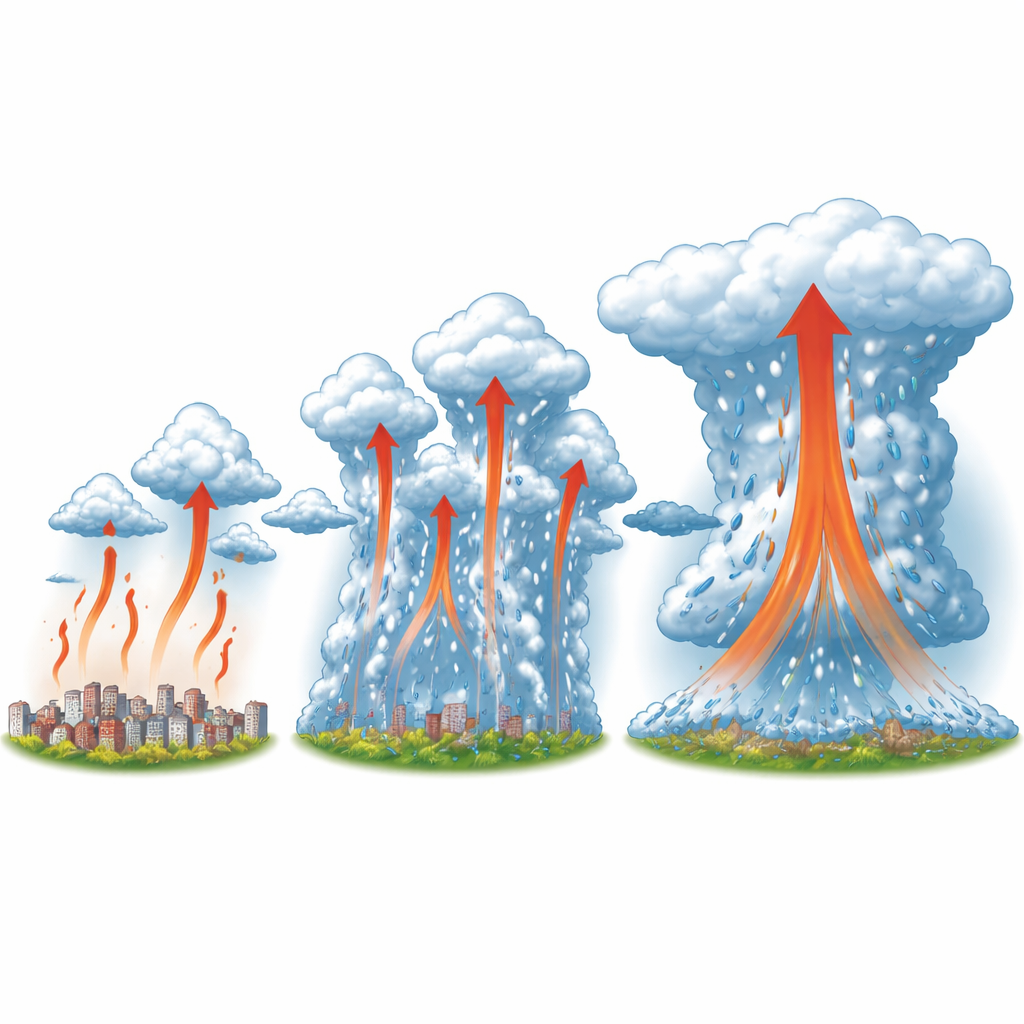
To understand why cities favor this more dangerous storm type, the team looked closely at the surrounding air. They combined detailed weather re‑analysis data with radar snapshots taken when storms were just beginning to form. Near cities, the lowest layers of the atmosphere were warmer and more unstable, conditions that make it easier for many small storm cells to pop up. As the surface warmed by about one to two degrees Celsius, the number of new cells and the frequency with which they collided both rose sharply. Computer simulations that explicitly included human‑generated heat from buildings, vehicles and industry showed the same effect: stronger warming over city surfaces led to more new storm cells, more mergers and much larger areas covered by hail. A case study of a “triple hail” event in southern China highlighted this chain of events in detail, showing how the key, most damaging hail burst occurred only after a new cell—sparked near a city—merged into an existing storm.
Climate warming and the future of urban hail
Because simulating every hailstone directly in future climate models is difficult, the researchers trained a machine‑learning model on present‑day hail events and the weather patterns associated with them. They then applied this model to climate‑model projections for North America under several greenhouse‑gas scenarios. Across all of them, warmer conditions consistently led to more merger hailstorms and fewer normal hailstorms. As average near‑surface temperatures rose, normal hailstorms declined by up to half, but merger hailstorms stayed steady at first and then increased rapidly beyond about 3.5 °C of warming. When the additional heating caused by urban heat islands was added on top of the background climate trend, many eastern North American cities appeared likely to cross this rapid‑increase threshold for merger hailstorms within the next few decades.
What this means for people and planning
For non‑specialists, the main message is that cities and a warming climate are working together to tilt hailstorms toward a more dangerous mode. Instead of a single isolated storm, multiple cells increasingly form and fuse into larger systems that produce broader swaths of damaging hail right where people live and work. The study suggests that future risk assessments and warning systems should pay particular attention to storm mergers near urban areas, and that city planning and building design need to account for the growing odds of intense hail in a hotter, more urbanized world.
Citation: Zhou, A., Zhao, K., Chan, J.C.L. et al. Increased hailstorms in cities through cell merger mechanism across North America and East Asia. Nat Commun 17, 3922 (2026). https://doi.org/10.1038/s41467-026-70826-0
Keywords: hailstorms, urban heat, severe weather, climate change, thunderstorms