Clear Sky Science · en
Structured coherent thermal emission from non-Hermitian metasurfaces
Turning Heat into Orderly Light
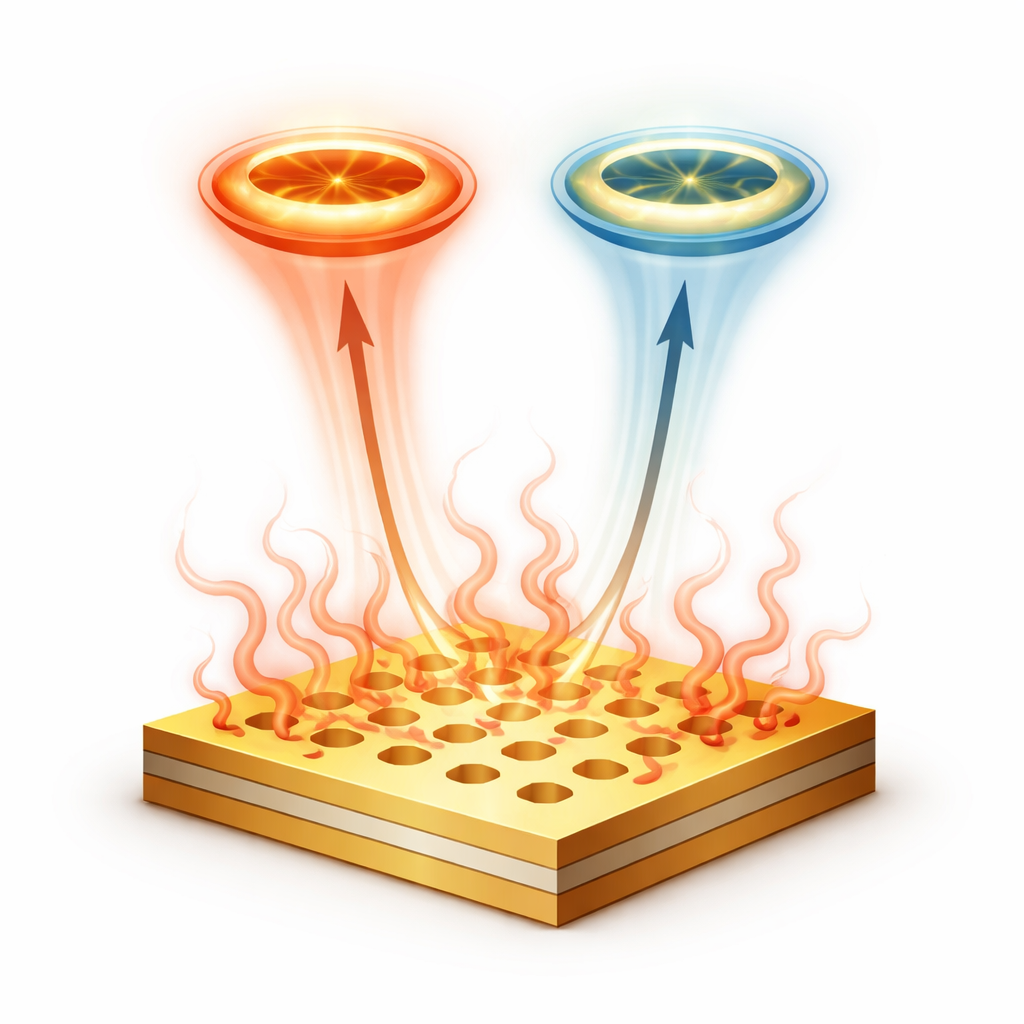
Any warm object, from a cup of coffee to the Earth itself, constantly glows in invisible infrared light. Normally this glow is messy—spreading in all directions, over many colors, and with no particular pattern. This paper shows how to turn that unruly heat radiation into laser‑like beams with carefully sculpted shapes, all using a flat nanostructured surface. Such control over “glowing heat” could power sharper thermal cameras, efficient infrared sensors, and compact on‑chip light sources without traditional lasers.
Why Heat Light Is Usually Chaotic
Thermal radiation arises from countless random jostlings of charged particles inside any object hotter than absolute zero. Classical physics says this light should be broad in color, spread out in angle, and lack any fixed phase or polarization—it behaves like a noisy crowd rather than a choir. Over the past decade, however, nanostructured materials called metasurfaces have begun to change this picture. By carving precise arrays of holes or pillars into thin films, researchers can trap and re‑release selected portions of thermal light, sharpening its color, direction, and polarization. Even so, achieving simultaneously narrow color, high directionality, and exotic polarization patterns from pure heat has remained very challenging.
A Flat Chip That Sculpts Thermal Beams
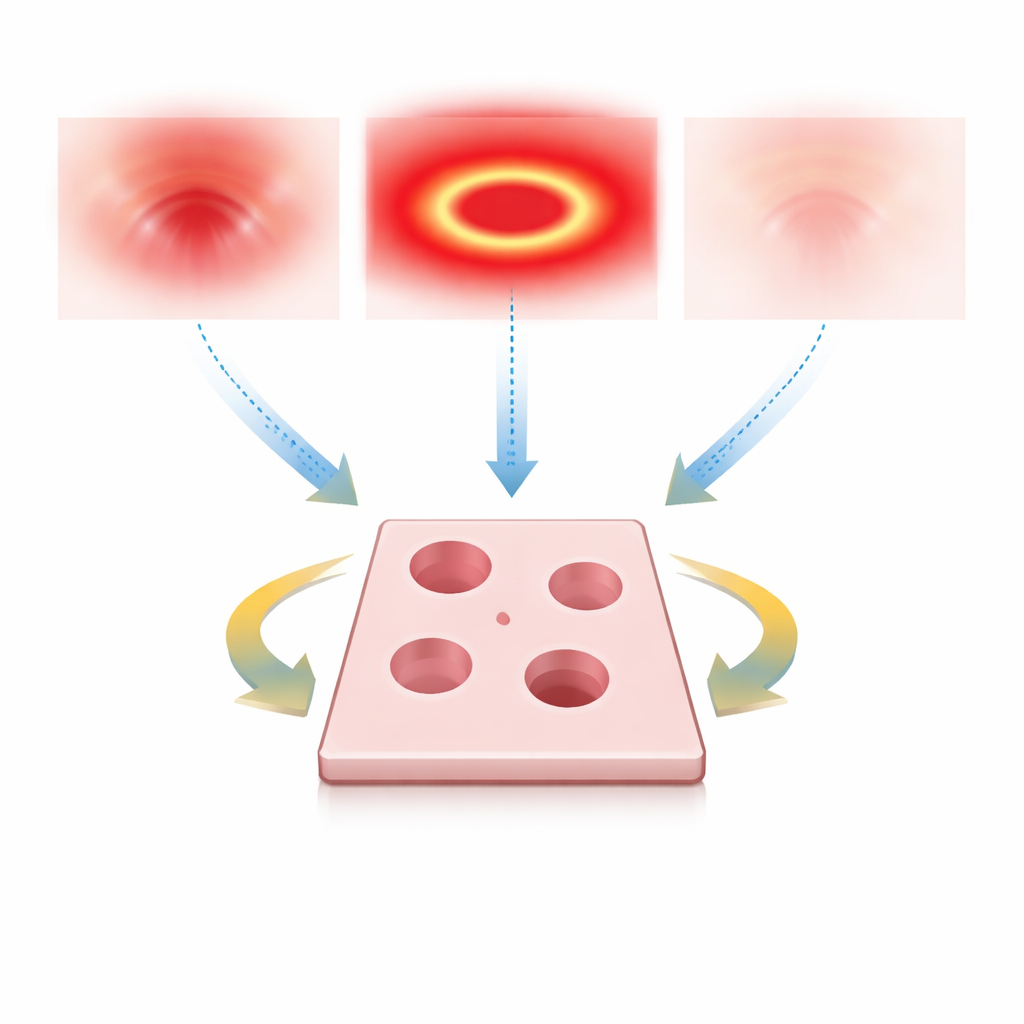
The authors design a multilayer “thermal meta‑emitter” that looks, under a microscope, like a patterned tile sitting on a metal mirror. A gold film at the bottom acts as a heater and reflector, with a low‑loss spacer and a thin germanium layer on top. In this upper layer, each repeating cell contains four closely spaced circular holes whose positions are slightly shifted from perfect symmetry. When the device is heated, random thermal fluctuations in the metal and dielectrics feed into carefully chosen resonant modes of this patterned layer. Instead of leaking out as a broad glow, the energy is funneled into a few tightly controlled channels that radiate into free space as highly directional mid‑infrared beams around 3–5 micrometers—an important “molecular fingerprint” region for sensing gases and other chemicals.
Using Subtle Losses to Tame the Rainbow
A key idea in the work is to treat the metasurface as an open, “non‑Hermitian” system where light can leak out and be absorbed. By delicately balancing these leakage and absorption paths, the authors engineer special operating points where radiation and material loss match, maximizing emission in a narrow range of directions and suppressing it elsewhere. They achieve this via a concept known as bound states in the continuum—modes that, in theory, do not radiate at all. By perturbing the four‑hole pattern, these hidden modes are coaxed to radiate only in a tiny angular window while retaining very high quality factors. This creates short, nearly flat bands in momentum space, meaning the emission frequency stays essentially fixed while the direction varies only slightly. As a result, the usual “rainbow” effect—where different angles emit different colors—is strongly suppressed, and the device emits mainly at one color over a narrow cone.
Shaping the Twist of the Beam
Beyond direction and color, the team sculpts the polarization structure—the way the electric field oscillates across the beam. Because of the symmetry and topology of the engineered modes, the far‑field polarization forms vortices around the central, non‑emitting direction. One mode produces a pure doughnut‑shaped beam whose polarization lines circle around the ring (azimuthal polarization). Another mode creates a doughnut where the polarization switches between radial and azimuthal along different directions. These patterns are examples of vectorial beams, prized in applications like high‑resolution focusing, optical trapping of particles, and advanced imaging. Remarkably, this work generates such structured beams not with bulky optics and lasers, but directly from thermal emission of a single chip.
From Hot Surfaces to Laser‑Like Thermal Sources
By combining topological design, careful control of leakage, and non‑Hermitian physics, the researchers transform random thermal photons into coherent, doughnut‑shaped beams with tunable polarization and narrow color. Experiments on fabricated samples confirm the theory: measurements show high spectral purity, strong directionality with very small divergence angles, and two distinct vectorial polarization states at nearby wavelengths. Put simply, the device turns heat into well‑behaved, laser‑like infrared beams without requiring an external laser to drive it. This approach opens a path toward compact, chip‑scale thermal light sources for infrared sensing, imaging, and energy applications, and it can be adapted to many wavelength ranges by redesigning the metasurface pattern.
Citation: Sun, K., Wang, K., Li, W. et al. Structured coherent thermal emission from non-Hermitian metasurfaces. Nat Commun 17, 2449 (2026). https://doi.org/10.1038/s41467-026-70823-3
Keywords: thermal metasurfaces, structured thermal emission, vector beams, non-Hermitian photonics, mid-infrared optics