Clear Sky Science · en
A dihydrouracil CRBN ligand mitigates IMiD associated safety liabilities in heterobifunctional targeted protein degrader
Why safer smart drugs matter
Many modern cancer drugs work by telling cells to throw away harmful proteins. This strategy has great promise, but it can also disturb how new blood cells are made, leading to low blood counts and other side effects. This paper explores why some of these “smart” drugs cause problems in the bone marrow and describes a new building block that could make future medicines kinder to healthy blood cells. 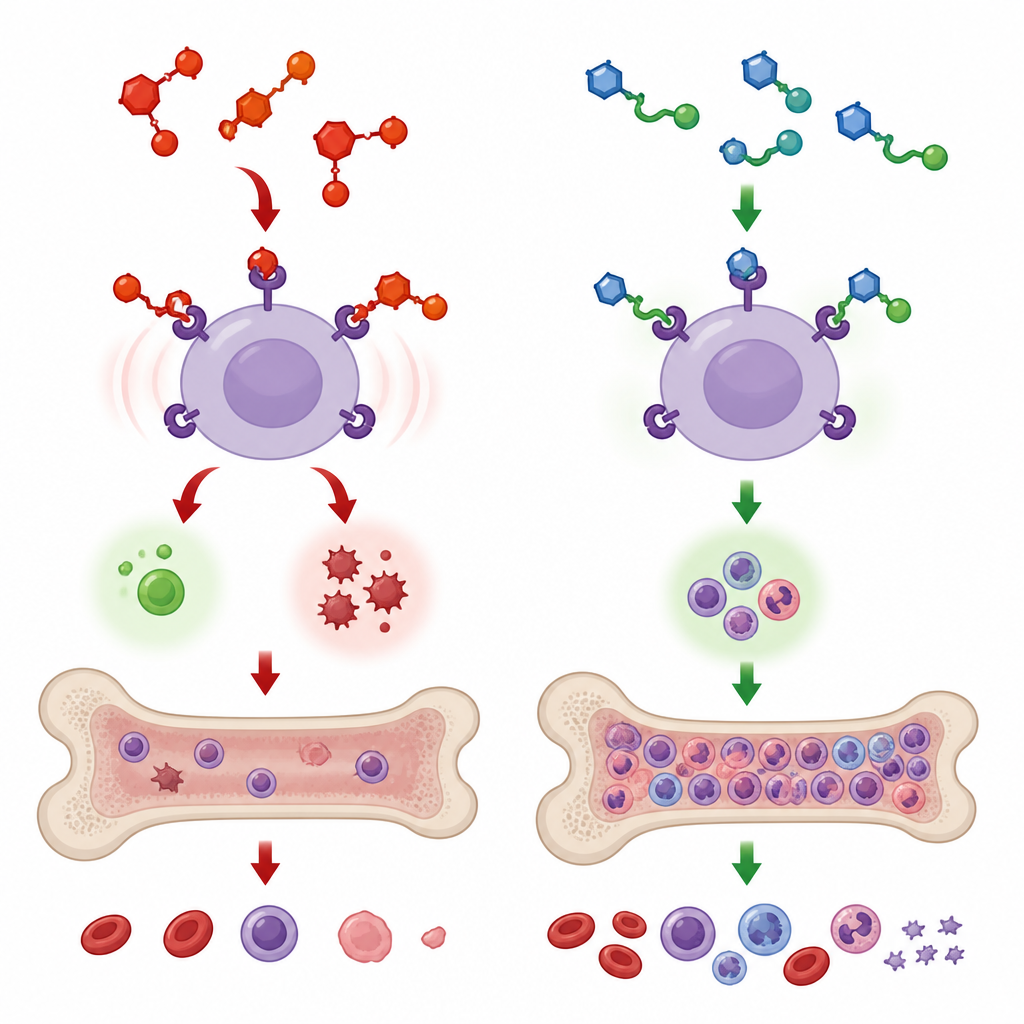
Old drug, new uses and new risks
The story begins with thalidomide, once prescribed for morning sickness and later linked to severe birth defects. Decades of research revealed that thalidomide and related medicines, now used to treat multiple myeloma, work by recruiting a cell’s waste‑disposal machinery to break down certain control proteins. Drug designers have reused this trick in newer two‑headed molecules called protein degraders, which bring a target protein together with a disposal tagger inside the cell. However, when these degraders use thalidomide‑like parts, they can unintentionally trigger the breakdown of extra proteins, including Ikaros and Aiolos, which are important for normal blood cell development.
Unwanted hits in blood‑forming cells
The researchers first mapped how existing thalidomide‑based degraders behave in leukemia cells using high‑throughput protein analysis. Many of these molecules did their main job but also lowered the levels of Ikaros and Aiolos. The team then moved to human stem and progenitor cells from bone marrow, which give rise to all blood lineages. Here, common multiple myeloma drugs such as lenalidomide and pomalidomide slowed cell expansion without killing the cells outright. By using gene‑editing tools to remove Ikaros or the protein cereblon, which serves as the drug docking partner, they confirmed that loss of Ikaros through cereblon was central to this growth block.
How cell fate is rewired in the marrow
To see what this meant for blood formation, the authors tracked thousands of proteins as stem cells matured into red and white blood lineages. When Ikaros was removed, either by gene editing or by thalidomide‑like drugs, the cells shifted away from making red blood precursors and some types of white cells. Instead, they favored a pathway leading to platelet‑producing megakaryocytes and showed signs of an activated antiviral‑like response. These patterns were mirrored in cells treated with lenalidomide or iberdomide but not in cells exposed to the new compound described in the study. In engineered mice that were made sensitive to these drugs, lenalidomide lowered white blood cell counts, again linking loss of Ikaros and Aiolos with blood‑related side effects. 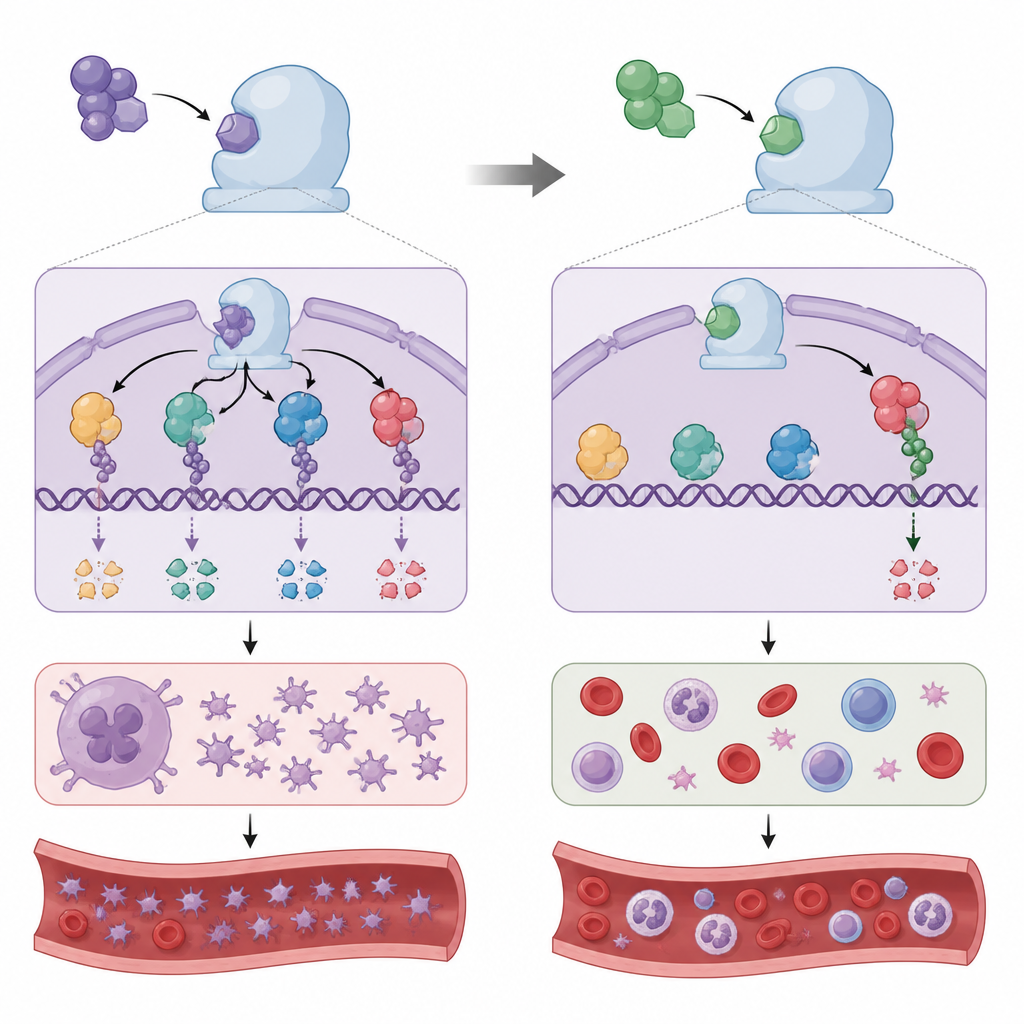
A new handle for safer degraders
Seeking a safer way to harness cereblon, the team searched chemical collections for molecules that bound cereblon without sharing the unstable, shape‑shifting core of thalidomide. They homed in on a small dihydrouracil‑based compound, called compound 2, that attached to cereblon strongly, was chemically stable, and behaved well in lab and animal tests. Crucially, in both leukemia cells and the engineered mouse model, this compound did not cause the breakdown of Ikaros or Aiolos and did not disturb the growth or maturation of human blood stem cells. Using structural studies, chemists then attached linkers and target‑binding heads to this new cereblon handle to build full degraders that could remove a test protein, BRD4, while sparing the usual thalidomide‑linked off‑targets.
What this means for future medicines
This work shows that it is possible to keep the useful “trash‑tagging” action of cereblon while avoiding much of the collateral damage to blood‑forming cells. By swapping the thalidomide‑like core for a dihydrouracil‑based one, drug designers created degraders that were effective against their chosen protein yet did not strip away key regulators like Ikaros and Aiolos. For patients, this approach could translate into future treatments that maintain the benefits of targeted protein disposal with a lower risk of anemia, low white counts, or platelet‑related problems, especially in long‑term use beyond cancer.
Citation: Rodrigo-Brenni, M.C., Komen, J.C., Hamza, G.M. et al. A dihydrouracil CRBN ligand mitigates IMiD associated safety liabilities in heterobifunctional targeted protein degrader. Nat Commun 17, 4460 (2026). https://doi.org/10.1038/s41467-026-70663-1
Keywords: targeted protein degradation, cereblon ligands, IMiD safety, hematopoietic stem cells, PROTAC design