Clear Sky Science · en
Hydrogen bonding mediated electron donor-acceptor acceptor catalysis in hydrosulfonylation and sulfonyl dehydrogenation of olefins
Shaping useful molecules with light
Chemists are always searching for gentler ways to build complex molecules used in medicines and materials. This study shows how simple, inexpensive ingredients and ordinary visible light can be combined to forge valuable sulfur containing building blocks under mild conditions. By letting molecules briefly hold each other through hydrogen bonds and then shining light on them, the researchers unlock a new route to reactive particles that stitch together carbon chains in a controlled way.
A new twist on light driven chemistry
Modern organic chemistry often uses light to create short lived, highly reactive fragments called radicals, which can snap new bonds into place. Many such methods rely on specialized metal based photocatalysts that absorb light and transfer electrons. The team behind this work focuses on a different strategy based on electron donor acceptor pairs, where one molecule gives up a little electron density and another takes it, forming a loose partnership that can be activated directly by light. While versions in which the electron donor is catalytic are now well explored, catalytic systems where the electron hungry partner does the key work have been much slower to develop.
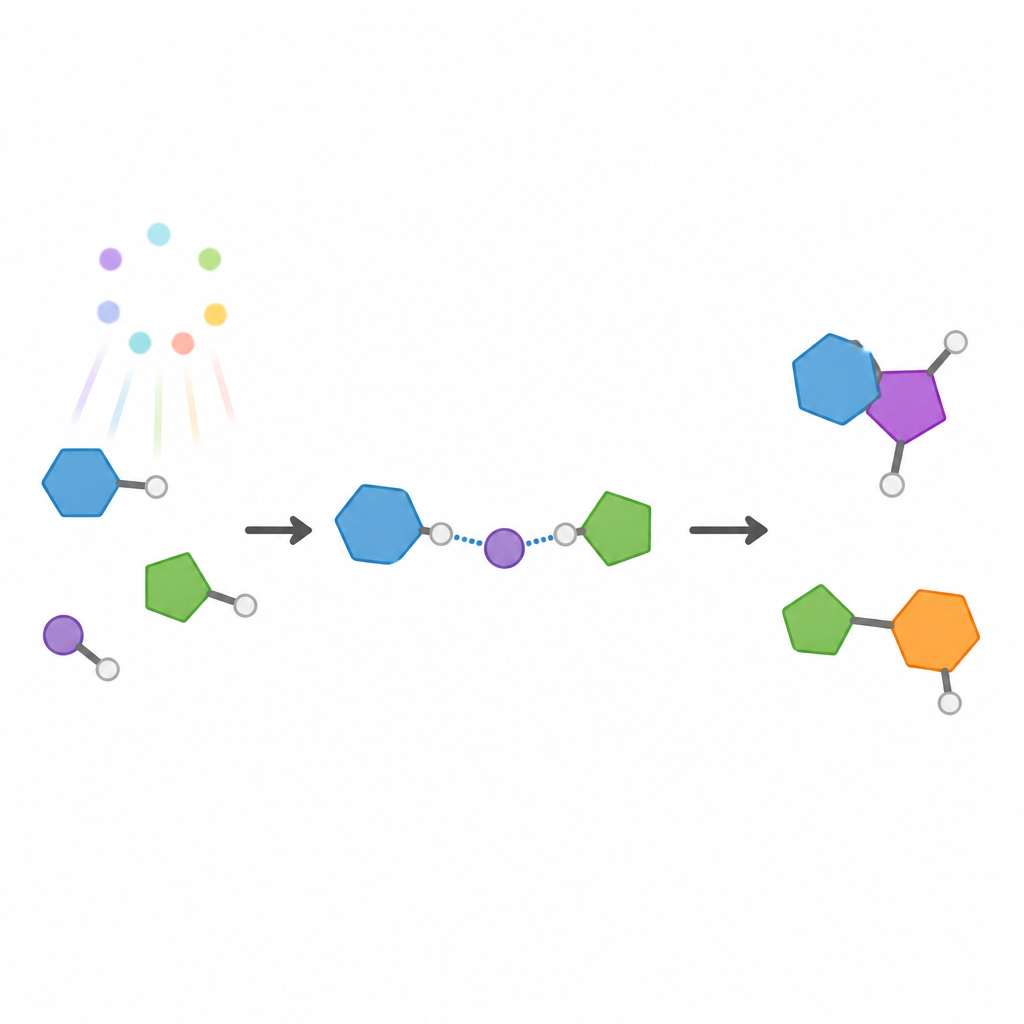
Using gentle bonds to prepare a light ready pair
The researchers realized that a simple ring shaped base, pyridine, could serve as the electron hungry partner if it first formed a hydrogen bond with a sulfinic acid, a sulfur containing compound that donates both a proton and electrons. In this temporary embrace, the hydrogen of the acid points toward the nitrogen atom of pyridine, drawing the two molecules close enough for their electron clouds to interact. Calculations show that the highest occupied electron region lies on the sulfur group while the lowest empty region sits on the pyridine ring, setting the stage for electron transfer when light is absorbed. This hydrogen bond does not create a permanent structure but instead organizes the pair just long enough for a light induced reaction to happen.
Building sulfur rich products under mild conditions
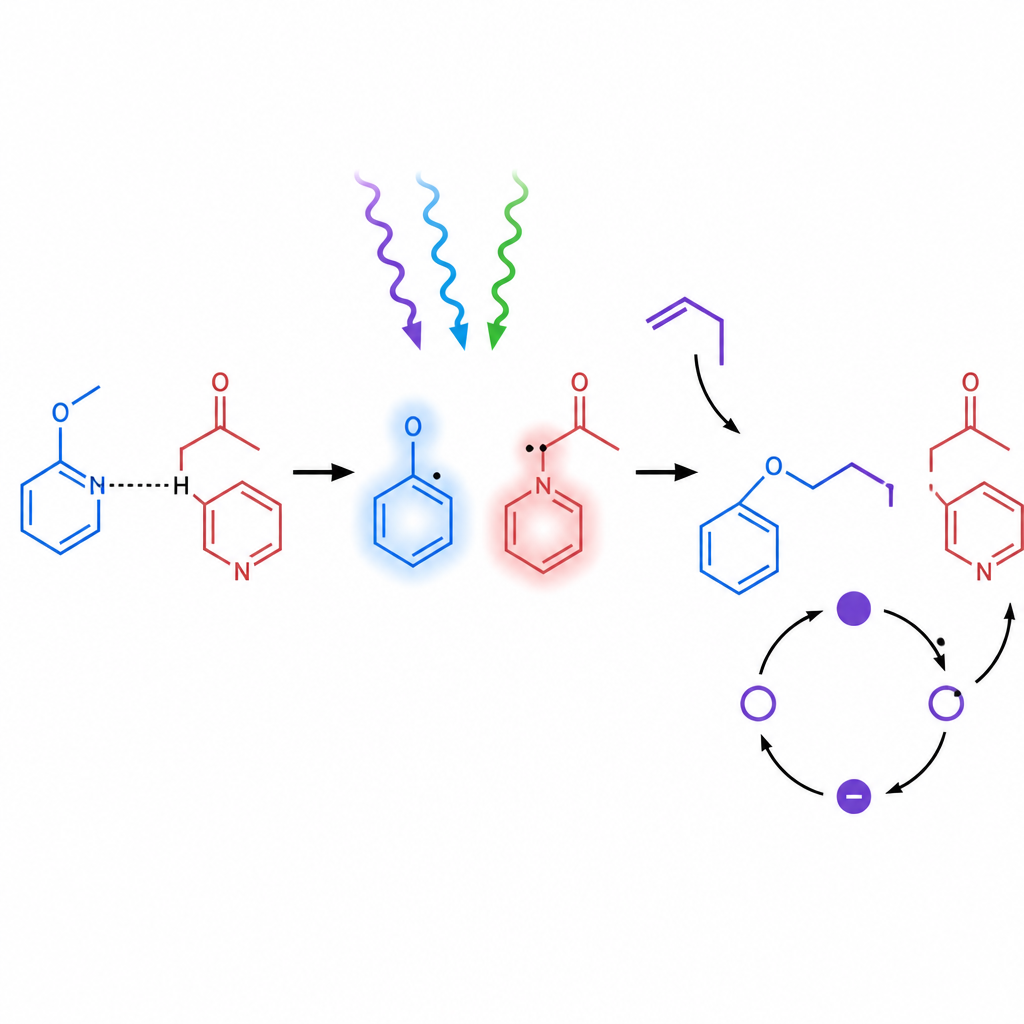
When the hydrogen bonded pair is exposed to blue light, a proton and an electron move from the sulfinic acid to pyridine, generating a sulfonyl radical and a charged pyridine species. The sulfonyl radical then adds across the carbon carbon double bond of a simple alkene, creating a new carbon sulfur bond and a carbon centered radical. A thiol, used in small amounts, donates a hydrogen atom to finish the hydrosulfonylation step, giving an alkyl sulfone product while itself becoming a radical that is later reduced back in the cycle. By adjusting the conditions and adding a cobalt complex, a parallel pathway removes hydrogen instead, turning styrene like starting materials into allylic sulfones through a dehydrogenation sequence that also releases molecular hydrogen.
Wide reach for drug like molecules
The method works with a broad range of unactivated alkenes, including simple carbon chains, rings, and fragments taken from known drugs such as lipid lowering agents and anti inflammatory compounds. Sensitive groups like aldehydes, halides, nitriles, amides, sulfamides, indoles, and heavily oxygenated sugars survive the reaction, highlighting how gentle the light driven process is. The scientists also show that many different sodium sulfinates, both aromatic and aliphatic, can serve as sulfur sources, although those with electron rich rings react less efficiently. Together these tests demonstrate that the approach can efficiently decorate complex molecules with sulfone groups, which frequently appear in pharmaceutical structures.
How theory and tests support the picture
To verify the proposed mechanism, the team combined trapping experiments, labeling with heavy hydrogen, light on light off studies, and detailed computer calculations. Adding a radical trap nearly stops product formation and reveals a side product consistent with a sulfonyl radical. Replacing normal water with heavy water leads to slower reactions and incorporation of deuterium into the products, indicating that proton transfer steps are intertwined with light absorption. Spectroscopic measurements show new absorption features when the catalyst and sulfinic acid are mixed, and these extend into the green region of the spectrum, matching the light that can still drive the reaction. Computational models reveal that in the excited state the hydrogen bond rearranges and promotes a combined transfer of proton and electron, giving the radical pair that launches the bond forming steps.
A simple way to harness light and hydrogen bonds
In practical terms, this work provides chemists with a straightforward recipe for making alkyl and allylic sulfones from common starting materials, using inexpensive pyridine based catalysts and sodium sulfinates under visible light. At a deeper level, it highlights how a weak hydrogen bond can be used to assemble a light sensitive donor acceptor pair that does not need a separate photocatalyst. For nonspecialists, the key message is that by carefully arranging simple molecules so they share a fleeting hydrogen link, scientists can coax them to respond to light in a productive way, opening fresh routes to structures that underpin many modern medicines.
Citation: Hu, Q., Li, Y., Zeng, T. et al. Hydrogen bonding mediated electron donor-acceptor acceptor catalysis in hydrosulfonylation and sulfonyl dehydrogenation of olefins. Nat Commun 17, 4350 (2026). https://doi.org/10.1038/s41467-026-70618-6
Keywords: photoredox chemistry, electron donor acceptor complex, hydrosulfonylation, sulfone synthesis, hydrogen bonding