Clear Sky Science · en
Structural basis of lipid-linked galactan export by the mycobacterial ABC transporter Wzm-Wzt
Why this bacterial gate matters
Drugs that cure tuberculosis and related infections must breach some of the toughest cell walls in biology. Mycobacteria, the group that includes the tuberculosis germ, surround themselves with a thick, waxy armor. At the heart of this armor lies a long sugar-based scaffold called arabinogalactan. This study reveals, at near-atomic detail, how a crucial molecular machine—an export gate called Wzm-Wzt—pushes a key building block of that scaffold across the cell membrane. Understanding this process opens new avenues for weakening the bacterial wall and designing future antibiotics.
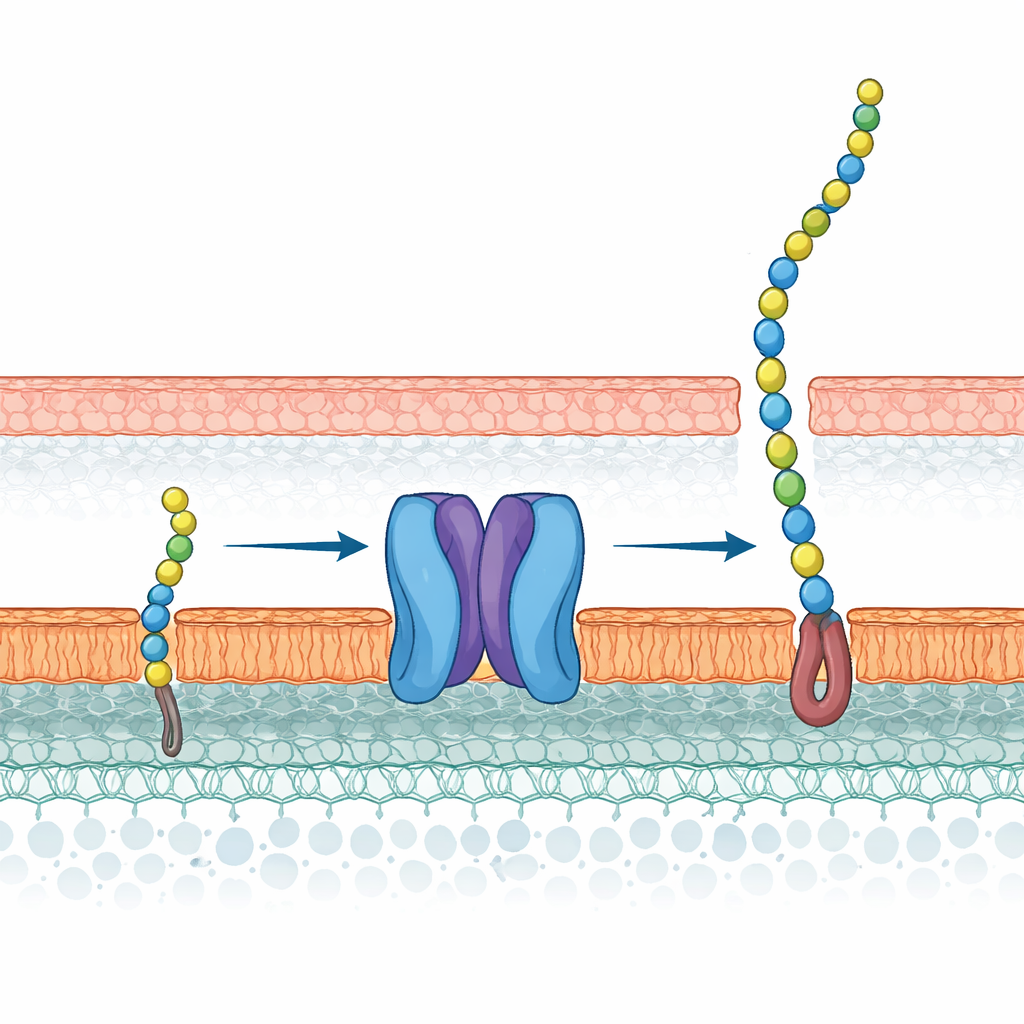
The special armor of mycobacteria
Most bacteria have cell envelopes built from layers of fat and sugar molecules, but mycobacteria take this to an extreme. Their inner membrane is covered by a dense sugar mesh, arabinogalactan, which is then decorated with very long fatty acids, forming a protective outer “mycomembrane.” Several frontline tuberculosis drugs already target enzymes that build parts of this matrix. Before these enzymes can work, however, the bacterium must flip a precursor called lipid-linked galactan from the inside of the cell to the outside face of the inner membrane. This precursor combines a greasy tail that nestles in the membrane with a long string of galactan sugars—making it both huge and chemically awkward to move.
Finding the sugar export machine
Earlier work had identified Wzm-Wzt as the transporter that performs this difficult flip. Like other ABC transporters, Wzm-Wzt burns cellular fuel (ATP) in its cytosolic portions to drive shape changes in its membrane-embedded channel. Yet it was unclear how such a machine could grab a molecule that is part fat, part highly charged linker, and part bulky sugar chain, and then move it stepwise across the membrane without puncturing the cell’s barrier. To answer this, the authors purified Wzm-Wzt from the pathogen Mycobacterium abscessus, embedded it either in detergent or in tiny synthetic membrane disks, and used cryo–electron microscopy to capture multiple snapshots of the transporter during its working cycle.
Snapshots of a molecular gate at work
The structures reveal Wzm-Wzt as a paired channel in the membrane linked to two ATP-powered engines inside the cell. Within the channel, three stacked “belts” of aromatic amino acids line a potential path for the sugar chain. A small stretch of protein on the cytosolic side, dubbed the gate helix, swings dramatically between open and closed positions as ATP binds and is broken down. By adding a synthetic mimic of the natural lipid-linked galactan, the researchers saw density consistent with the molecule wedged between two helices, with its hydrophobic tail entering first into a cavity and its sugar head poised at the mouth of the channel. This supports a “lipid-first” loading mode, where the greasy tail serves as a handle that the transporter recognizes, before the sugar chain is fed through.
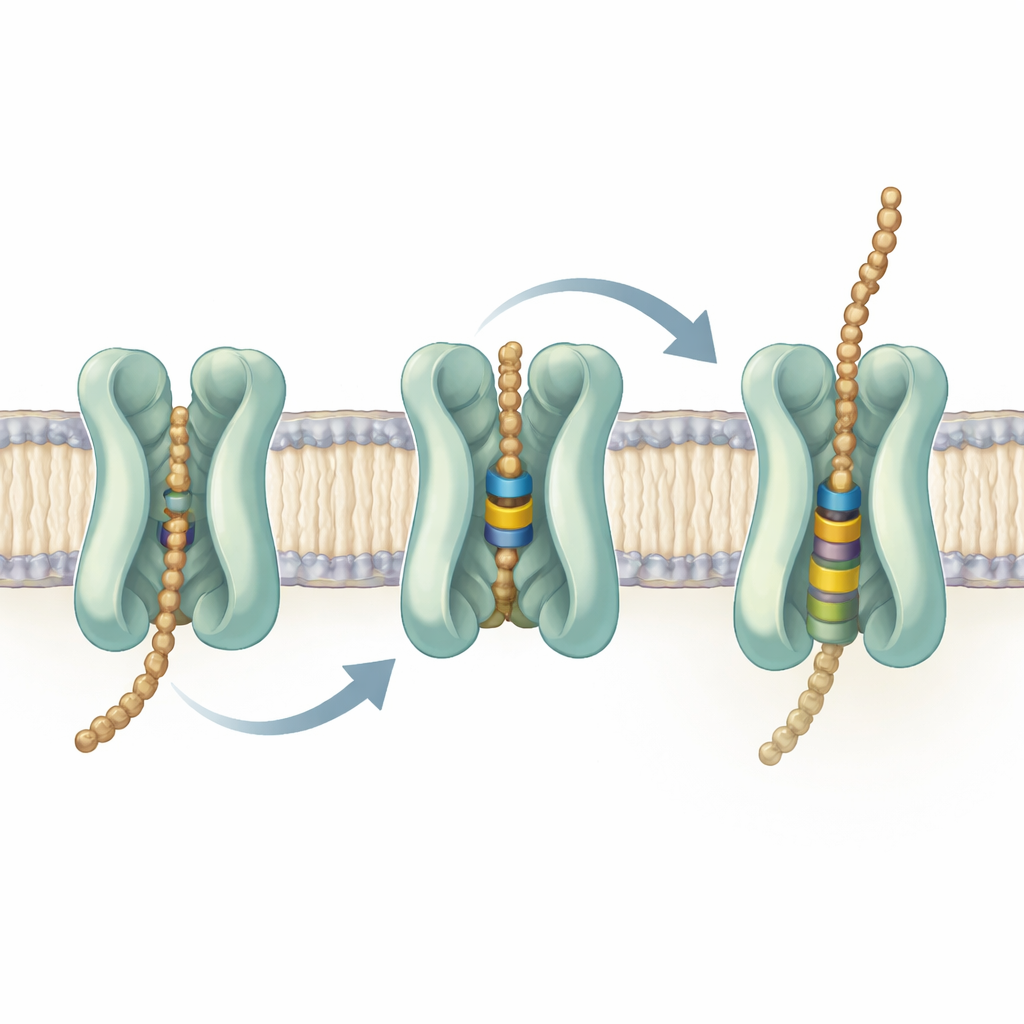
Testing the gate’s moving parts
To test which pieces of Wzm-Wzt are essential, the team introduced precise mutations and examined their effects in a model mycobacterial species. They used a genetic switch to partially shut down the native transporter and then supplied normal or altered versions from a plasmid. When Wzm-Wzt worked, the bacteria grew well and built normal cell walls. When key residues in the ATP site or the entire gate helix were disrupted, cells stopped growing, accumulated precursor lipids, and overproduced other wall components that normally attach to arabinogalactan—signatures of a broken export step. Mutations in a nearby loop at the channel entrance also crippled transport, whereas altering some aromatic residues deep in the cavity caused only partial slowdowns. These functional tests, paired with the structures, highlight the gate helix and the so‑called LG loop as active guides that help grip and ratchet the sugar chain.
A new weak spot in the tuberculosis wall
Taken together, the findings support a model in which lipid-linked galactan docks with its tail first, slips between two helices, and then has its long sugar chain threaded through a narrow, aromatic-lined tunnel as ATP-driven motions of the gate helix and entrance loop pull it outward. Because arabinogalactan assembly is essential for mycobacterial survival and Wzm-Wzt is highly vulnerable to disruption, this transporter now stands out as a promising drug target. Small molecules that block the lipid-binding cavity or freeze the moving gate elements could halt cell wall construction and, in combination with existing therapies, help overcome stubborn mycobacterial infections.
Citation: Garaeva, A.A., Fabianová, V., Savková, K. et al. Structural basis of lipid-linked galactan export by the mycobacterial ABC transporter Wzm-Wzt. Nat Commun 17, 2745 (2026). https://doi.org/10.1038/s41467-026-70429-9
Keywords: tuberculosis, bacterial cell wall, ABC transporter, arabinogalactan, antibiotic targets