Clear Sky Science · en
Subglacial water flow and ice dynamics during glacial lake outburst floods observed from space
Hidden Floods Beneath the Ice
High on Iceland’s Vatnajökull ice cap, enormous floods sometimes surge unseen beneath hundreds of meters of ice before bursting from the glacier’s edge. These glacial lake outburst floods, called jökulhlaups, can reshape river valleys, threaten roads and bridges, and offer a rare window into what happens at the hidden interface between ice and rock. This study uses satellites and field instruments to watch two such events in real time, revealing how water races, ponds, and carves paths under the ice — and how that secret plumbing controls the motion of the glacier itself.
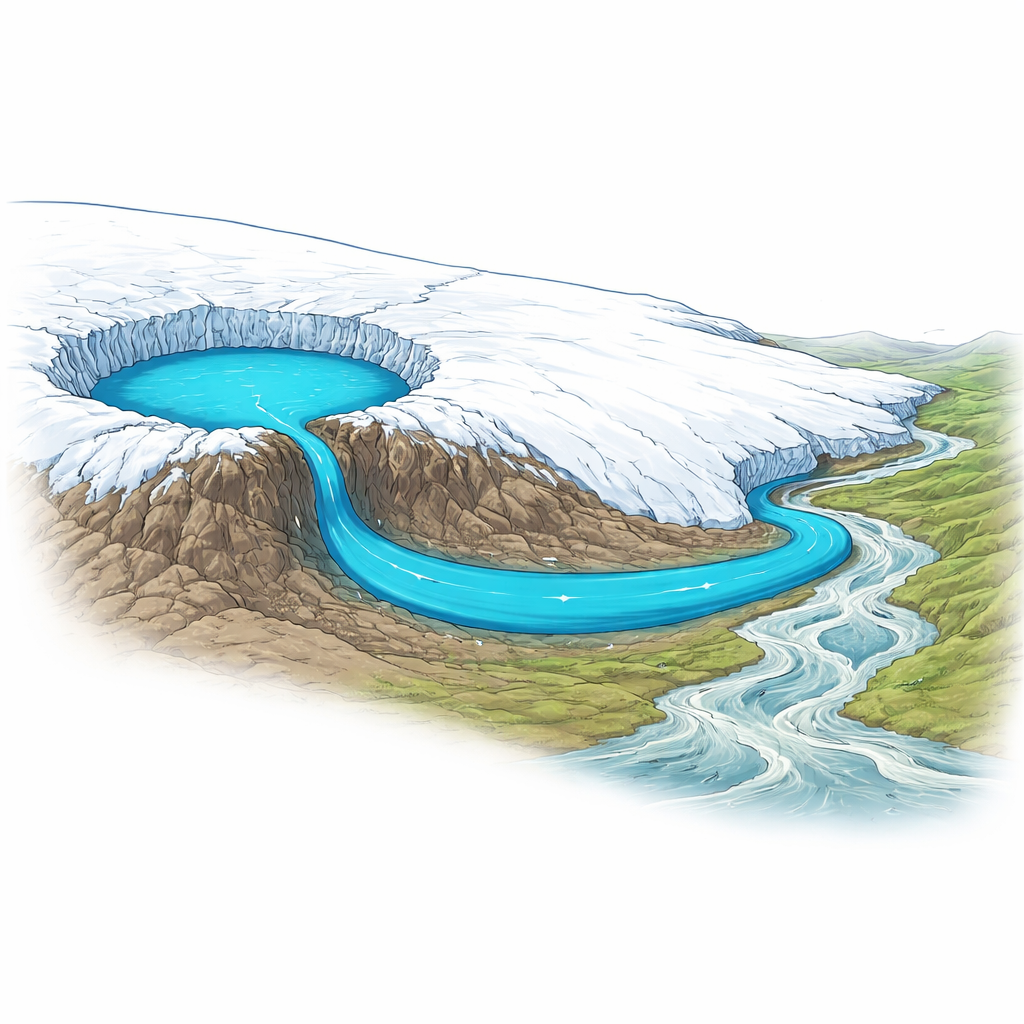
When a Buried Lake Lets Go
Under the Grímsvötn volcano, entombed by an ice cap up to 300 meters thick, a subglacial lake slowly fills with meltwater from geothermal heat, eruptions, and summer thaw. Every year or two, enough water builds up that it starts leaking past an ice “dam” and escapes beneath the glacier, feeding a flood that eventually pours out 50 kilometers away through the Gígjukvísl river. For decades, scientists have watched these jökulhlaups mainly by measuring the rising river, but that offers only a distant hint of what the water is doing on its journey through tunnels and sheets beneath the ice.
Watching the Ice Move from Space
In 2021 and 2022, the authors combined ground-based GPS stations on the ice with frequent radar images from the ICEYE satellite constellation. Radar can detect tiny changes in the glacier’s height and sideways motion, even through clouds and polar darkness. By stitching these snapshots together, the team built three-dimensional maps of how the glacier surface rose, fell, and sped up along the flood path before, during, and after the two jökulhlaups. They also used high-resolution optical images to reconstruct the shape of the buried lake and the rocky valley floor, letting them estimate how much water was stored and where it went.
Flood Waves, Hidden Ponds, and Flexing Ice
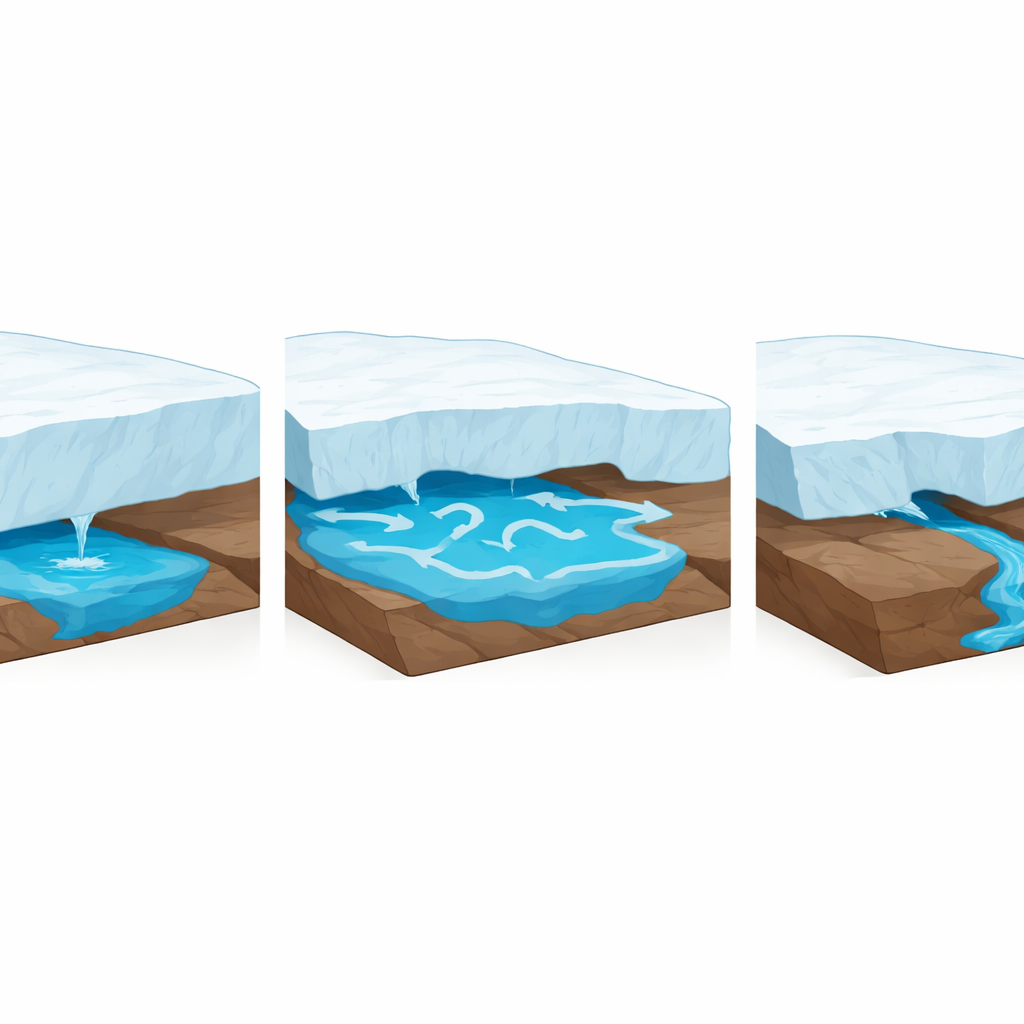
The satellite record shows that the outburst floods do not simply rush through a single tunnel like water in a pipe. Instead, after an initial leak near the lake carves a small passage, a bottleneck forms downstream that forces water to build up and then propagate as a slow-moving flood wave beneath the glacier. As this wave travels toward the ice margin, the overlying ice locally lifts off the bed by more than a meter over areas tens of kilometers long, creating vast subglacial ponds. The authors calculate that the volume of water temporarily stored in these ponds far exceeds what could be produced just by melting ice along a narrow conduit, meaning hydraulic “jacking” of the ice away from the rock is doing most of the storage work.
Switching Between Sheets and Tunnels
The detailed patterns of uplift and subsidence reveal that the drainage style varies along the flood route. In the steep upper section close to Grímsvötn, the glacier surface mainly sinks during high flow, consistent with fast water moving through relatively narrow, efficient channels that enlarge by melting. Farther down-glacier, where the bed is gentler, the main signal is ponding and later collapse of the ice as stored water drains away, a hallmark of broad sheet-like flow. Near the glacier margin, the scientists see a narrow band of surface lowering that appears as a final organized tunnel draining water into the river. Throughout the events, the glacier’s horizontal speed can jump to several times its usual rate, and those changes ripple even into areas that are not directly flooded, underscoring how sensitive glacier motion is to water pressure at its base.
A New Picture of Glacial Floods and Future Ice
By tying together lake levels, river discharge, and space-borne measurements of ice motion, the study proposes a unified, step-by-step picture of how these jökulhlaups develop: a small leak, a growing conduit, a downstream bottleneck, a propagating flood wave that ponds water and lifts the ice, and finally the growth and closure of tunnels that drain the system. The work shows that real floods blend behaviors once thought to belong to separate “slow” and “fast” types, and that temporary water storage beneath glaciers can be enormous. Understanding this hidden plumbing is crucial not only for forecasting hazardous floods but also for predicting how glaciers and ice sheets will respond as meltwater inputs change in a warming climate.
Citation: Magnússon, E., Drouin, V., Pálsson, F. et al. Subglacial water flow and ice dynamics during glacial lake outburst floods observed from space. Nat Commun 17, 3471 (2026). https://doi.org/10.1038/s41467-026-70428-w
Keywords: glacial lake outburst floods, subglacial water flow, Grímsvötn Iceland, glacier dynamics, satellite radar observations