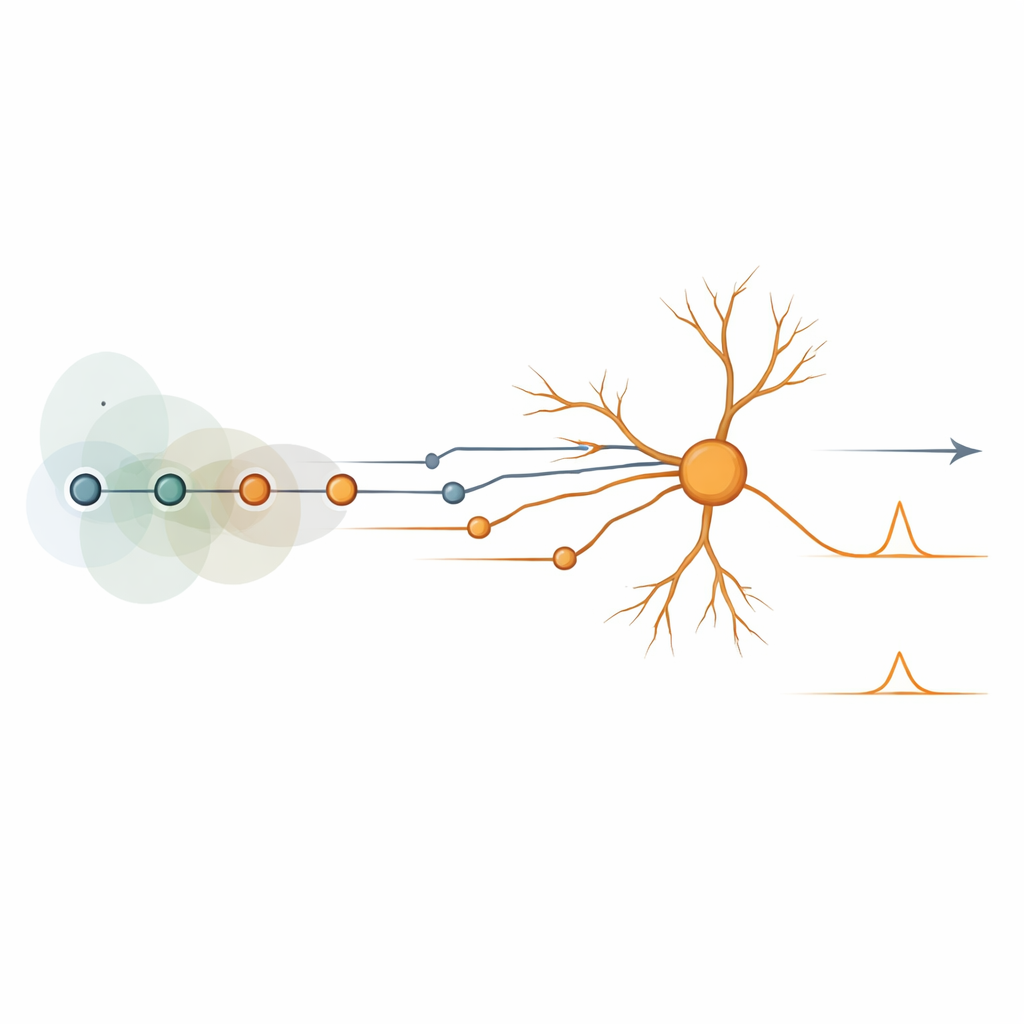
Whenever you catch a ball, notice a passing car, or simply watch leaves blowing in the wind, your visual system is quietly solving a tough problem: from a jumble of changing light patterns on the retina, it must figure out which way things are moving. For decades, scientists have relied on a few classic theories to explain how nerve cells detect motion. This study uses biologically inspired machine learning to ask a bolder question: are there many more ways for simple neural circuits to sense motion than we previously imagined?
Classic ideas about seeing motion
Early work on motion vision proposed that direction-sensitive neurons act as tiny calculators of timing. In one traditional scheme, inputs from neighboring points in space are compared after one of them is delayed, so that signals moving in the preferred direction arrive together and add up, while motion in the opposite direction does not. Another classic model pits fast excitation against delayed inhibition from the opposite side of a cell’s receptive field, cancelling responses to motion in the disfavored direction. These mechanisms, though influential, focus mainly on timing differences and leave open whether other circuit tricks could achieve the same end.
Letting evolution search the space of circuits Figure 1.
To explore this question, the author built detailed computer models of neurons in the retina and visual cortex and then set up an evolutionary search. Starting from random wiring and synaptic properties, a genetic algorithm repeatedly mutated circuit parameters and selected those models that best signaled the correct direction of moving bars and drifting gratings. Importantly, the individual input cells feeding the motion detectors were themselves not direction selective; only their collective organization and dynamics could give rise to tuned outputs. This automated exploration uncovered many different circuit layouts that rivaled or exceeded the performance of classical models, all while staying within biologically realistic constraints drawn from anatomy and physiology.
Many roads to the same motion sense
The search revealed that simple differences in the spatial layout of inputs can generate strong direction tuning even when their timing is identical. For example, arranging presynaptic cells so their receptive fields gradually increase in size, or rotate in orientation, along the preferred motion axis can cause their responses to line up in time for motion in one direction but not the other. Surround regions that suppress a cell’s response also proved powerful: by varying the strength, size, or speed of these surrounds across inputs, the model could carve out precise time windows in which signals line up only during motion in the preferred direction. Even unequal synaptic weights, with identical input filters, allowed circuits to become direction selective, although this strategy worked less well than those exploiting receptive field structure.
Hidden building blocks of motion circuits Figure 2.
Despite the bewildering variety of successful circuits, their behavior could be distilled into a small set of “computational primitives” – reusable algorithmic building blocks. Some matched the classic delay-and-compare and inhibition-based schemes. Others were new, such as mechanisms that rely on aligning the peaks of many inputs in time using spatial and surround interactions, or schemes in which pauses in inhibition or changes in response amplitude carry the directional signal. When inhibitory inputs were added, further variants emerged, including an “anti” form of the traditional inhibition model and patterns where inhibition briefly dips at the crucial moment to let excitation shine through. These primitives reappeared not only in detailed retinal ganglion cell models but also in cortical pyramidal neurons and in stripped-down two-input toy circuits, showing that they do not depend on a particular cell type or wiring diagram.
Resilient motion sensing in a noisy world
The study also asked how these mechanisms fare when motion is messy, as in real life where speeds vary unpredictably. Circuits that relied on changes in the size of input receptive fields, especially in their central regions, were remarkably robust: they kept signaling motion direction accurately even when the stimulus sped up and slowed down randomly. In contrast, models that depended mainly on subtle differences in surround properties or other finely tuned timing relationships tended to lose their selectivity under the same conditions. This suggests that some of the newly uncovered strategies may be particularly well suited for reliable motion perception in natural scenes.
What this means for understanding the brain
By letting machine learning freely explore how simple neural circuits might detect movement, this work shows that the brain is not limited to one or two tricks for sensing motion. Instead, many distinct circuit arrangements collapse onto a handful of underlying computational ideas that can be implemented with realistic biological components. For non-experts, the takeaway is that motion detection in the brain is both more flexible and more elegantly organized than previously thought: a small set of core operations, reused and recombined, can explain a wide variety of motion-sensitive cells across different brain regions and species.
Citation: Poleg-Polsky, A. Machine learning discovers numerous new computational principles supporting elementary motion detection.
Nat Commun17, 3424 (2026). https://doi.org/10.1038/s41467-026-70288-4
Keywords: motion detection, direction selectivity, neural circuits, retina and cortex, machine learning in neuroscience