Clear Sky Science · en
GREM1 acts in leptin receptor-expressing skeletal cells to mediate peri-implant fibrosis
Why some joint implants fail
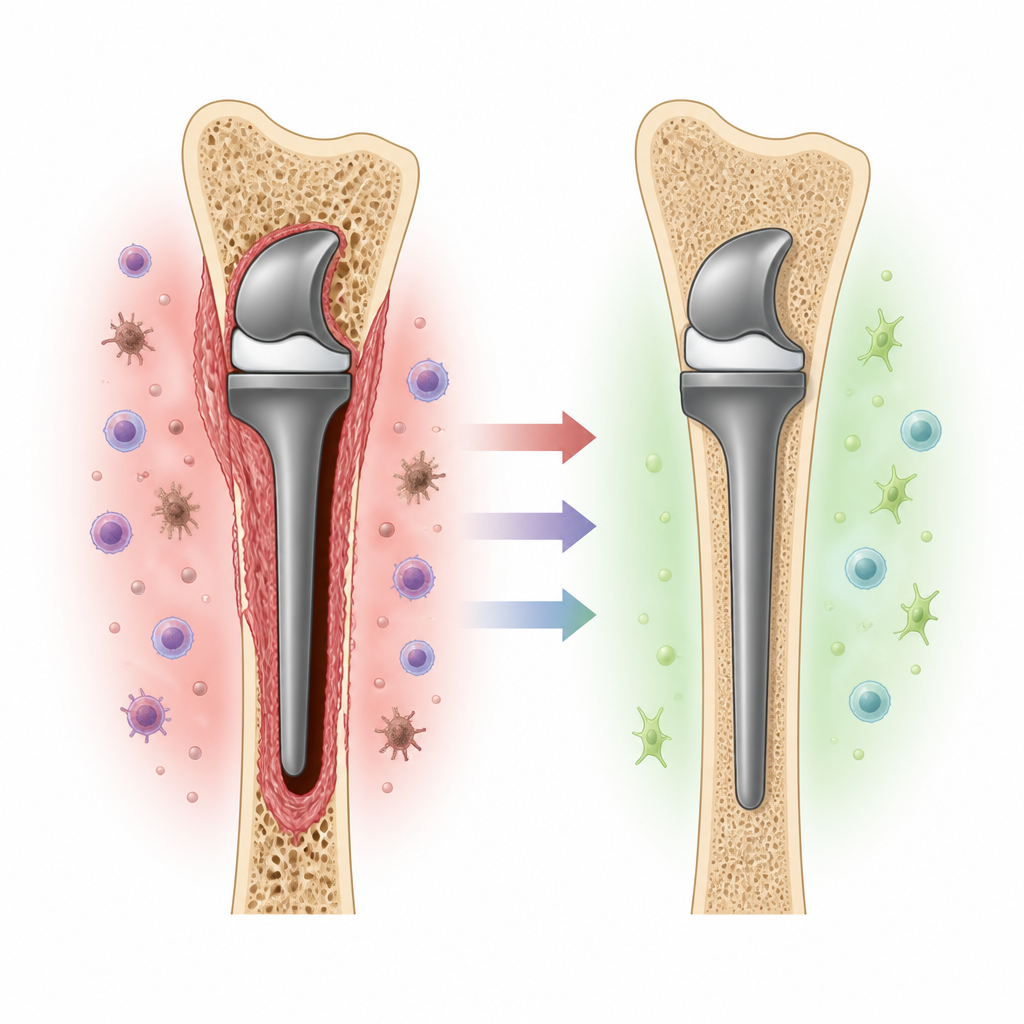
Total hip and knee replacements have transformed life for millions of people with painful arthritis. Yet a sizable number of patients eventually develop loosening of the artificial joint, where the implant no longer grips the bone firmly. Instead of strong bone growing around the metal, a soft fibrous layer forms and the implant can start to wobble, causing pain and sometimes requiring another major surgery. This study asks a simple but important question: what goes wrong in the body’s healing response after surgery, and can we nudge it back toward making bone instead of scar-like tissue?
A tug of war around the implant
When a joint implant is inserted, bone marrow cells near the device face a choice: they can mature into bone-forming cells that lock the implant in place, or they can turn into fibrous tissue–producing cells that create a weak, slippery interface. The researchers focus on a particular group of marrow cells that carry a receptor for the hormone leptin. These leptin receptor positive skeletal cells normally help build and repair bone. Examining tissue from patients undergoing revision surgery, as well as from mice with loosened implants, the team found that most of the cells in the fibrous layer came from this very bone-building population, suggesting that their original mission had been diverted.
A molecular brake that redirects healing
The work centers on a secreted protein called Gremlin-1, or GREM1, which is known to block bone growth signals. In both human and mouse peri-implant tissue, leptin receptor positive cells in the fibrous layer produced high levels of GREM1, while similar cells in nearby healthy bone made very little. These fibrotic cells did not just display markers of scarring; they also retained markers of bone-forming cells, hinting that they were bone builders that had been rerouted. The authors show that as healing progresses after surgery in mice, these leptin receptor positive cells first switch on early bone markers, then later gain GREM1 and fibrotic markers as the soft layer around a loose implant matures.
Turning off GREM1 to grow bone instead of scar
To test whether GREM1 truly drives this harmful switch, the team genetically removed the Grem1 gene only in leptin receptor lineage cells in mice. When these animals underwent a surgical procedure that normally produces a fibrous interface, they instead developed thicker bone around the implant and far less fibrous tissue. Mechanical testing showed that their implants were more securely anchored. Cell and gene analyses revealed why: without GREM1, bone-promoting signal routes, known broadly as BMP and WNT pathways, became more active, while genes linked to fibrosis and unchecked cell growth were dialed down. When these GREM1-lacking cells were transplanted into another site, they preferentially formed bone and fat rather than scar tissue, confirming that their internal program had been reset.
Antibody treatment that blocks fibrosis
Genetic manipulation is not a practical therapy for patients, so the investigators tried a drug-like approach in mice, injecting a neutralizing antibody that soaks up GREM1 near the implant. 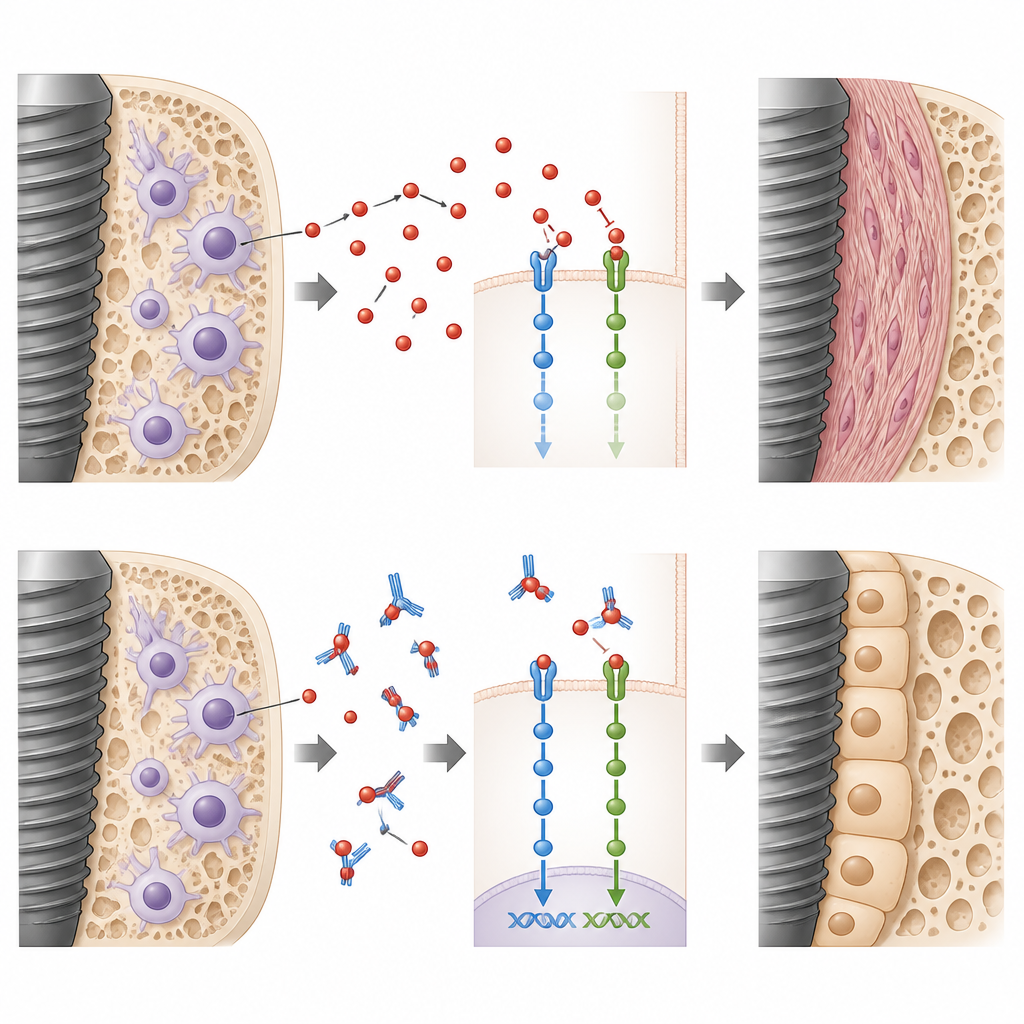
What this could mean for future joint surgery
This study suggests that a key reason some implants loosen is that normally bone-forming cells are pushed by GREM1 into making a soft fibrous sleeve instead. By blocking GREM1, either through targeted genetic changes in experimental models or by using antibodies, the researchers were able to tip the balance back toward healthy bone growth and away from scar. While more work is needed before any treatment reaches the clinic, the findings point to GREM1 as a promising molecular handle for protecting joint replacements and potentially rescuing failing ones without immediately resorting to another major operation.
Citation: Suhardi, V.J., Oktarina, A., Niu, Y. et al. GREM1 acts in leptin receptor-expressing skeletal cells to mediate peri-implant fibrosis. Nat Commun 17, 4353 (2026). https://doi.org/10.1038/s41467-026-70111-0
Keywords: joint replacement, peri-implant fibrosis, bone healing, GREM1, aseptic loosening