Clear Sky Science · en
Gear-like MOF microrobots for single cell mechanotransduction of microvilli
Tiny gears that talk to single cells
Every cell in your body constantly feels and responds to mechanical forces, from the rush of blood in arteries to the flow of fluid in your kidneys. But until now, scientists have had no way to reach down to a single cell and gently tug on its smallest surface structures to see exactly how it reacts. This study introduces tiny gear-shaped microrobots that can roll up to an individual cell, grab its microscopic surface fingers called microvilli, and pull on them with exquisite precision—opening the door to new ways of studying disease and delivering drugs directly into single cells.
Why cell surface fingers matter
Cell surfaces are not smooth. Many important cells, including kidney, gut, and immune cells, are covered with dense forests of hair-like protrusions called microvilli. These tiny fingers are not just for absorbing nutrients; they also act as sensitive antennas that convert physical forces into biochemical signals inside the cell, a process known as mechanotransduction. Traditional ways to study these forces—such as pushing fluid over cells or squeezing them into narrow channels—act on large areas and can distort the cells in non‑natural ways. The authors of this paper set out to build a miniature tool that could mechanically stimulate only the microvilli of a chosen single cell, without clamping or trapping the cell itself.

Building gear-shaped cell-scale robots
The team engineered microrobots from metal–organic frameworks (MOFs), porous crystalline materials that can store molecules like a sponge. By carefully growing one MOF on the corners of another, they created particles with a four-lobed, gear-like shape. These were then coated with thin layers of nickel to make them magnetic and gold to make them biocompatible. The result, called a “MOFbot,” is about a micron across—roughly the size of a bacterium. When placed in a rotating magnetic field, MOFbots can either spin in place or roll across surfaces, even climbing over micron-scale steps that defeat simpler spherical robots. Computer simulations showed that the sharp “teeth” of the gear focus fluid flow and mechanical stress at the corners, making them ideal for gripping soft cellular structures.
Grabbing microvilli and tugging on the cell
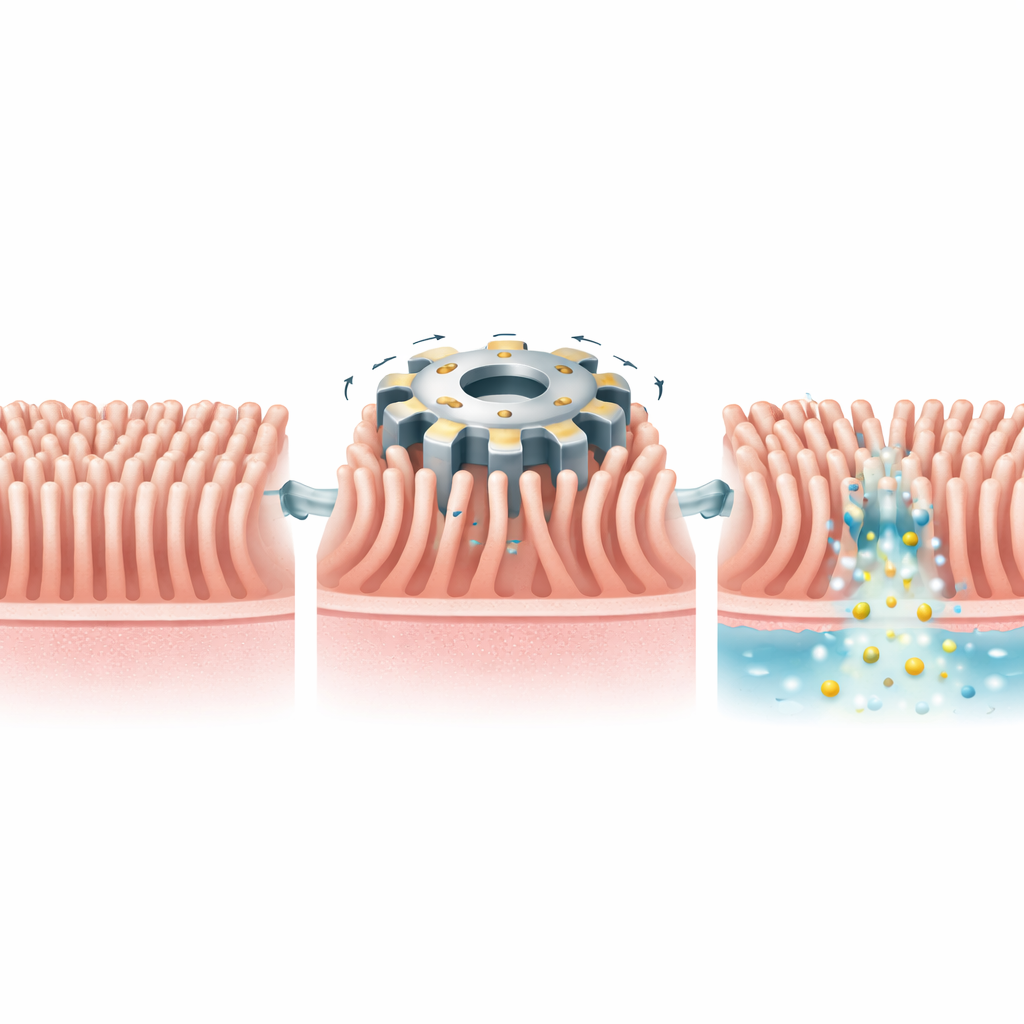
When the researchers brought MOFbots into contact with cultured human cancer cells, high‑resolution imaging revealed that rotating gear-shaped bots became intertwined with the cells’ microvilli, while non‑moving bots or smooth spheres did not. Using soft gel substrates seeded with fluorescent beads, they measured how much the cells pulled on their surroundings when MOFbots were rotating versus still. The moving gears increased local traction forces about fifteen‑fold, and this effect largely disappeared when the cells’ microvilli or internal actin scaffolding were disrupted. A separate molecular tension sensor inside the cells showed that rotation of MOFbots transmitted forces deep into the actin network, and these forces vanished when microvilli were removed. Together, these experiments pinpoint microvilli as critical conduits that channel external mechanical tugging into the cell’s interior.
Switching on inner signals and opening the membrane
Mechanical pulling on the microvilli did more than bend the cell surface. It triggered classical mechano-sensitive pathways inside the cell. A genetically encoded calcium indicator revealed that MOFbot stimulation caused a strong rise in calcium levels, a key messenger signal, which was largely blocked when two known force‑gated ion channels, PIEZO1 and TRPV4, were inhibited. At the same time, levels of a phosphorylated form of focal adhesion kinase (FAK)—a protein that relays mechanical information from the cell’s outer scaffolding—rose significantly. Simulations and dye‑uptake experiments showed that repeated gear‑like rotation at the microvilli can loosen the packing of membrane lipids and transiently increase membrane permeability. Under magnetic control, MOFbots carrying fluorescent dyes or the chemotherapy drug doxorubicin delivered much more cargo into targeted cells than stationary bots, while leaving most cells alive and intact.
What this could mean for future therapies
In simple terms, this work shows that carefully designed microrobots can roll up to a single cell, latch onto its tiniest surface features, and “shake the doorknob” just enough to both probe and influence how the cell responds. By proving that microvilli act as mechanical amplifiers that connect outside forces to calcium signals, structural proteins, and membrane permeability, the study offers a new way to study diseases where these surface structures go wrong—from intestinal disorders to cancer spread—and hints at future treatments where drugs are not only delivered to the right cell, but are actively pushed across its membrane by mechanical cues on demand.
Citation: Liu, X., Wang, Y., Lin, L. et al. Gear-like MOF microrobots for single cell mechanotransduction of microvilli. Nat Commun 17, 3254 (2026). https://doi.org/10.1038/s41467-026-70052-8
Keywords: microrobots, microvilli, mechanotransduction, targeted drug delivery, cell mechanics