Clear Sky Science · en
tRNA-derived RNA processing in sperm transmits non-genetically inherited phenotypes to offspring in C. elegans
How Fathers Can Shape Offspring Without Changing DNA
We usually think parents pass traits to their children through genes encoded in DNA. This study shows that fathers can also influence their offspring through tiny RNA molecules in sperm, without altering DNA sequences. Working in the microscopic worm Caenorhabditis elegans, the authors uncover how a special class of RNAs, chopped from transfer RNAs (tRNAs), helps transmit survival traits from fathers to their young—revealing a deeply conserved, non-genetic layer of inheritance.
Tiny RNA Messages Riding in Sperm
Cells use tRNAs as adaptors to build proteins, but these same molecules can be cut into shorter pieces called tRNA-derived RNAs (tDRs). In mammals, tDRs are unusually abundant in sperm and can influence metabolism and development in offspring, but how they are produced and function has been unclear. The authors first asked whether this phenomenon exists beyond mammals. By purifying sperm from male C. elegans and sequencing their small RNAs, they found that tDRs are substantially enriched in worm sperm, much like in mice. Certain tDR types, especially fragments derived from tRNAs for the amino acids glycine (Gly-GCC) and glutamate (Glu-CTC), are particularly abundant, hinting that specific tDRs may be key information carriers between generations. 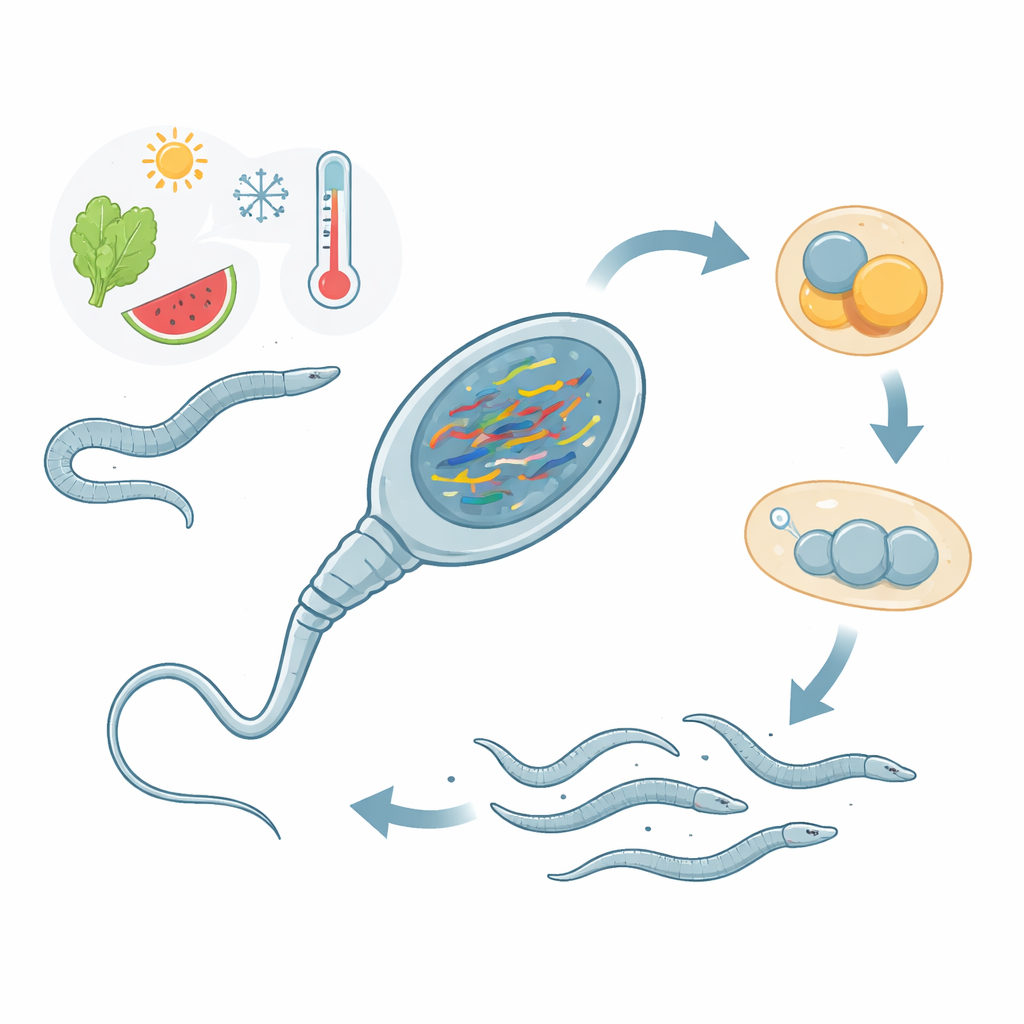
An RNA-Cutting Enzyme That Sets the Signal
The team next focused on how these tDRs are generated and controlled. Worms lack one major RNA-cutting enzyme family found in mammals, but they do have a single RNaseT2 enzyme, called RNST-2. By using CRISPR to disrupt the rnst-2 gene, they created worms in which RNST-2 either was missing entirely or carried a single disabled catalytic residue. In these mutant males, tDRs in sperm surged, especially longer pieces corresponding to half of a tRNA molecule. Detailed analysis showed that in normal males RNST-2 helps trim or remove these long tRNA halves, shifting the population toward shorter fragments. In mutants, that trimming step fails: long 5′ tRNA halves from Gly-GCC and Glu-CTC accumulate, and male fertility drops, indicating that properly processed tDRs are important for healthy sperm.
From Altered Sperm RNAs to Altered Embryos
Finding extra tDRs in sperm is suggestive, but do they actually matter for offspring? To test this, the researchers mated rnst-2 mutant males with normal females and examined individual early embryos using sensitive RNA sequencing. Even at the 2-cell stage, before the embryo’s own genome is fully active, they saw changes: a key translation factor, ife-2, was upregulated. By the 8-cell stage, broad shifts appeared, including lowered expression of many histone genes (which package DNA) and a large family of protein quality-control genes. These coordinated changes suggest that the cargo of sperm tDRs can re-tune the embryo’s gene-expression landscape during a narrow developmental window.
Inherited Survival Traits Without DNA Changes
The consequences reached well beyond early development. Offspring of rnst-2 mutant fathers survived prolonged starvation as newly hatched larvae better than controls, yet as adults they were more vulnerable to heat stress and showed reduced activity in genes tied to stress responses and protein synthesis. To pin these effects specifically on Gly-GCC and Glu-CTC tDRs, the team microinjected complementary “anti-tDR” RNAs into the mothers’ germlines. These antisense molecules bind the targeted tDRs and block their function after fertilization. When Gly-GCC and Glu-CTC tDRs were neutralized, the previously altered embryonic gene expression largely reverted toward normal, and the heightened heat sensitivity in adult offspring was rescued—strong evidence that these particular sperm tDRs causally transmit non-genetic traits. 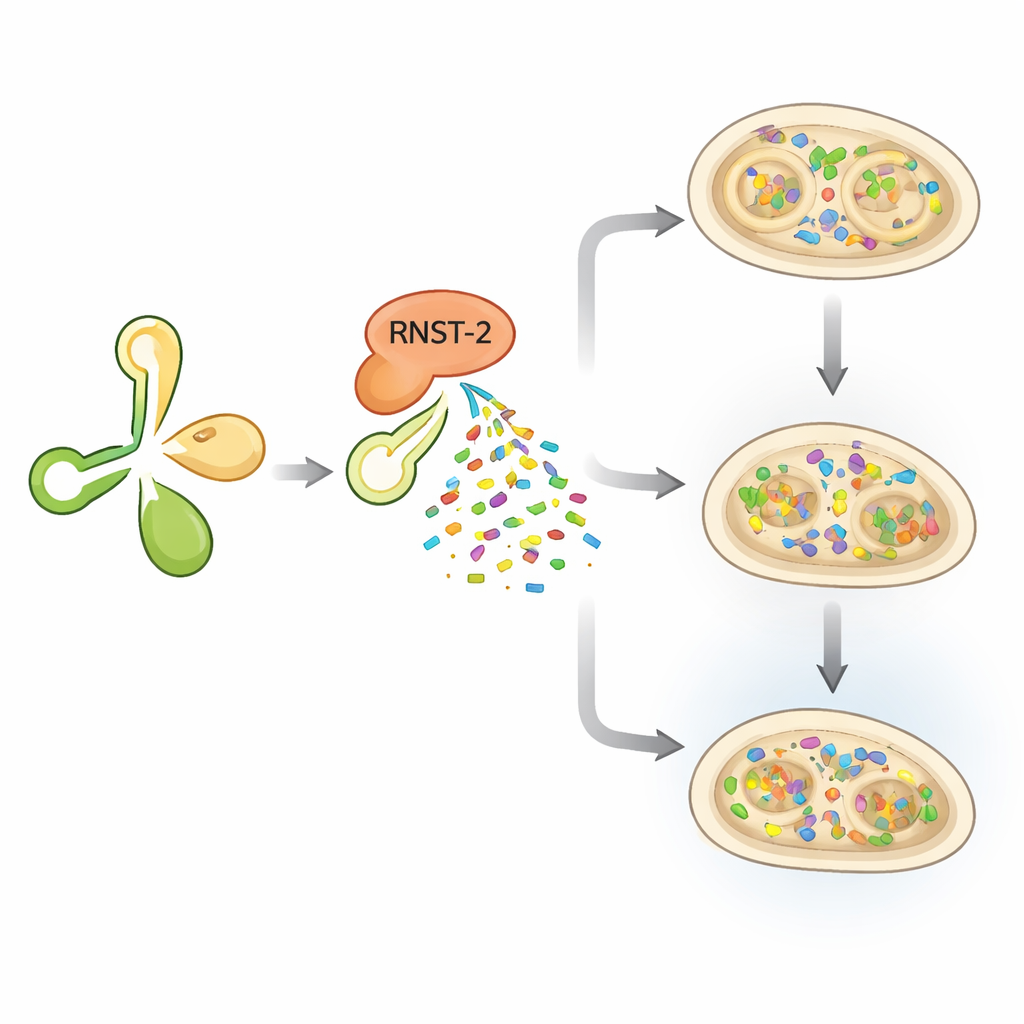
A Conserved System for Non-Genetic Inheritance
Together, the results reveal an RNA-based inheritance system in which an RNaseT2 enzyme, RNST-2, sculpts the size and abundance of specific tRNA fragments in sperm. These tDRs then act in the early embryo to reset gene expression, ultimately shifting how offspring cope with starvation and heat. Because similar tDRs in mammalian sperm have been linked to diet-induced traits in mice, the work in C. elegans establishes this tiny worm as a powerful model for dissecting how fathers pass on information through RNA, adding a flexible, epigenetic layer to the familiar genetic code.
Citation: Galambos, N.S., Crocker, O.J., Schneider, B.K. et al. tRNA-derived RNA processing in sperm transmits non-genetically inherited phenotypes to offspring in C. elegans. Nat Commun 17, 3999 (2026). https://doi.org/10.1038/s41467-026-70029-7
Keywords: epigenetic inheritance, sperm RNA, tRNA fragments, C. elegans, paternal effects