Clear Sky Science · en
Interplate rheological contrast revealed by asymmetric deformation after the 2023 Kahramanmaraş earthquakes
How Earth Slowly Heals After a Giant Quake
The twin earthquakes that struck southeastern Türkiye and northwestern Syria in February 2023 shattered buildings in seconds, but the ground itself has kept on moving for years. Understanding this slow-motion shift matters because it reveals how Earth’s deep layers behave, how stress is passed to neighboring faults, and where future quakes might be more likely. This study uses advanced radar satellites to watch the land around the East Anatolian Fault in three dimensions over nearly two years, uncovering a surprising imbalance in how the two sides of the fault deform and what that says about the hidden strength of the plates below.
A Tale of Two Sides of a Fault
The earthquakes occurred on the boundary between the Arabian and Anatolian plates along the East Anatolian Fault, a major sideways-slipping break in Earth’s crust. Although the shaking ended quickly, satellite measurements show that the surface continued to creep, rise, and sink for hundreds of kilometers around the fault. The researchers combined dozens of images from Europe’s Sentinel‑1 radar satellites to build time-lapse maps of ground motion east–west, north–south, and up–down. These maps reveal that horizontal motion dominates, reaching up to about 15 centimeters in two years, and that the zone of post-quake movement is much broader than the region that slipped during the main shocks, hinting at important processes deep below the brittle crust. 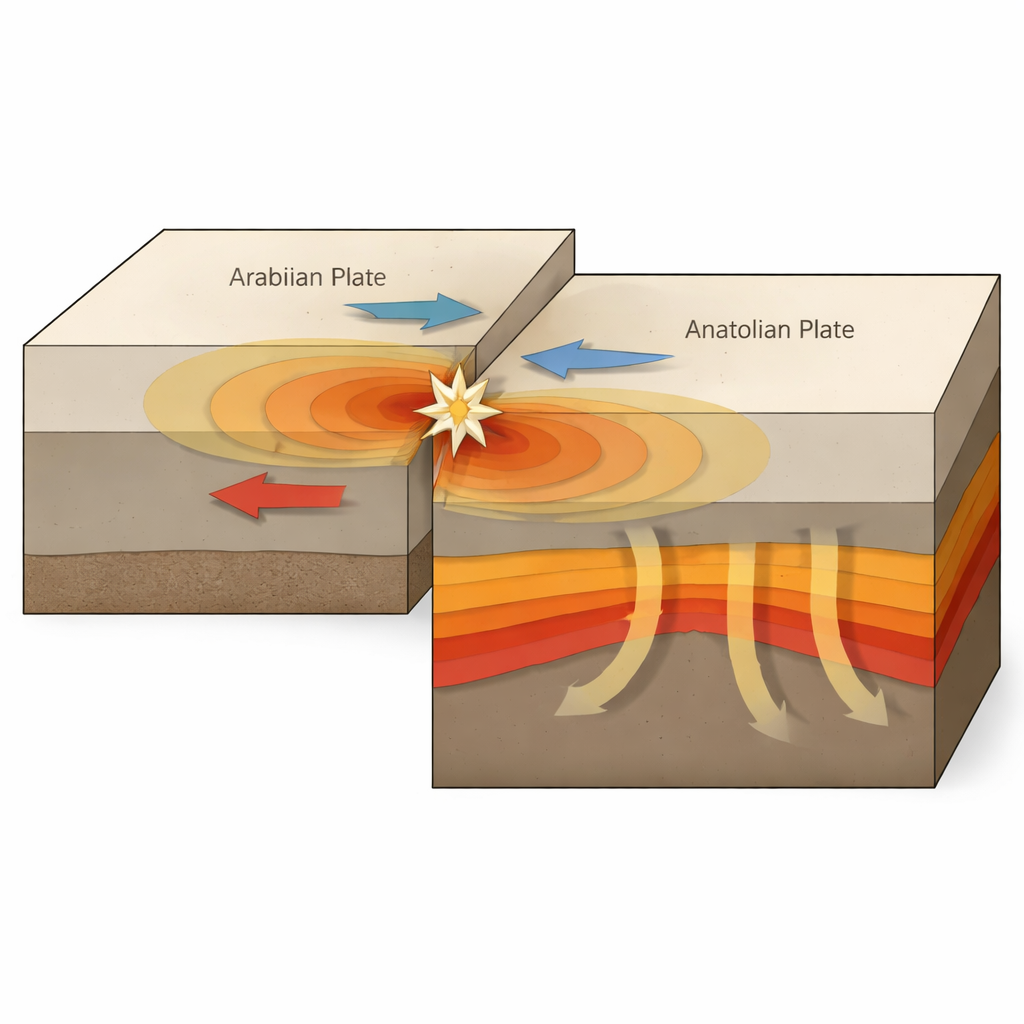
Detecting an Invisible Imbalance
The most striking pattern is a strong imbalance between the two plates. North of the fault, on the Anatolian side, the deformation is larger and more tightly focused near the fault. South of the fault, on the Arabian side, the motion is smaller but spread across a wider region, and it fades more slowly with time. By fitting the time evolution of the motion with simple curves, the team shows that the "decay time" of the deformation—how long it takes for the movement to slow down—is consistently longer under Arabia than under Anatolia. This difference in tempo cannot be explained by shallow sliding on the fault alone, which would tend to produce similar timing on both sides. Instead, it points to contrasting flow properties deeper in the crust and upper mantle.
Peering into Earth’s Deep Layers
To test this idea, the authors built computer models of how the lower crust and upper mantle would flow after the earthquakes if they behaved like very thick, slow-moving fluids. They assigned different strengths to the layers beneath each plate, guided by independent seismic studies that suggest the Arabian side is more rigid. Through extensive trial and error, they found that the observations are best matched when the lower crust beneath Arabia is significantly stronger than beneath Anatolia, and when the upper mantle beneath Anatolia relaxes faster than beneath Arabia. In this picture, the softer Anatolian side deforms quickly and close to the fault, while the stiffer Arabian side responds more slowly but over a broader area, naturally reproducing the observed spatial and temporal imbalance. 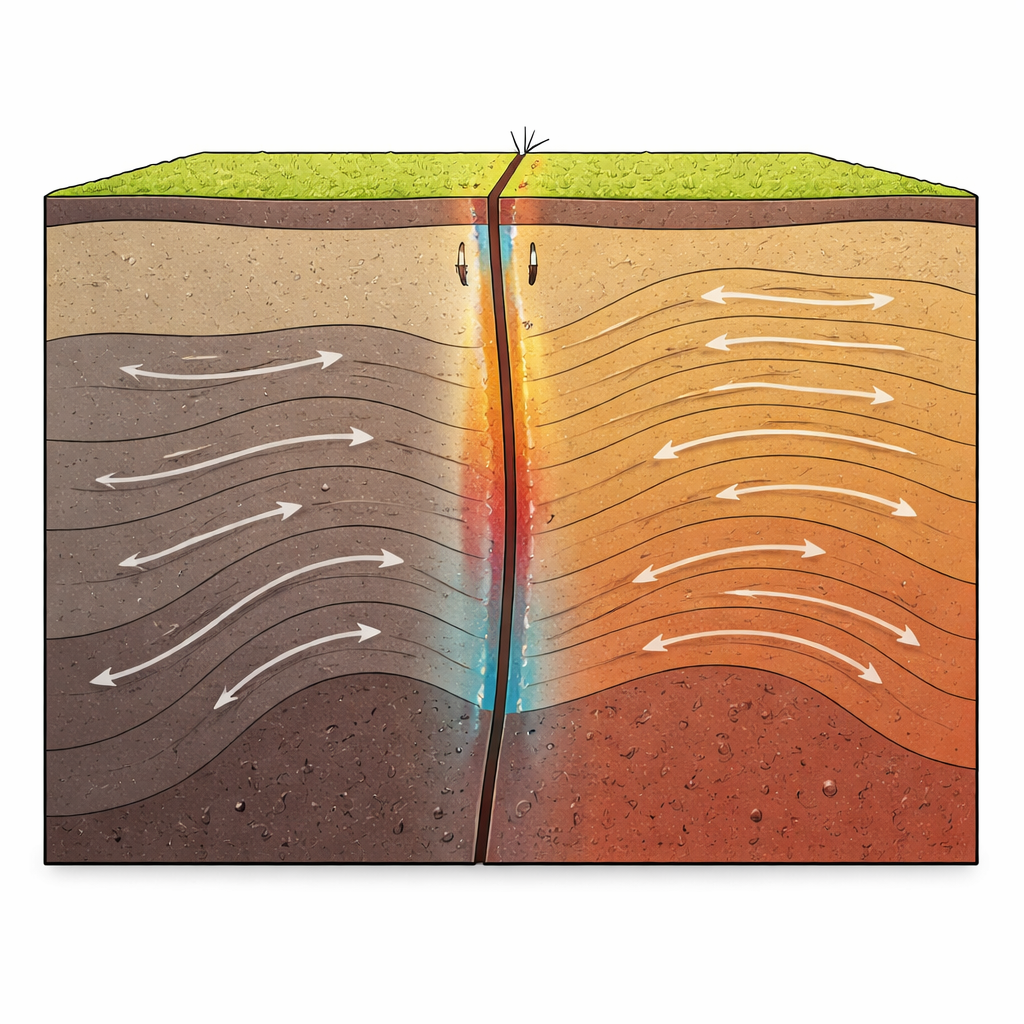
Water in the Crust and the Role of Pore Pressure
Even with this deep-flow model, there were still unexplained vertical motions: broad uplift north of the fault and subsidence to the south. The team linked these up-and-down movements to changes in fluid pressure within tiny pores in the crustal rocks—a process known as poroelastic rebound. When the fault slipped, it squeezed and stretched water-filled rocks, temporarily changing how compressible they are. As fluids slowly redistributed, the surface rose or sank in response. By comparing modeled and observed vertical shifts, the authors inferred unusually large changes in how the crust responds to squeezing, especially beneath the stiffer Arabian plate, suggesting that the 2023 earthquakes substantially altered rock properties at depth.
Rethinking How Post-Quake Motion Works
Putting the pieces together, the study concludes that most of the ongoing deformation after the 2023 Kahramanmaraş earthquakes is driven by deep, slow flow in the lower crust and upper mantle, assisted by fluid-related rebound in the shallower crust. In contrast, continued sliding on the fault itself—a process often blamed for post-quake motion—plays only a minor role here. For non-specialists, the key message is that Earth’s interior is far from uniform: one side of this major plate boundary is mechanically tougher than the other, and this hidden contrast controls how and where the ground keeps moving long after the shaking stops. Such detailed, three-dimensional "movies" of the surface are beginning to turn destructive earthquakes into natural experiments that reveal the inner workings of our planet.
Citation: Liu, J., Jónsson, S., Li, X. et al. Interplate rheological contrast revealed by asymmetric deformation after the 2023 Kahramanmaraş earthquakes. Nat Commun 17, 3182 (2026). https://doi.org/10.1038/s41467-026-69992-y
Keywords: postseismic deformation, East Anatolian Fault, viscoelastic relaxation, porous crust rebound, Kahramanmaras earthquakes