Clear Sky Science · en
Structural and functional implications of phase separation of membrane protein LacY in Escherichia coli
How Cells Use Soft Clumps to Organize Life
Inside every cell, countless molecules bustle about, yet this apparent chaos is surprisingly well organized. In recent years, biologists have discovered that many of these molecules gather into soft, droplet-like clusters rather than rigid structures. This study explores how a classic bacterial membrane protein, the lactose transporter LacY, can be coaxed into forming such clusters and what that means for how cells manage stress and run their chemistry. The work not only sheds light on a basic organizing principle of life but also hints at new ways to engineer microbes for biotechnology.
Droplets Without Walls
Many cellular components group into “biomolecular condensates” – liquid-like droplets that form without surrounding membranes. These condensates create tiny zones where conditions, such as concentration or viscosity, differ from the rest of the cell, which can speed up some reactions and slow others. Until now, most work has focused on soluble proteins floating in the cell interior. Much less was known about whether proteins that span membranes, such as transporters, can also form such condensates, and if they do, whether this affects how they work.
Engineering a Clustering Switch
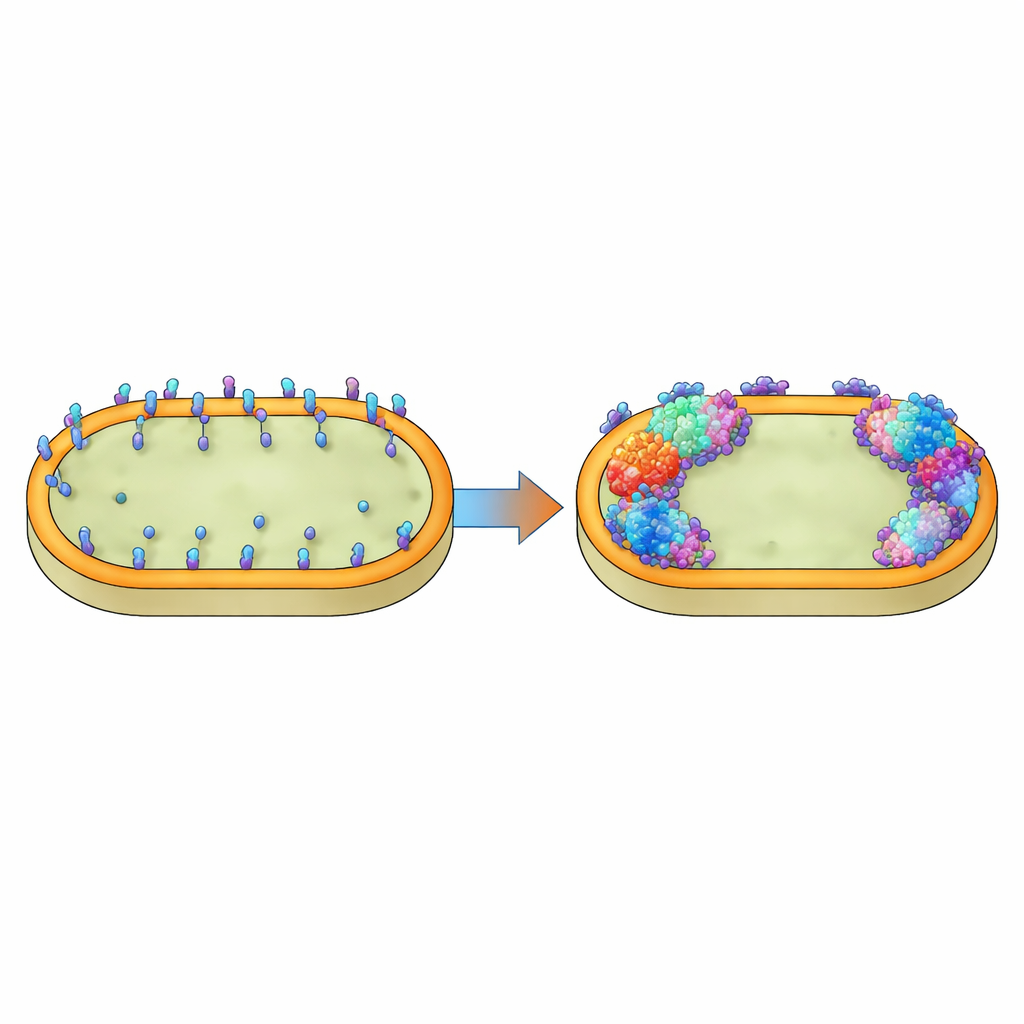
The researchers set out to make LacY, a well-studied protein that ferries lactose across the inner membrane of the bacterium Escherichia coli, behave like a condensate-forming protein. To do this, they fused LacY to a short tag called PopTag, derived from a bacterial protein known to self-cluster. PopTag carries several “sticky” segments that can interact with one another multiple times, a key feature that promotes droplet formation. When this fusion, LacYPop, was produced in E. coli and viewed by advanced fluorescence microscopy and electron microscopy, it no longer spread evenly across the membrane. Instead, it gathered into large patches at the rounded ends of the cells and smaller speckles along the sides, forming thin, sheet-like condensates anchored to the inner membrane.
How Stickiness and Shape Work Together
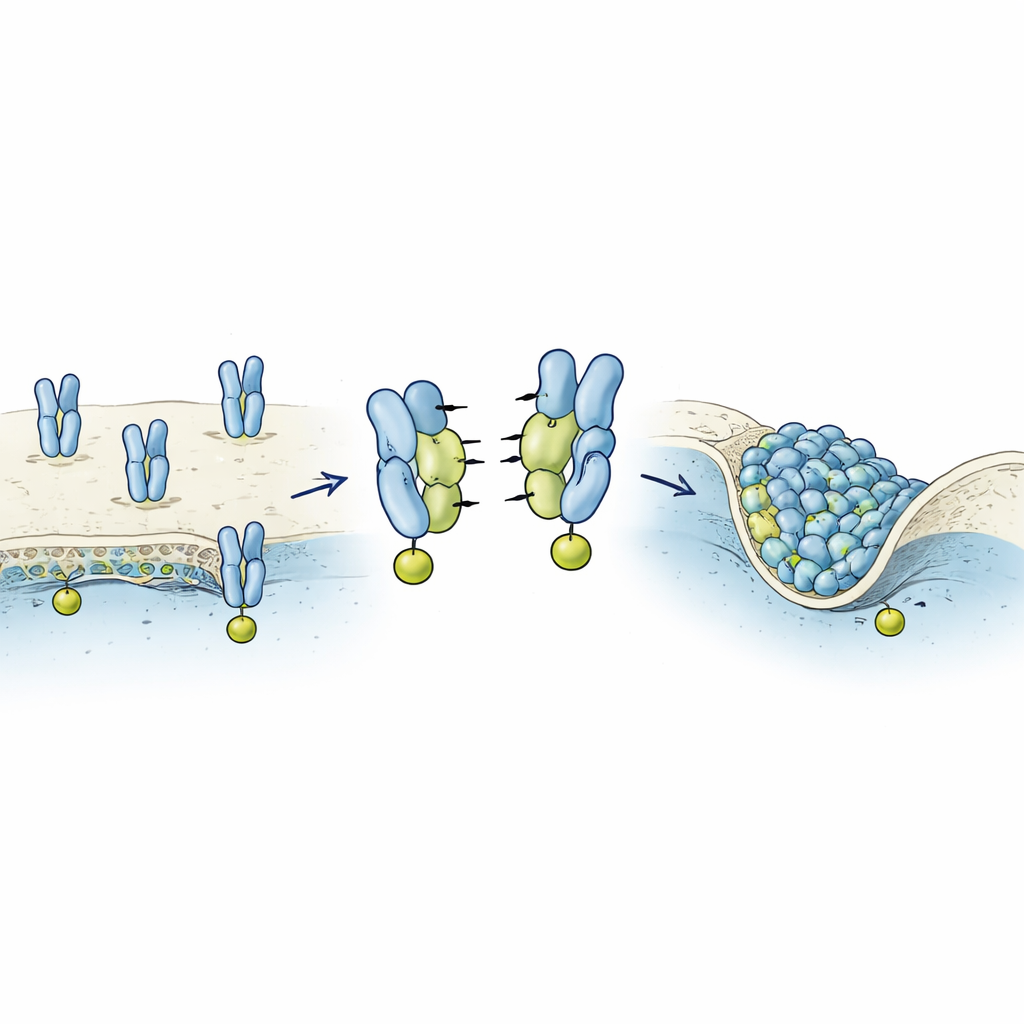
Computer simulations helped explain how the tag drives clustering. In coarse-grained molecular dynamics models, multiple LacYPop molecules embedded in a realistic bacterial membrane spontaneously moved together over time, unlike plain LacY, which stayed mostly in small, scattered groups. The simulations showed that specific helical segments of PopTag with hydrophobic (water-repelling) faces act as “stickers” that latch onto matching faces on nearby tags. Initially, these sticky helices lie against the membrane surface, but as local concentration rises they increasingly bind to each other, weaving a dynamic network that pulls LacY molecules into condensates. Experiments that changed cell shape revealed another key factor: curvature. When cells were converted into round spheroplasts, polar clusters melted away and LacYPop spread more evenly. When curvature was reintroduced by shrinking the membrane under osmotic stress, the clusters reappeared, especially at highly curved inward regions. This indicates that the geometry of the membrane strongly guides where condensates form.
Keeping Transport Running Under Stress
Clustering could, in principle, jam transporters and slow nutrient uptake. To test this, the team measured how fast cells imported radioactive lactose using either normal LacY or LacYPop. Surprisingly, the fused, condensate-forming version transported slightly more lactose under normal conditions, even though its expression level was nearly the same. When the surrounding medium was suddenly made saltier, mimicking hyperosmotic stress, both versions slowed, but LacYPop consistently outperformed LacY. Microscopy of stressed cells revealed that those with LacYPop had fewer severe membrane deformations, suggesting that the condensates act like a supportive mesh along the inner membrane, limiting its collapse and helping maintain a more favorable internal volume for transport.
Building Tiny Assembly Lines
The authors then asked whether condensates could be used to physically couple a transporter with its downstream enzyme, creating a nanoscale assembly line. They fused PopTag not only to LacY but also to LacZ, the enzyme that breaks down lactose inside the cell, and observed how these proteins arranged themselves. When both partners carried PopTag, they formed shared “heterocondensates” in which a membrane sheet of LacYPop was covered by a dome of LacZPop. Electron microscopy confirmed thick, electron-dense layers at the inner membrane, sometimes with an additional bulkier droplet attached. Activity measurements showed that LacZPop in its own condensates worked about one and a half times better than normal LacZ, likely because the crowded environment stabilizes its active form. When LacY and LacZ shared a condensate, LacZ’s activity was somewhat reduced compared to its solo droplets, probably because its geometry becomes more constrained on the membrane surface. Still, both transporter and enzyme remained functional in these complex structures.
What This Means for Future Cells
Overall, the study shows that a membrane protein can be made to phase-separate into soft, two-dimensional condensates without losing its job – and may even perform better under stress. By revealing how simple sticky segments and membrane shape conspire to gather transporters and enzymes into localized patches, the work offers a blueprint for designing bacterial cells with built-in reaction hubs and reinforced membranes. In the long run, such engineered condensates could help scientists build more efficient cell factories, stabilize fragile proteins, and more precisely control where and how key reactions take place inside living cells.
Citation: Linnik, D., Sultanji, S., Stevens, J.A. et al. Structural and functional implications of phase separation of membrane protein LacY in Escherichia coli. Nat Commun 17, 3174 (2026). https://doi.org/10.1038/s41467-026-69951-7
Keywords: biomolecular condensates, membrane proteins, lactose transport, cellular stress, synthetic biology