Clear Sky Science · en
Forest canopy insects are safer from predators in the tropics than at higher latitudes
Why the Height of the Forest Matters
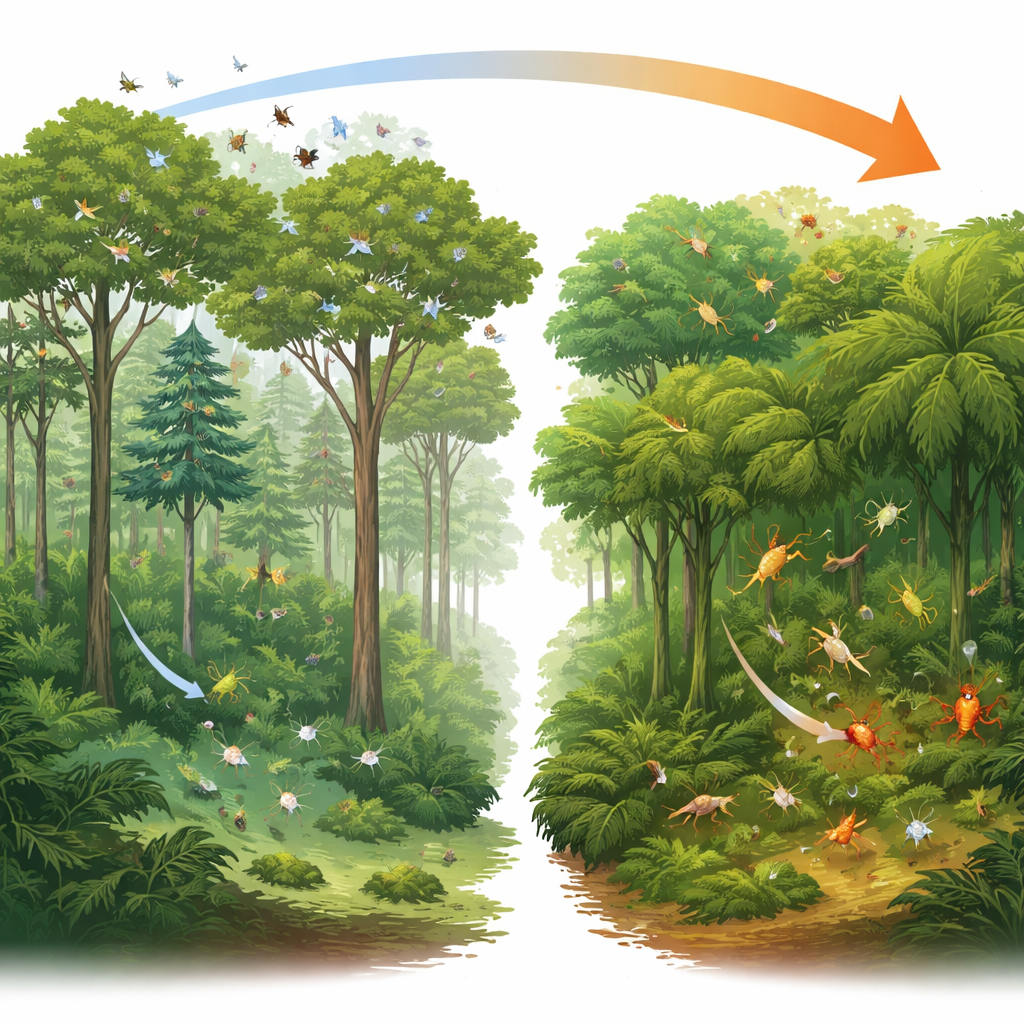
Walk through a forest and you might think the action is all around your feet. But for insects living high in the treetops, life-and-death struggles with hungry birds and other predators play out many meters above the ground. This study asks a simple but surprising question: are insects in the leafy roof of the forest safer in the tropics or nearer the poles? The answer turns out to depend not just on latitude, but also on how high up in the forest you live.
A Global Look from Tree Tops to Forest Floor
The researchers used giant construction cranes in six forests around the world, from cool temperate woods in Europe and Japan to warm tropical forests near the equator and in Australia. These cranes let scientists ride up into the canopy, 10 to 35 meters above the ground, and reach leaves that are usually out of human reach. At each site, they compared two layers of the forest: the shady understory a few meters above the ground, and the sunlit canopy above.
Fake Caterpillars as Tiny Test Subjects
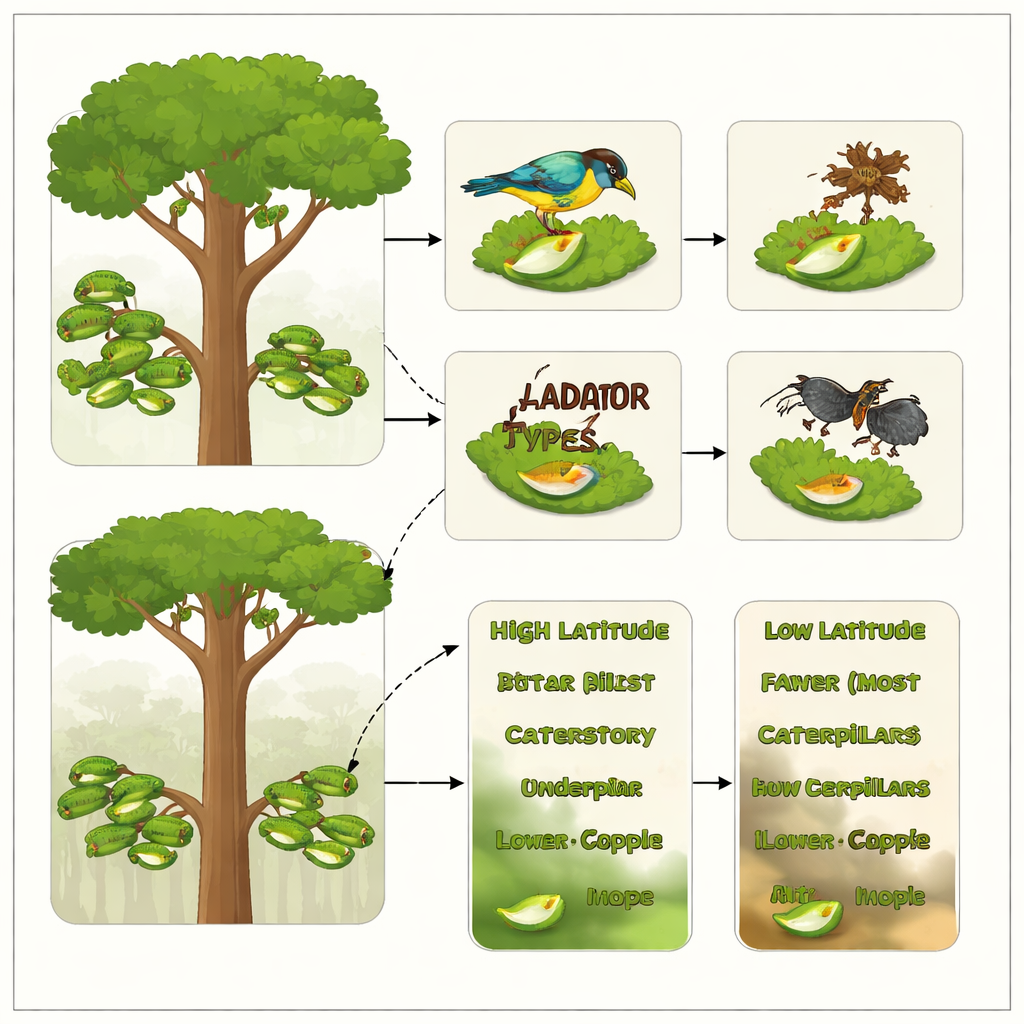
To measure how dangerous each layer was for plant-eating insects, the team placed more than three thousand green plastic caterpillars on leaves in both canopy and understory. These dummies cannot move, but they record attacks as tiny bite or peck marks. After three days, the scientists collected the caterpillars and examined the marks to tell whether birds, mammals, or other arthropods such as ants and wasps had attacked. They also counted real insects on the foliage and surveyed birds and ants, building a fuller picture of who was hunting whom.
Where Insects Face the Greatest Danger
The results overturned a long-standing expectation that predation should simply get stronger toward the tropics. On average, more dummy caterpillars were attacked in temperate regions than in tropical ones. But the real twist was the contrast between forest layers. At high latitudes, caterpillars in the canopy were far more likely to be attacked than those in the understory, sometimes by a factor of ten. Closer to the equator, the pattern reversed: attacks were more common in the understory, while the canopy was comparatively safer for insects.
Different Hunters Rule Different Layers
Part of this pattern comes from the changing roles of birds and arthropods. In the understory, attacks by arthropods peaked near the equator, echoing earlier studies done only near ground level. Bird attacks there showed little consistent trend with latitude. In the canopy, however, bird and arthropod attacks both became much more frequent toward higher latitudes. The numbers of insect-eating birds matched these changes: more birds tended to mean more attacks, especially in the canopy of cooler forests. Ants, which are famously abundant in tropical canopies, did not neatly track attack rates, suggesting that other predators such as wasps may be important.
More Leaves, More Insects, More Risk
Predation pressure does not depend only on how often a single prey item is attacked, but also on how many prey are available. The researchers found that in temperate forests, the understory held three to four times more arthropods per unit of leaf area than the canopy, while in the tropics the two layers had similar insect densities. Canopy trees also tend to carry more total leaf area, especially in tropical forests. Putting these pieces together, the team concludes that even when attack rates seem similar, the upper canopy can host higher overall pressure on insects simply because there is more food for predators concentrated there.
What This Means for Forest Life
For a layperson, the takeaway is that there is no single answer to the question “Where is it most dangerous to be an insect?” Insect prey living high in the canopy are actually safer from predators in tropical forests than in cooler ones, while understory insects can be at greater risk in the tropics. These findings show that to understand how climate and geography shape life, scientists must look not only from pole to equator, but also from forest floor to treetop. The study also underlines the value of rare canopy cranes, which open a window onto one of the most biologically rich yet least explored habitats on Earth.
Citation: Sam, K., Sivault, E., Fernandez Garzon, S. et al. Forest canopy insects are safer from predators in the tropics than at higher latitudes. Nat Commun 17, 3283 (2026). https://doi.org/10.1038/s41467-026-69935-7
Keywords: forest canopy, trophic interactions, insect predation, latitudinal gradient, bird and arthropod predators