Clear Sky Science · en
Dual-atom Rh-Co catalysts for synergistically boosting nitrile hydrogenation
Catalysts that make useful amines
Amines are building blocks for medicines, crop protectants, and specialty materials, so making them cleanly and efficiently matters far beyond the chemistry lab. This study introduces a new type of catalyst that turns nitriles, a common starting material, into secondary amines with high efficiency and selectivity under relatively gentle conditions, hinting at more sustainable ways to produce many everyday products.
The challenge of steering tricky reactions
Turning nitriles into amines sounds simple: add hydrogen and convert a carbon–nitrogen triple bond into a friendlier single bond. In practice, the reaction easily overshoots, giving mixtures of primary, secondary, and tertiary amines along with other byproducts. Traditional solid catalysts use metal particles with many surface sites, which boost activity but make it hard to control which products form, often yielding only about two thirds of the desired amine and requiring high temperatures and pressures. Single-atom catalysts, where isolated metal atoms are anchored on a support, solve part of the problem by offering well-defined sites that give very high selectivity, but they often work slowly, especially for larger, ring-shaped nitriles that need more than one metal atom to grip and transform the molecule.
Pairing two metal atoms on a carbon sheet
To escape this trade-off between activity and selectivity, the researchers built a dual-atom catalyst in which a rhodium atom and a cobalt atom sit side by side on a thin carbon support made of graphene grown on nanodiamond. Using advanced electron microscopy and X-ray techniques, they confirmed that most of the metal atoms are either isolated singles or closely spaced pairs about a quarter of a nanometer apart, with no larger metal clusters present. Subtle shifts in how carbon monoxide and X-rays interact with the metals show that the rhodium and cobalt atoms influence each other electronically, sharing charge in a way that gives both atoms a distinctive environment not found in simple mixtures of the two metals. 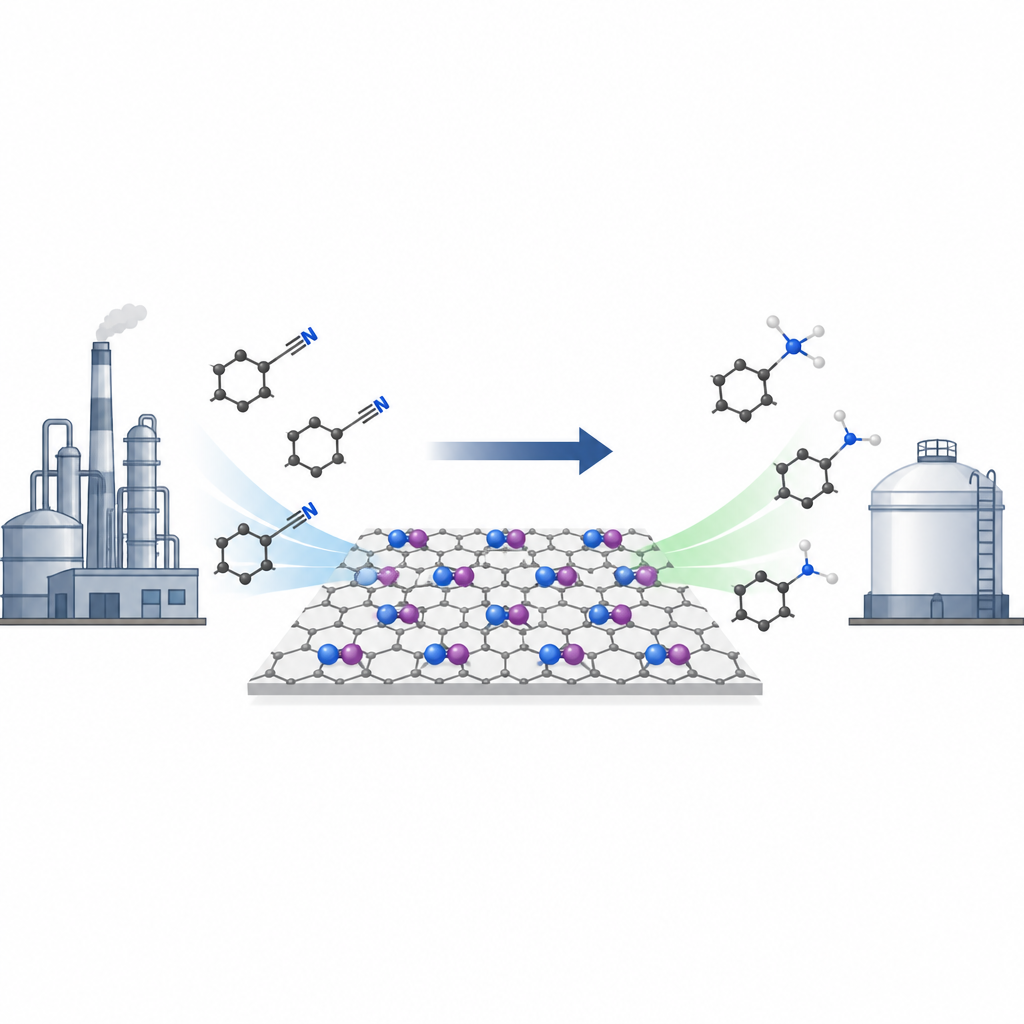
Turning nitriles into secondary amines more efficiently
The team tested their material on benzonitrile, a model compound with an aromatic ring. Under mild conditions in methanol and modest hydrogen pressure, the dual-atom catalyst converted benzonitrile completely within three hours and delivered more than 98 percent of the desired secondary amine, dibenzylamine. Its turnover frequency, a measure of how fast each rhodium atom works, was about one and a half times higher than that of a comparable single-atom rhodium catalyst, while single-atom cobalt alone showed almost no activity. A simple physical mixture of separate rhodium and cobalt single-atom catalysts improved performance slightly but still fell short of the true dual-atom material, underscoring that having the two metals locked together at the atomic scale is crucial. The apparent energy barrier for the key reaction step dropped markedly, and the catalyst could be reused at least twelve times with only modest loss of yield, while its atomic structure remained intact.
How two neighboring atoms share the work
To understand why this pairing is so effective, the researchers combined temperature-programmed desorption, infrared spectroscopy, and computer simulations. Their results show that rhodium is chiefly responsible for splitting hydrogen molecules into reactive hydrogen atoms, whereas cobalt plays the lead role in holding the nitrile through its aromatic ring. On the dual site, the nitrile binds more strongly and in a different geometry than on single-atom sites, with both the ring and the carbon–nitrogen group engaged. Calculations reveal that on a single rhodium atom the first hydrogen addition must occur through a demanding collision between gas-phase hydrogen and an already bound nitrile, giving a relatively high energy barrier. On the Rh–Co pair, the same step has a lower barrier because the shared binding distorts and polarizes the nitrile, making the triple bond easier to hydrogenate, while an adjacent hydrogen atom sits ready on rhodium to participate. This cooperative division of labor between the neighboring atoms speeds the rate-determining step without sacrificing control over the final product.
Broader reach for making useful molecules
Beyond benzonitrile, the dual-atom catalyst efficiently converted a variety of nitriles, including those bearing electron-withdrawing or electron-donating groups and some ring systems containing other elements, into secondary amines in high yields. Although long-chain aliphatic nitriles were less reactive, even simple acetonitrile gave its secondary amine product in high yield. 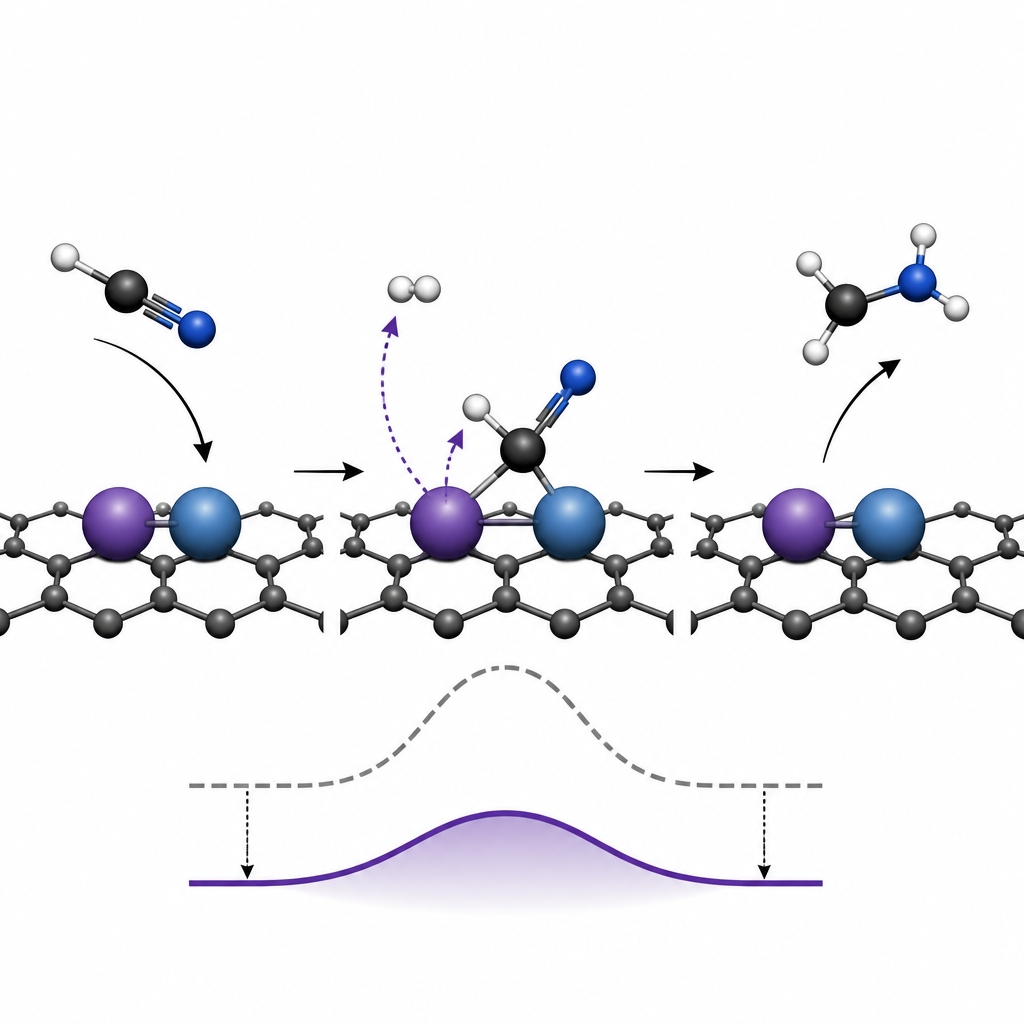
What this means for future chemical manufacturing
In plain terms, this work shows that pairing just two different metal atoms on a carbon surface lets them share tasks in a way that makes a tough reaction both faster and cleaner. Rhodium focuses on activating hydrogen, cobalt helps hold and shape the nitrile, and together they guide the reaction toward the desired secondary amine with very little waste. This simple but powerful idea of cooperative dual-atom sites could guide the design of next-generation catalysts for hydrogenation and other key industrial reactions, offering more sustainable paths to many molecules that underpin modern life.
Citation: Chen, J., Chen, H., Cai, X. et al. Dual-atom Rh-Co catalysts for synergistically boosting nitrile hydrogenation. Nat Commun 17, 4389 (2026). https://doi.org/10.1038/s41467-026-69778-2
Keywords: nitrile hydrogenation, dual-atom catalyst, secondary amines, rhodium cobalt, heterogeneous catalysis