Clear Sky Science · en
Clonal evolutionary analysis reveals patterns of malignant transformation of Intraductal Papillary Mucinous Neoplasms of the pancreas
Why tiny pancreatic cysts matter
Pancreatic cancer is one of the deadliest cancers, largely because it is usually found late. Yet many patients are discovered to have small, fluid-filled cysts in their pancreas called intraductal papillary mucinous neoplasms (IPMNs). These cysts can be seen on scans years before cancer develops, offering a rare window for prevention. The challenge is knowing which cysts will quietly sit there and which will evolve into life-threatening pancreatic ductal adenocarcinoma (PDAC). This study asks a simple but crucial question: how, exactly, do these cysts turn into cancer at the DNA and tissue level?
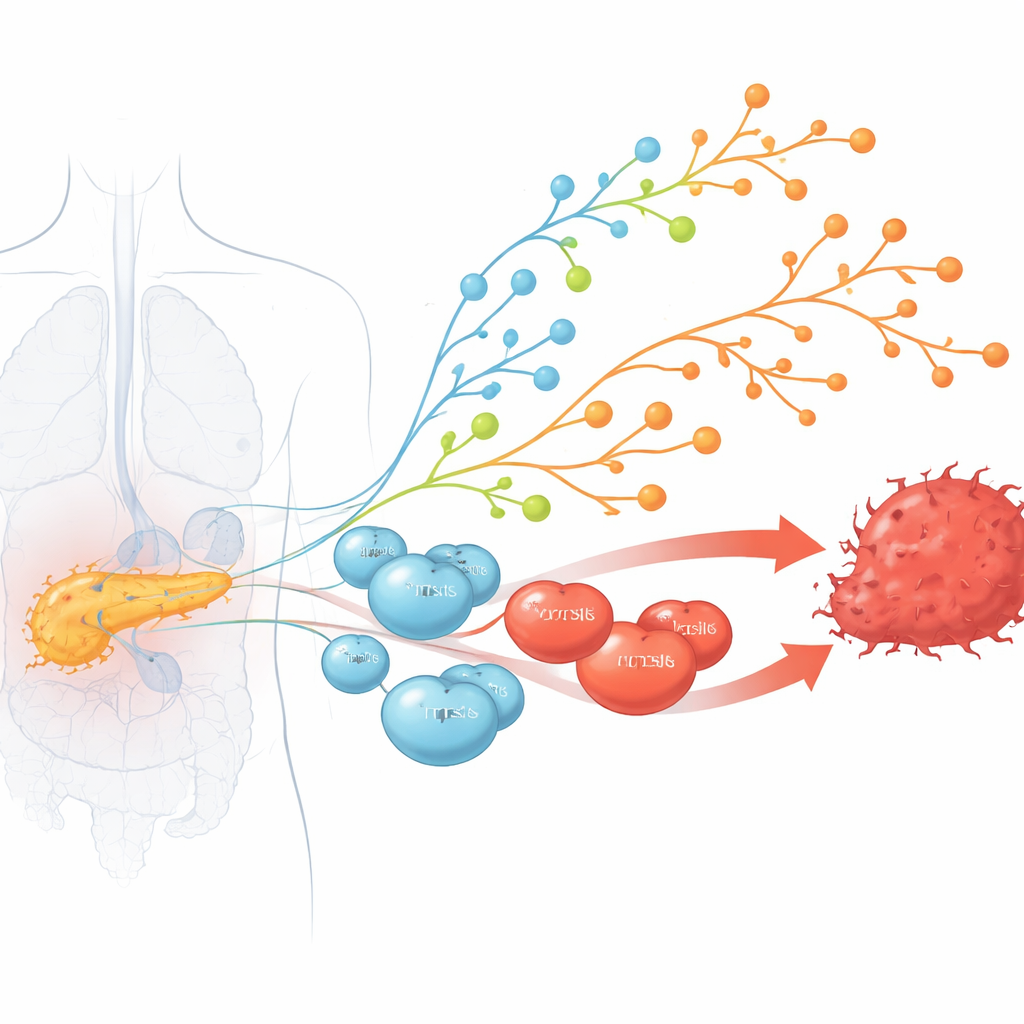
Following the life story of precancerous cysts
The researchers studied IPMNs removed from the pancreas of 12 patients during surgery. Instead of treating each tumor as a single lump, they sampled several regions from each lesion—low-grade areas, high-grade areas, and nearby invasive cancer when present. They then sequenced the entire genome and the activity of thousands of genes (the transcriptome) from 47 tumor samples and matching normal tissue. This allowed them to reconstruct “family trees” of cancer cells, track how DNA damage accumulated over time, and link genetic changes to shifts in cell behavior and the surrounding immune environment.
Two main paths from cyst to cancer
The DNA family trees revealed two broad evolutionary patterns. In most patients, all parts of the lesion traced back to a single founding clone, like a tree with one trunk that later branches. In others, different parts of what looked like a single cyst actually arose from independent starting clones growing side by side, more like a thicket of bushes. Both patterns showed a stepwise build-up of genetic damage: early, shared mutations in genes such as KRAS and GNAS appeared in the trunk, while later changes—including alterations in TP53, LRP1B, and losses of genes like RNF43 and U2AF1—were linked to high-grade precancer and invasive cancer. Importantly, the number and complexity of large-scale DNA rearrangements, known as structural variants and copy-number changes, were much higher in full-blown cancer than in IPMNs, and especially enriched in lesions with more branched, complex evolution.
Hidden mutational forces and DNA instability
By examining the “signatures” of different types of mutations, the team could infer the processes shaping these genomes over time. Age-related wear-and-tear was present throughout, helping to kick-start IPMNs and drive their slow expansion. In some cases, other mutational processes turned on later, including those linked to enzymes that can hyper-mutate DNA, and patterns hinting at chromosome-level instability. Interestingly, certain insertion–deletion patterns usually associated with mismatch repair defects appeared early, even though standard tests showed these tumors did not have classic mismatch repair failure. This suggests alternative, more subtle breakdowns in DNA maintenance may quietly nudge some IPMNs toward more chaotic genomes and higher risk.
Gene activity patterns and the surrounding immune cells
The RNA data showed that IPMNs are not all on the same biological track. The researchers identified two main expression clusters. One cluster had higher overall mutation burden, increased activity of genes linked to a more aggressive “squamous-like” pancreatic cancer subtype, and frequent changes in the gene LRP1B; it also tended to have more killer (CD8+) T cells present. The other cluster looked more like the “classical” pancreatic subtype, often associated with a somewhat better outlook, and showed higher expression of genes like GATA6, HNF4A, KRAS, and GNAS. Comparing precancerous and invasive samples, they found that as lesions progressed to PDAC, the tissue became more dominated by cancer-associated fibroblasts (support cells forming dense scar-like stroma) and lost some of its normal epithelial character, while T cells generally decreased. This shift in the tumor microenvironment tracked with more aggressive molecular features.
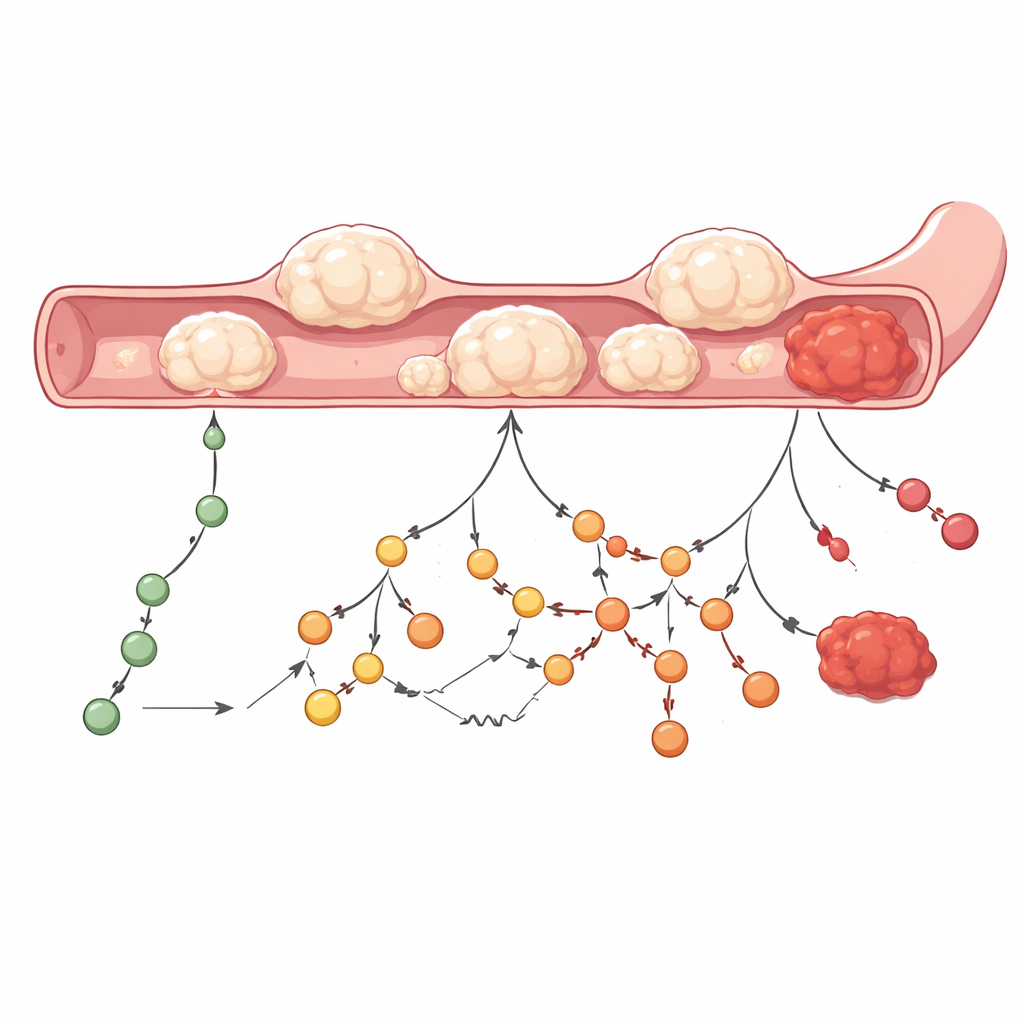
What this means for patients and early detection
Overall, the study shows that IPMNs are often made up of multiple, genetically distinct cell populations that can follow different routes toward—or sometimes away from—cancer. Some lesions grow from a single ancestral clone that gradually acquires dangerous changes, while others contain several independent clones evolving in parallel, each with its own DNA faults and immune footprint. Large structural DNA changes and certain gene expression patterns mark the step from harmless cyst to invasive tumor. For patients, this work underscores why it is so hard to predict risk from imaging alone, and why simple one-mutation tests in cyst fluid may miss the full picture. In the long run, combining whole-genome and RNA-based readouts—possibly adapted to less invasive sampling—could help doctors distinguish low-risk cysts that can be safely watched from high-risk ones that warrant timely surgery, offering a path toward true prevention of pancreatic cancer.
Citation: Pea, A., He, X., Upstill-Goddard, R. et al. Clonal evolutionary analysis reveals patterns of malignant transformation of Intraductal Papillary Mucinous Neoplasms of the pancreas. Nat Commun 17, 3427 (2026). https://doi.org/10.1038/s41467-026-69762-w
Keywords: pancreatic cancer, precancerous cysts, tumor evolution, genomic instability, tumor microenvironment