Clear Sky Science · en
Polyanion-stabilized amorphous halide electrolytes with low lithium content for all-solid-state lithium batteries
Why this new battery material matters
As our lives fill with electric cars, smartphones, and renewable power systems, we need batteries that store more energy, last longer, and are safer. One promising route is all-solid-state lithium batteries, which replace flammable liquid electrolytes with solid materials. But today’s best solid electrolytes often rely on large amounts of lithium, making them expensive and sensitive to moisture in the air. This study introduces a different kind of solid electrolyte that uses much less lithium while keeping fast ion transport and good stability, pointing toward safer and more affordable high‑energy batteries.
Making a fast pathway with less lithium
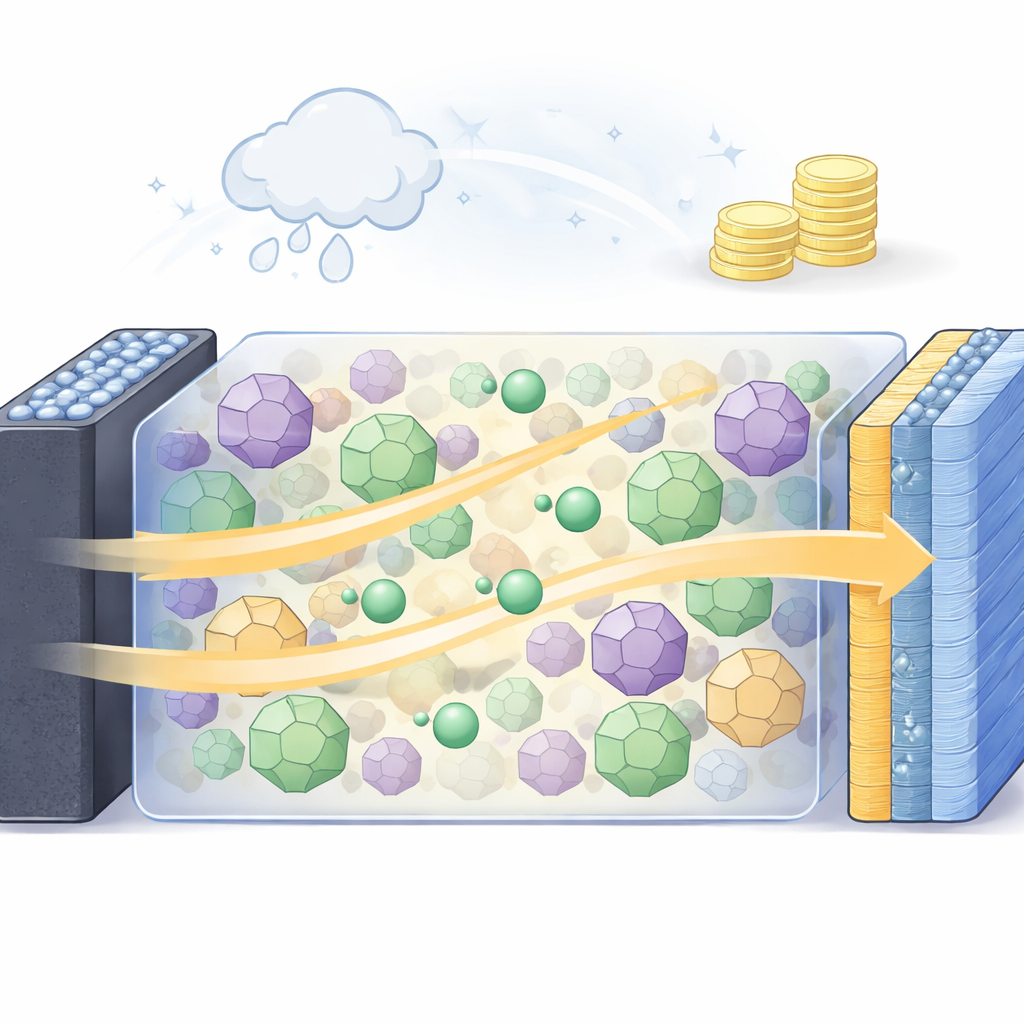
The heart of the work is a new solid electrolyte made from a mixture of lithium sulfate and zirconium chloride, written as 0.5Li2SO4–ZrCl4. Unlike many existing solid electrolytes that pack in lithium, this material contains only 2.4 percent lithium by weight—about half the lithium content of leading halide and sulfide electrolytes. Even so, it conducts lithium ions very quickly: at room temperature, its ionic conductivity reaches 1.5 millisiemens per centimeter, comparable to the best halide conductors that use far more lithium. This is achieved by combining two types of negatively charged building blocks (chloride-based and sulfate-based groups) into a single disordered solid, created simply by ball‑milling common starting powders.
Stable in air and cheaper to make
Using less lithium is not only about saving a scarce element; it also improves how the material behaves in ordinary air. High lithium content usually makes halide electrolytes react quickly with water vapor, forming unwanted by‑products and losing performance. The new 0.5Li2SO4–ZrCl4 material resists this degradation much better than a widely studied reference electrolyte called 2LiCl–ZrCl4. Under moderately humid conditions (about 30 percent relative humidity), the reference material absorbs moisture faster, its structure changes more, and its conductivity drops more sharply. In contrast, the new electrolyte keeps its phase and conductivity relatively stable. Combined with the use of low‑cost raw materials like lithium sulfate and zirconium chloride, this improved air stability makes the material more suitable for large‑scale, factory‑level processing and storage.
A glasslike network that speeds lithium along
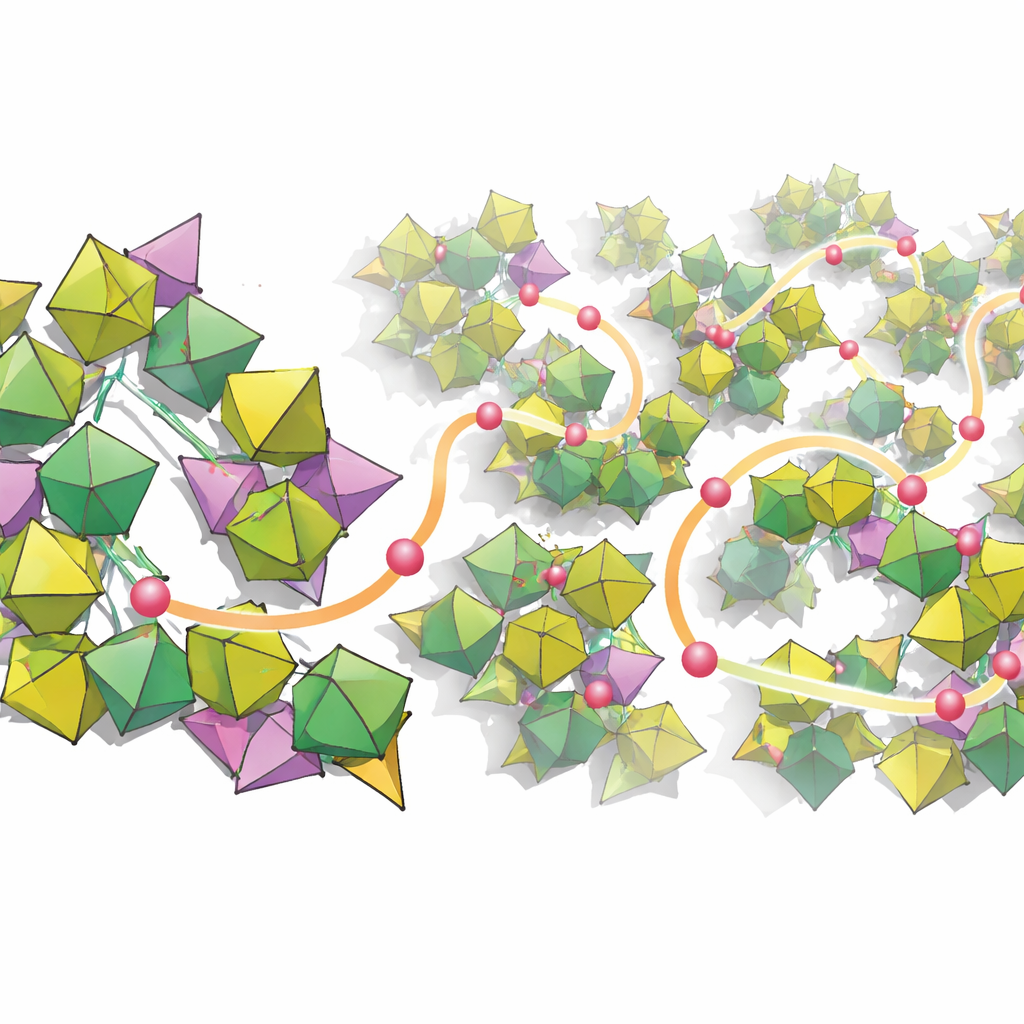
To understand why this low‑lithium material conducts ions so well, the researchers probed its internal structure using advanced neutron and synchrotron X‑ray scattering, Raman spectroscopy, and computer simulations accelerated by machine learning. The data show that 0.5Li2SO4–ZrCl4 is mostly amorphous—more like glass than a regular crystal—built from disordered clusters where zirconium centers are surrounded by a mix of chloride and oxygen from sulfate groups. These clusters link together into a backbone described as [ZraCl4a(SO4)]2− with different local arrangements. Lithium ions occupy irregular sites around this framework, often near oxygen atoms, and move by hopping between positions with low oxygen coordination. Because the surroundings vary from place to place, the energy landscape is “frustrated,” without a repeating pattern, which actually helps form continuous diffusion pathways through the material.
Putting the new electrolyte into real batteries
Good conductivity on its own is not enough; a solid electrolyte must also be soft enough to press into tight contact with electrodes and stable at the high voltages used in advanced cathode materials. Measurements show that the new electrolyte has a relatively low stiffness (a Young’s modulus around 2 gigapascals), similar to other “soft” halide electrolytes and much lower than many oxide or sulfide solids. It can be cold‑pressed into dense pellets, which reduces contact resistance inside a battery. Electrochemical tests reveal that it remains stable up to about 4.4 volts versus lithium, allowing it to pair well with high‑voltage cathodes such as the nickel‑rich NCM811 material used in commercial‑grade cells.
Long‑lasting performance in demanding tests
When assembled into all‑solid‑state cells with an indium–lithium negative side, an intermediate sulfide layer, and an NCM811 positive electrode, the new electrolyte supports both high capacity and impressive cycling life. At moderate loading, cells deliver nearly 210 milliamp‑hours per gram at low current and maintain good capacity as the charge–discharge rate increases. At a one‑hour charge/discharge rate, the cells retain 81.1 percent of their initial capacity even after 1,400 cycles at 30 degrees Celsius, and can continue operating to 2,500 cycles with high efficiency. In thicker, more practical cathodes with about 39 milligrams of active material per square centimeter, cells reach areal capacities above 6 milliamp‑hours per square centimeter and still retain over 80 percent of that capacity after 300 cycles. The electrolyte also tolerates an extended voltage window up to 4.6 volts, broadening its compatibility with future high‑energy designs.
What this means for future batteries
By carefully engineering the arrangement of negative ions into a disordered cluster network, this work shows that high lithium‑ion conductivity does not require packing a material with lithium. The 0.5Li2SO4–ZrCl4 electrolyte combines low lithium content, high conductivity, good air stability, mechanical softness, and high‑voltage tolerance—traits that are rarely achieved together. For non‑specialists, the key message is that controlling the “scaffolding” atoms in a solid, rather than just adding more lithium, can yield safer, longer‑lasting, and potentially cheaper all‑solid‑state batteries suitable for electric vehicles and grid storage.
Citation: Tang, W., Wang, F., Liang, S. et al. Polyanion-stabilized amorphous halide electrolytes with low lithium content for all-solid-state lithium batteries. Nat Commun 17, 3326 (2026). https://doi.org/10.1038/s41467-026-69737-x
Keywords: solid-state lithium batteries, solid electrolytes, lithium halides, battery materials, energy storage