Clear Sky Science · en
B7-H3-mediated cis-inhibition of EGFR by a tumor-selective bispecific antibody enhances anti-tumor efficacy and minimizes toxicities
Why a smarter cancer antibody matters
Many cancers depend on a powerful growth switch on their surface called EGFR. Drugs that shut off this switch can shrink tumors and prolong life, but they often damage healthy skin and gut cells that also rely on EGFR, causing painful rashes and digestive problems. This study describes a new antibody, IBI334, designed to turn off EGFR mostly on tumor cells while sparing normal tissues, potentially offering strong anti-cancer effects with far fewer side effects.
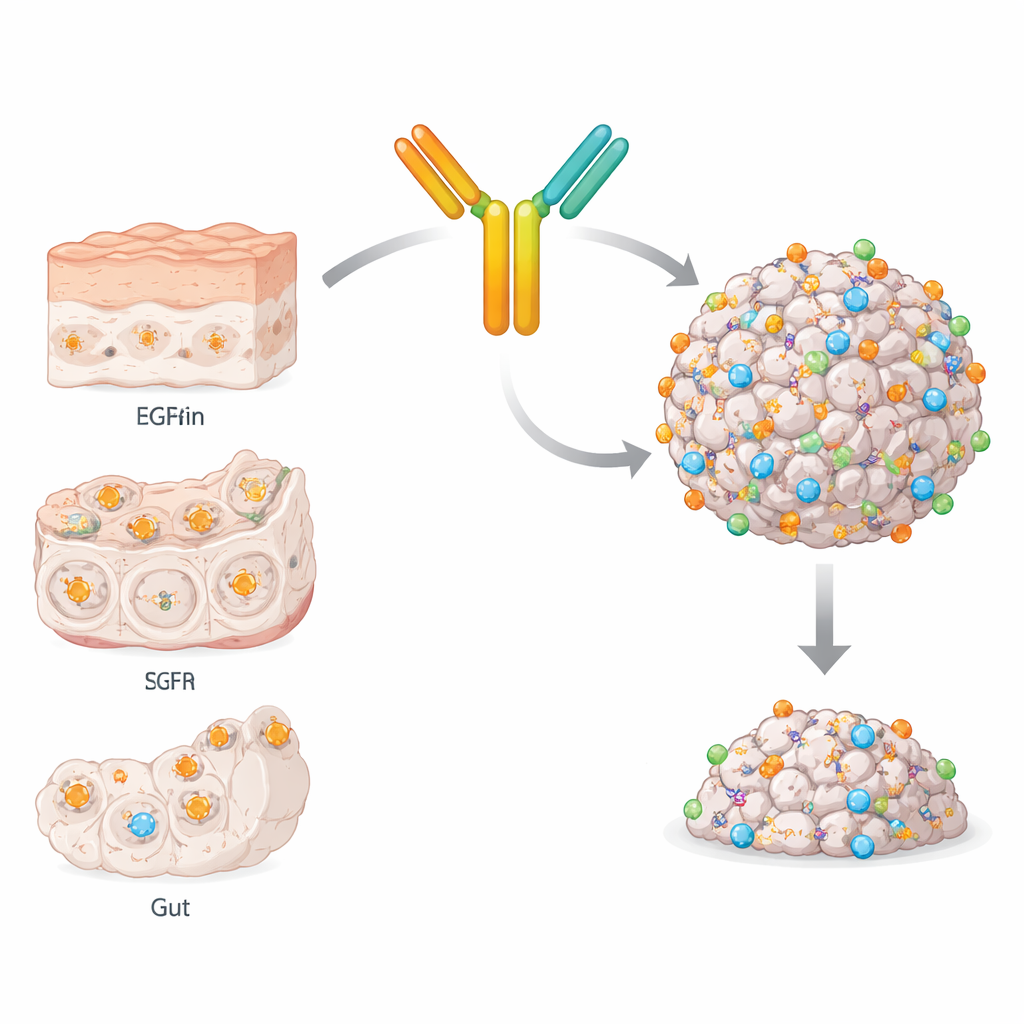
Finding a tumor-only doorway
The researchers began by searching large cancer databases and tumor samples for a marker that appears alongside EGFR in cancers but is rare in healthy organs. They focused on B7-H3, a surface protein that is barely detectable in normal tissues yet strongly increased in many EGFR-positive tumors, including lung, head and neck, pancreatic, and colorectal cancers. Staining of human tumor slices confirmed that tumor cells often carried both EGFR and B7-H3 together, whereas normal skin showed EGFR without B7-H3 and other healthy tissues expressed little of either. This pattern suggested that B7-H3 could act as a “tumor flag” to help guide EGFR-blocking drugs more selectively to cancer cells.
Building a two-key antibody
To exploit this difference, the team engineered a bispecific antibody—one molecule with two distinct arms—that could bind EGFR with one arm and B7-H3 with the other. They combined multiple candidate EGFR and B7-H3 binders and screened dozens of antibody pairs in cancer and normal skin cells. The goal was a molecule that powerfully blocked tumor growth but had weak activity on skin. The winning design, later optimized into IBI334, used a moderate-strength EGFR arm paired with a very high-affinity B7-H3 arm. This “two-key” design means the antibody latches tightly onto B7-H3-rich tumor cells, then locally grabs EGFR on the same cell, but it binds much less efficiently where B7-H3 is scarce, such as in skin.
How the new antibody switches off growth signals
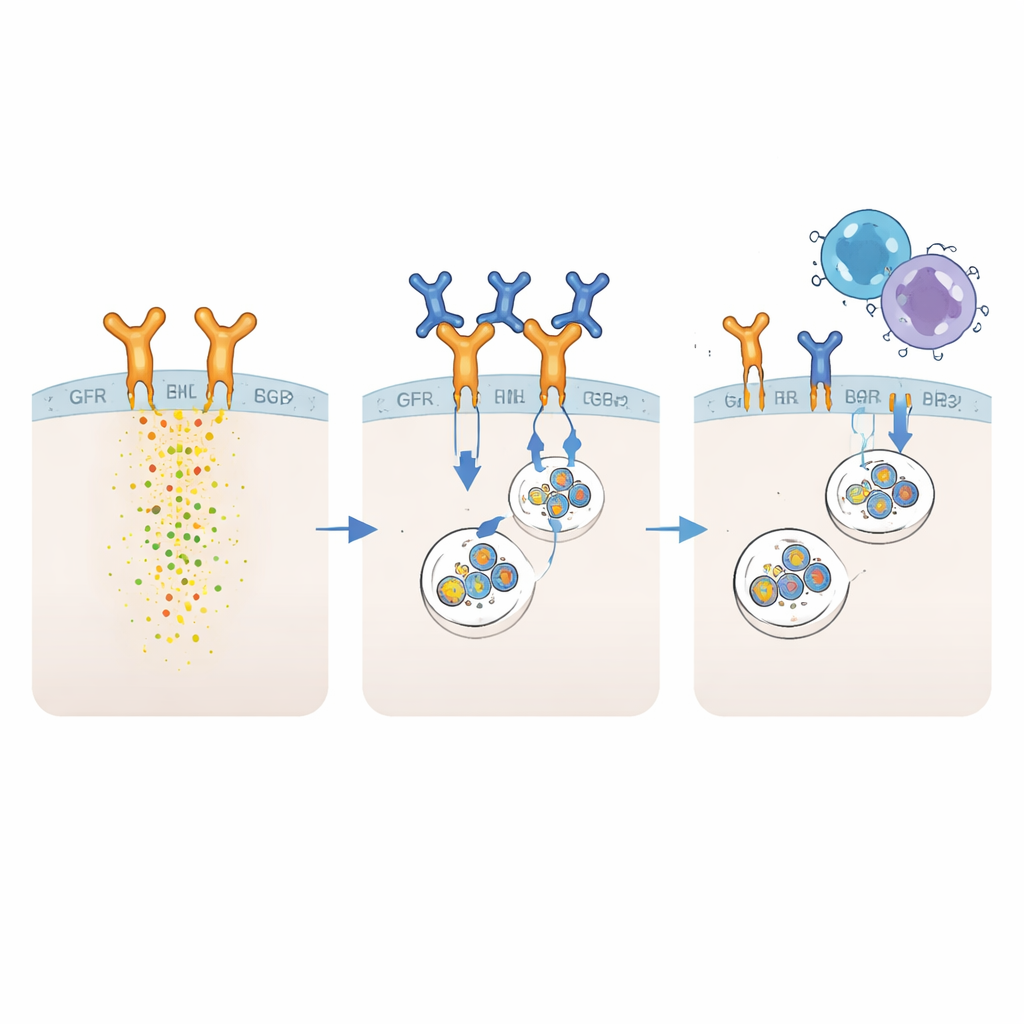
Detailed experiments showed that IBI334 and its prototype (called 20G5/Zalu) do more than simply sit on EGFR. On tumor cells that carry both markers, the antibody occupies EGFR more completely than standard EGFR drugs, blocks incoming growth signals, and speeds the internalization and breakdown of EGFR inside the cell. The authors call this “cis-inhibition,” meaning both antibody arms act on the same cell surface, rather than bridging between neighboring cells. Using structural studies with cryo-electron microscopy, they mapped exactly where the B7-H3 arm binds, identifying key contact points that allow a snug and durable grip on B7-H3 and help position the EGFR arm for efficient blocking. The antibody’s tail was also modified to enhance immune-cell attack, so it can both cut the growth signal and flag tumor cells for destruction.
Performance in tumor models and drug combinations
In a wide range of laboratory and animal models—including lung, head and neck, colorectal, and pancreatic cancers—IBI334 slowed or shrank tumors more effectively than several approved EGFR antibodies and even an EGFR/MET bispecific drug. It remained active in tumors carrying EGFR mutations that resist modern EGFR pills such as Osimertinib. When combined with Osimertinib in a particularly resistant lung cancer model, the duo worked better than either drug alone, strongly suppressing growth signals inside the tumor. IBI334 also synergized with inhibitors of KRAS, another major cancer driver, suggesting it could become a useful partner in combination therapies aimed at shutting down multiple growth pathways at once.
Safety signs from animal studies
Because earlier EGFR drugs can cause serious skin and gut toxicities, the team ran extensive safety tests in non-human primates. Weekly high-dose infusions of IBI334 for four weeks produced no EGFR-like skin or intestinal damage and only mild, reversible changes in certain tissues and blood markers. Drug levels in the blood stayed high enough to support convenient once-weekly or less frequent dosing. In mouse models that are highly sensitive to EGFR-related skin damage, IBI334 caused milder effects than a conventional EGFR antibody at similar doses, supporting the idea that its tumor-selective design widens the safety margin.
What this could mean for patients
Taken together, the results suggest that IBI334 is a next-generation EGFR therapy that concentrates its punch where EGFR and B7-H3 coexist—inside tumors—while easing the collateral damage in healthy organs. By combining precise tumor targeting, strong and durable shutdown of growth signals, immune-cell engagement, and compatibility with other targeted drugs, this bispecific antibody offers a promising path toward more effective and tolerable treatment of EGFR-driven cancers. Encouraged by these findings, the authors have moved IBI334 into an early-stage clinical trial for patients with advanced solid tumors.
Citation: Guan, J., Chia, T., Li, B. et al. B7-H3-mediated cis-inhibition of EGFR by a tumor-selective bispecific antibody enhances anti-tumor efficacy and minimizes toxicities. Nat Commun 17, 3113 (2026). https://doi.org/10.1038/s41467-026-69703-7
Keywords: EGFR-targeted therapy, bispecific antibodies, B7-H3, tumor-selective drugs, drug resistance in cancer