Clear Sky Science · en
PRMT5 in mitochondria regulates mtDNA stability through TFAM arginine methylation
Why tiny powerhouses inside our cells need protection
Mitochondria, often called the powerhouses of the cell, carry their own small loop of DNA that helps keep our energy supply running. Damage to this mitochondrial DNA has been linked to cancer, heart disease, and brain disorders such as Alzheimer’s and Parkinson’s. This study uncovers an unexpected guardian of mitochondrial DNA inside human cells and shows how its failure can destabilize these power stations and push cells toward death. 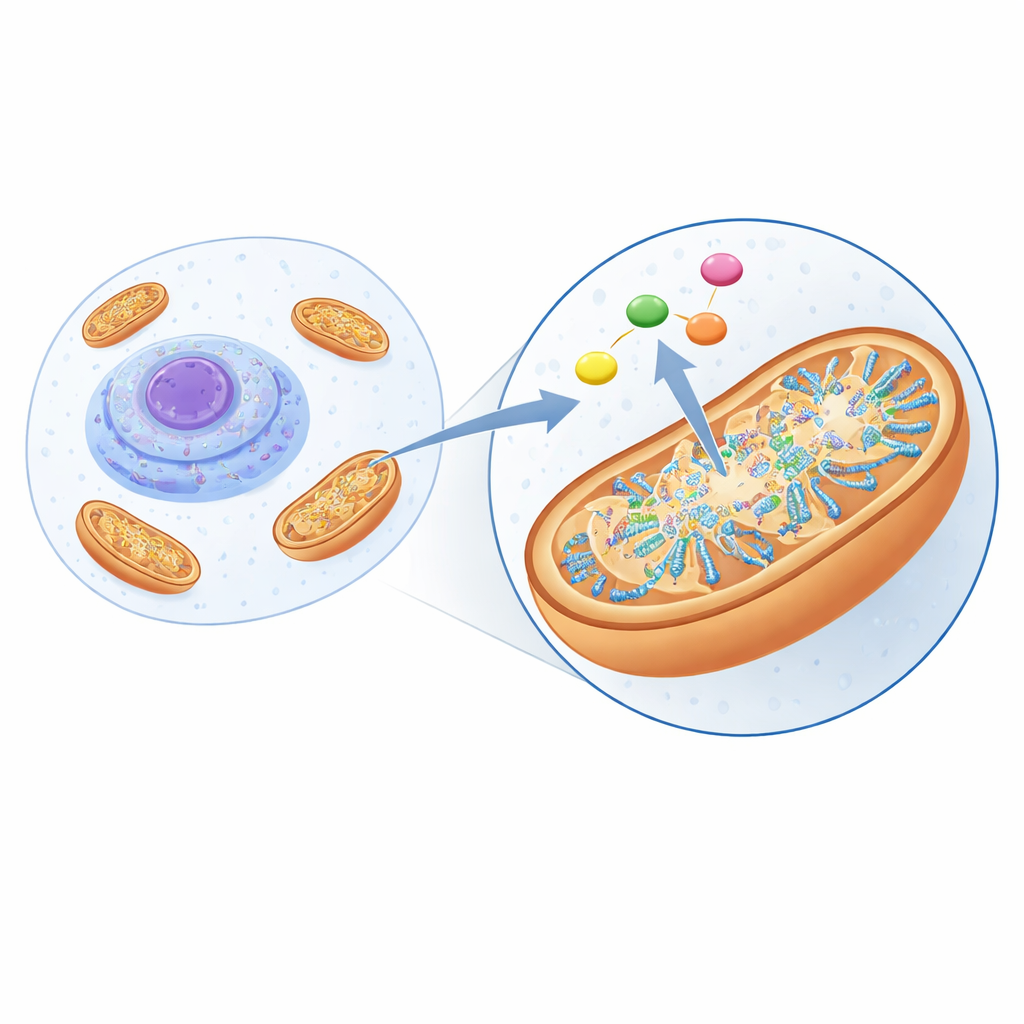
A hidden caretaker moves into mitochondria
The researchers focused on an enzyme called PRMT5, previously known for working in the cell nucleus to modify proteins involved in gene regulation and DNA repair. To their surprise, they found that part of the PRMT5 pool actually travels into the mitochondria and settles in the innermost compartment, the matrix, where mitochondrial DNA resides. Using high-resolution microscopy, cell fractionation, and import assays, they showed that PRMT5 is not just loosely attached to the outside, but truly imported across the mitochondrial membranes in a way that depends on the organelle’s energy state.
When the guardian is gone, mitochondrial DNA suffers
To test what PRMT5 does there, the team knocked out the PRMT5 gene in human breast cancer cells. Without PRMT5, mitochondria contained far fewer DNA “nucleoids” – compact bundles of mitochondrial DNA and proteins – and the total number of mitochondrial DNA copies dropped. These cells were much more vulnerable to agents that damage mitochondrial DNA or interfere with the respiratory chain. Their ability to consume oxygen and produce ATP fell sharply, and they were more likely to undergo cell death. Mitochondria in these cells also became abnormally elongated and hyperfused, indicating that the normal fission–fusion balance that distributes and renews mitochondrial DNA had been disturbed. 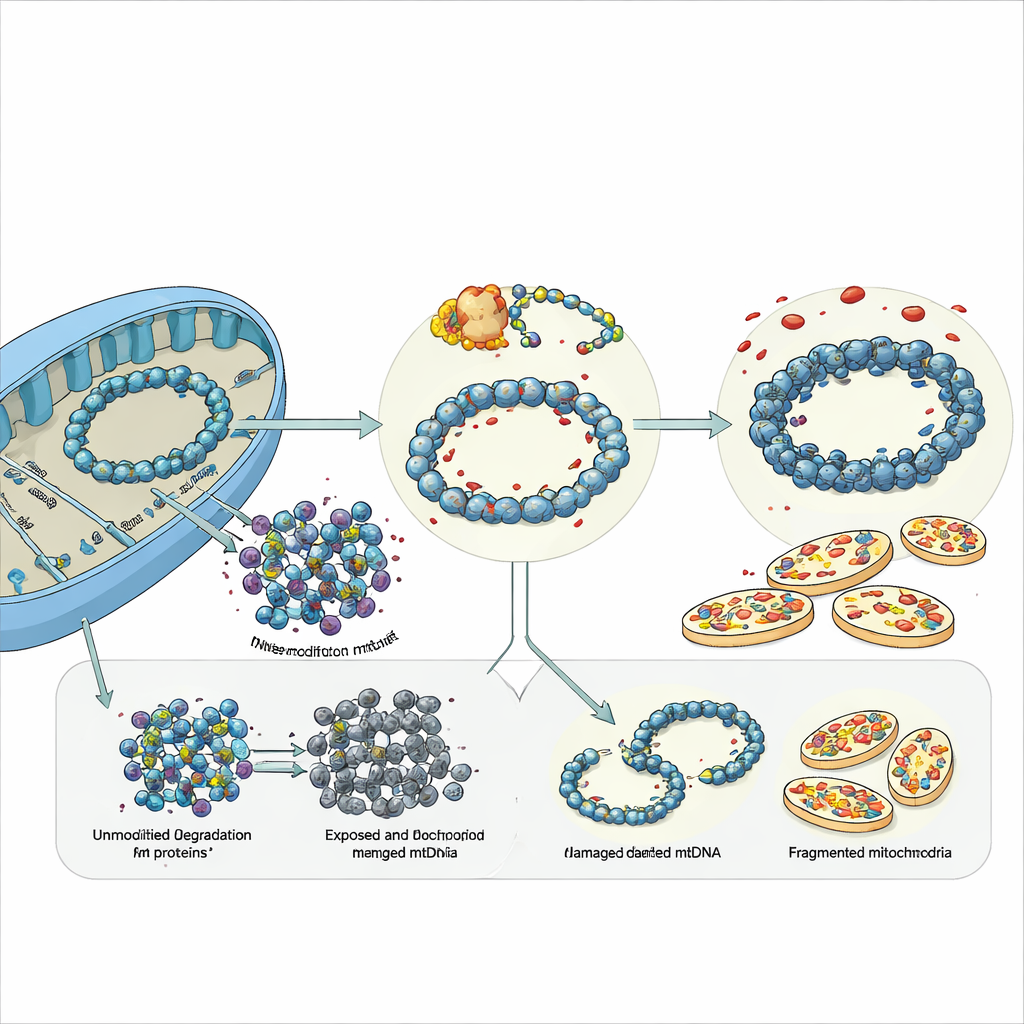
A key partnership with a DNA-packaging protein
Digging deeper, the scientists searched for mitochondrial partners of PRMT5 and identified TFAM, a protein that wraps and packages mitochondrial DNA and helps start transcription. PRMT5 physically bound to TFAM inside mitochondria and chemically modified it at a specific amino acid, an arginine at position 82. This subtle chemical mark made TFAM bind more strongly and broadly to mitochondrial DNA, improving compaction and promoter binding. When TFAM lacked this modification (because the arginine was mutated or PRMT5 was missing), it clung less well to DNA, leaving stretches of the mitochondrial genome exposed and less able to drive gene expression.
Keeping TFAM on the job and out of the shredder
TFAM’s stability turns out to depend on its relationship with mitochondrial DNA. When it is not bound tightly, another mitochondrial enzyme, the LonP1 protease, recognizes and degrades it. The study shows that unmodified TFAM is degraded faster, while the PRMT5-produced mark at arginine 82 protects TFAM from LonP1. In cells that either lack TFAM altogether or carry only the unmodifiable version, mitochondrial DNA breaks accumulate more quickly after damage and are repaired more slowly. These cells show reduced mitochondrial transcripts, weaker respiration, greater fragmentation of their mitochondrial network under stress, and heightened sensitivity to toxic insults.
What this means for health and disease
Taken together, the work reveals a new mitochondrial stress-response axis: PRMT5 enters mitochondria, chemically marks TFAM, and thereby tightens TFAM’s grip on mitochondrial DNA while shielding it from destruction. This modification stabilizes mitochondrial DNA copy number, maintains healthy fission–fusion dynamics, and supports efficient energy production. Because drugs that inhibit PRMT5 are being explored as cancer therapies, and mitochondrial DNA damage is implicated in neurodegeneration, understanding this pathway may help fine-tune such treatments – either to push cancer cells over the edge by weakening their mitochondria or to bolster mitochondrial resilience in vulnerable tissues like the brain.
Citation: Bhattacharjee, S., Das, S., Chowdhury, B. et al. PRMT5 in mitochondria regulates mtDNA stability through TFAM arginine methylation. Nat Commun 17, 3078 (2026). https://doi.org/10.1038/s41467-026-69676-7
Keywords: mitochondrial DNA, PRMT5, TFAM, mitochondrial dynamics, arginine methylation