Clear Sky Science · en
A phosphorylation-dependent ubiquitination switch orchestrates nuclear immune reprogramming upon chitin perception
How rice fights a devastating crop disease
Rice farmers around the world battle blast disease, a fungal infection that can wipe out fields and threaten food security. This study uncovers how rice plants use a tiny fragment of the fungal cell wall, called chitin, as an alarm signal and then flip an internal molecular switch to turn on powerful defenses in the cell nucleus. Understanding this switch not only explains a long-missing step in plant immunity but could guide breeding or engineering of hardier rice varieties.

A surface alarm travels deep inside the cell
Plants cannot run from infection, so they rely on built-in sensors on the surface of their cells. In rice, one such sensor detects chitin, a key component of the blast fungus shell. Earlier work showed that once chitin is sensed at the cell surface, a helper enzyme called OsRLCK185 relays the signal and helps trigger early defense reactions like bursts of reactive oxygen molecules. What remained mysterious was how this early signal reaches the nucleus, where genes controlling long-term immunity are switched on or off. This paper fills that gap by tracing a direct route from the chitin sensor through OsRLCK185 to key regulators that reshape nuclear gene activity.
Helpful guardians and a destructive tag
The authors focus on two closely related proteins, OsGF14f and OsGF14c, members of the 14-3-3 family that often act as molecular “escorts” or stabilizers. By knocking out or overproducing these proteins in rice, they show that both OsGF14f and OsGF14c make plants more resistant to blast fungus: plants lacking them have larger disease spots and more fungal growth, while plants with extra copies are better protected. However, the cell also carries a built-in brake: an enzyme called OsPUB20 that attaches small molecular tags (ubiquitin) to OsGF14f and OsGF14c. This tagging marks them for destruction by the cell’s protein-shredding machinery, weakening the plant’s defenses. A related enzyme, OsPUB19, plays a similar negative role, and plants missing both become especially resistant as their protective 14-3-3 proteins accumulate.
A phosphorylation switch that spares a key defender
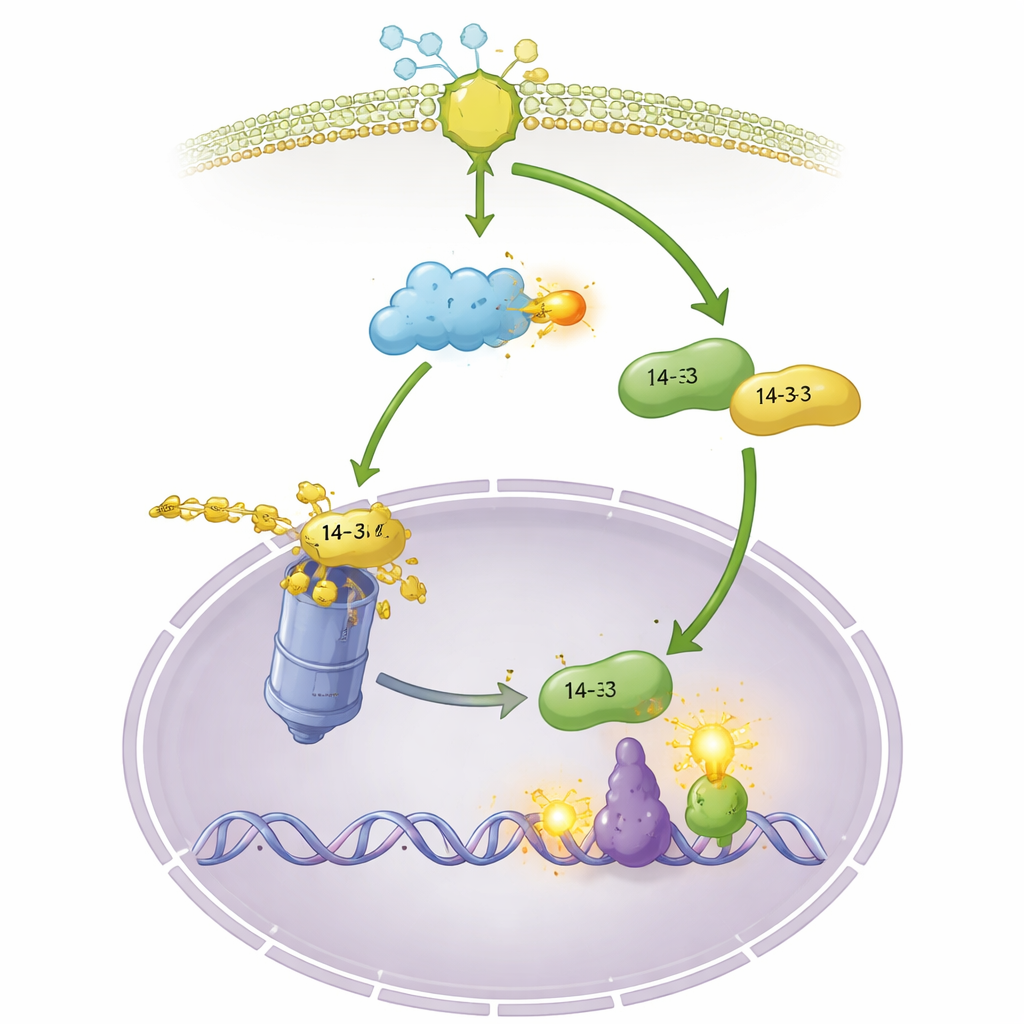
Chitin perception does more than just start an alarm; it reshapes how OsPUB20 behaves. The team shows that OsRLCK185 physically binds to OsPUB20 and adds a small phosphate group at a single position (the amino acid threonine 153). This chemical change does not turn OsPUB20 off entirely, but it weakens its grip specifically on OsGF14f. As a result, OsGF14f is less heavily tagged with ubiquitin and escapes destruction, while OsGF14c remains more vulnerable. Plants engineered to carry a version of OsPUB20 that mimics permanent phosphorylation protect OsGF14f and show stronger blast resistance, whereas plants with a non‑phosphorylatable version lose more OsGF14f and become more susceptible. In this way, OsRLCK185 acts as a fine-tuning switch that selectively safeguards one of the plant’s most important defenders.
From the cell fluid to the control center
Stabilizing OsGF14f is only part of the story. The authors find that, after chitin treatment or fungal infection, OsGF14f moves from the cell fluid into the nucleus, while OsGF14c mostly stays outside. Forcing OsGF14f into the nucleus makes plants even more resistant, underscoring how crucial this relocation is. Inside the nucleus, OsGF14f binds to a transcription factor called OsWRKY42, which normally acts as a brake on defense by damping down hormone-related genes. OsGF14f promotes the breakdown of OsWRKY42 via the same protein-degradation machinery, lifting this brake. Plants lacking OsWRKY42 are more resistant, and plants rich in OsGF14f show higher activity of defense genes tied to both jasmonic acid and salicylic acid, two key immune hormones. Thus, OsGF14f serves as a shuttle that connects the cytoplasmic alarm to nuclear reprogramming of defense genes.
Why this molecular circuit matters
Taken together, the work reveals a layered defense circuit in rice. When chitin from the blast fungus is detected at the cell surface, OsRLCK185 modifies OsPUB20, weakening its ability to destroy OsGF14f. The spared OsGF14f then accumulates and travels into the nucleus, where it helps remove the repressor OsWRKY42 and frees important defense pathways to act. This phosphorylation‑dependent “ubiquitination switch” elegantly connects an outside danger signal to deep changes in gene activity, helping the plant pivot from normal growth to heightened protection. By mapping this pathway, the study highlights promising targets for breeding or engineering rice varieties that can better withstand blast disease with fewer chemicals.
Citation: Zhang, C., Suttiviriya, P., Wang, R. et al. A phosphorylation-dependent ubiquitination switch orchestrates nuclear immune reprogramming upon chitin perception. Nat Commun 17, 2998 (2026). https://doi.org/10.1038/s41467-026-69627-2
Keywords: rice blast disease, plant immunity, protein degradation, signal transduction, crop protection