Clear Sky Science · en
Space ionizing radiation triggers the formation of peptides and organophosphates on olivine surfaces
Building Life’s Pieces in the Harshness of Space
When we imagine the origins of life, we usually look down at oceans and hot springs on early Earth, not up into space. Yet meteorites and asteroid samples show that space is full of life’s basic ingredients, from amino acids to simple sugars. This study asks a bold question: can some of life’s next‑level molecules actually be built in space itself, using nothing more than mineral dust and the steady drizzle of cosmic radiation? The answer, tested aboard the Chinese Space Station, is yes.
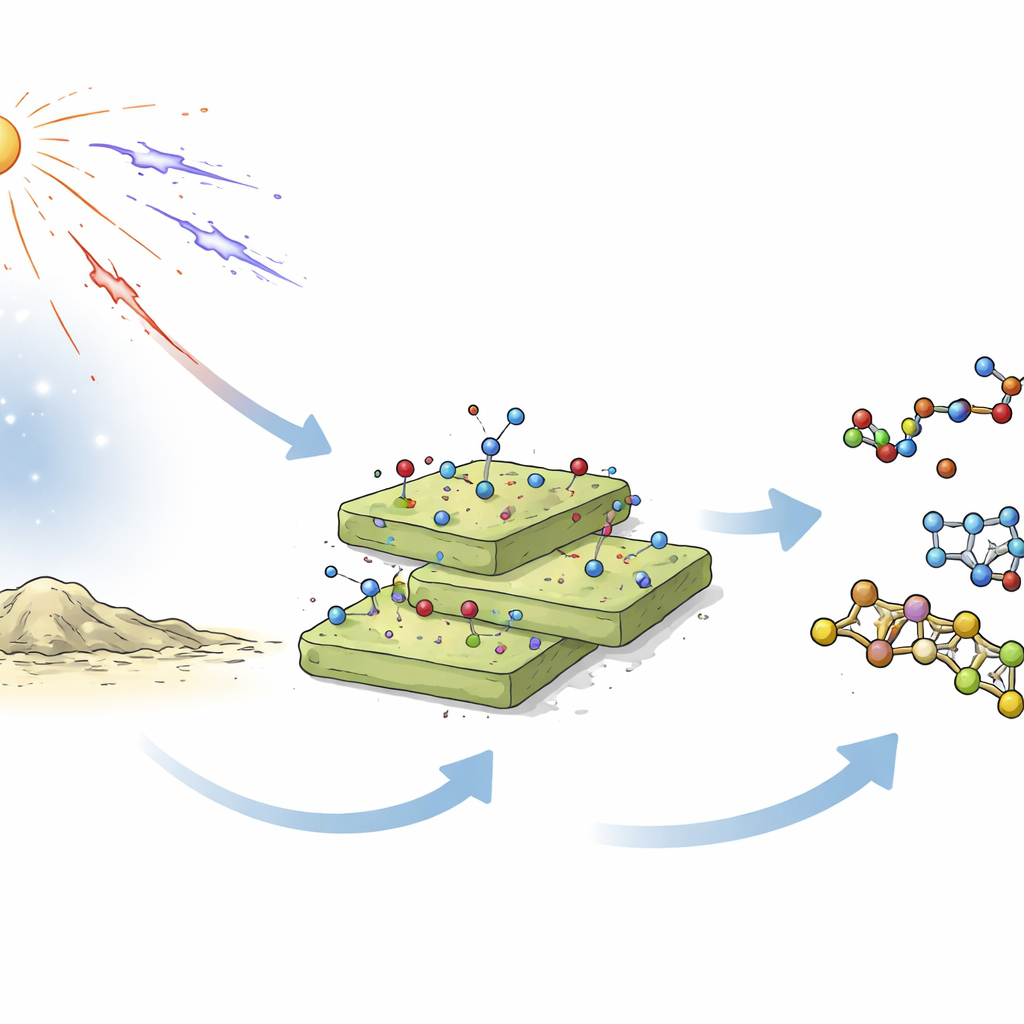
Space Dust as a Hidden Workshop
The researchers focused on forsterite, an iron‑magnesium silicate that is a common form of the mineral olivine, found in meteorites, Martian and lunar dust, and interstellar grains. They coated tiny grains of this mineral with solutions containing simple organic building blocks: several amino acids (the subunits of proteins) and nucleosides (the subunits of RNA and DNA). After removing the water by freeze‑drying, they attached these mineral–organic mixtures to an exposure facility mounted outside the Chinese Space Station, where they were bombarded for months with low doses of ionizing radiation similar to the background found in space.
From Simple Molecules to Tiny Chains
Once the samples returned to Earth, the team used high‑precision chemical analysis to see what had changed. They found that the combination of forsterite and long‑term, low‑dose space radiation had stitched amino acids together into dipeptides—tiny chains of two amino acids linked by the same kind of bond found in proteins. These products did not appear without radiation, and they were much rarer when minerals were absent or when the samples were only blasted briefly with high doses in ground‑based controls. Forsterite not only helped protect the fragile organics from being destroyed; it also acted like a catalyst, boosting how many and which types of dipeptides formed, with some yields rising more than forty‑fold when a phosphorus‑rich additive was present.
Charging Up Life’s Energy Carriers
Life depends not just on chains of amino acids, but also on molecules that carry energy and store genetic information. To probe this side, the scientists added sodium trimetaphosphate, a reactive phosphorus compound, and nucleosides to their mineral‑coated samples. Under space radiation, this combination produced nucleotides—nucleosides with phosphate groups attached—that closely resemble the building blocks of RNA and key energy molecules like ATP. One product, a form of adenosine monophosphate (AMP), was especially abundant and showed a strong preference for the same attachment position favored in modern biology. These nucleotides could form even without minerals, but forsterite greatly increased their amount and helped them survive months of radiation exposure.
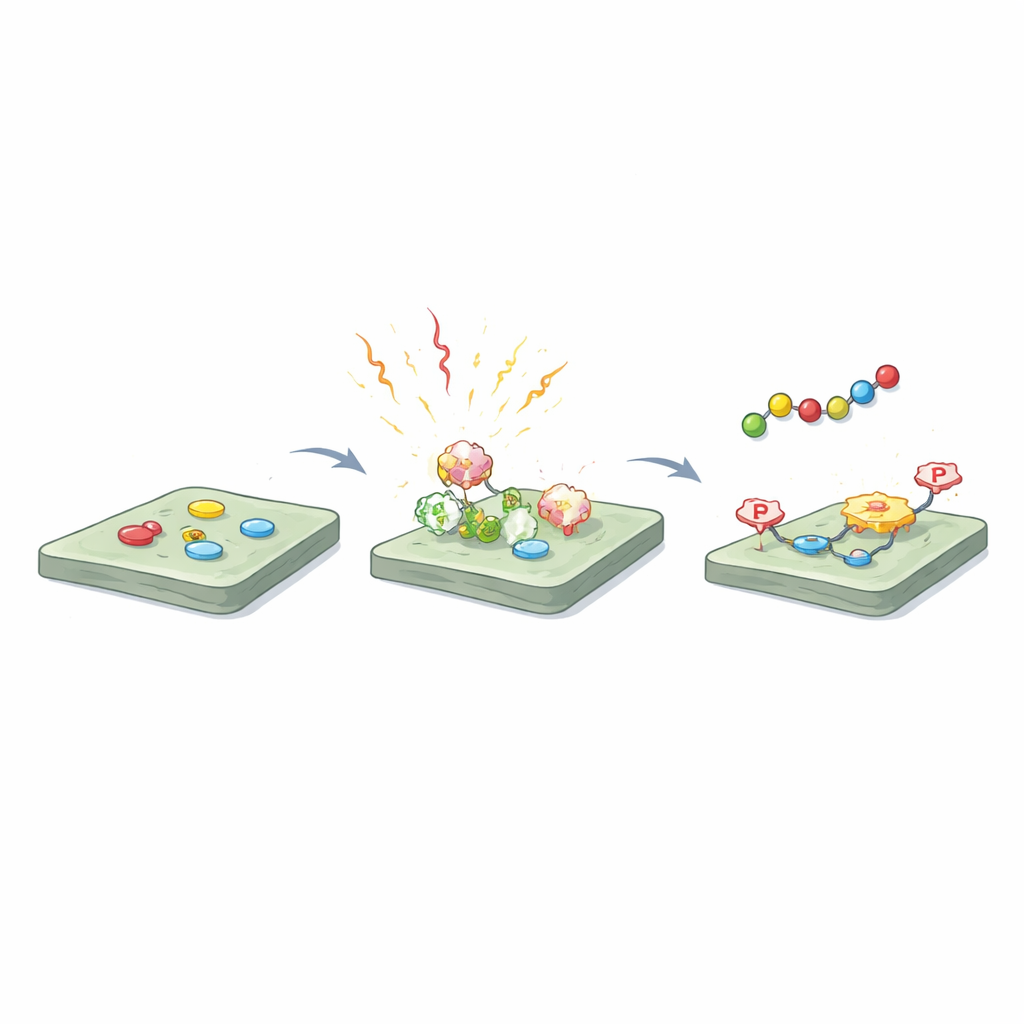
Linking Energy Chemistry to Tiny Peptides
In living cells, special enzymes activate amino acids by temporarily joining them to ATP in a high‑energy intermediate before building proteins. Remarkably, the space‑exposed mineral samples formed close chemical cousins of these intermediates without any enzymes or liquid water. The study detected amino acid–nucleotide hybrids that mirror the structures biology uses to connect genetic information with peptide formation. Ground‑based experiments and mechanism tests suggested that the mineral’s magnesium ions, its slightly alkaline surface, and the electric attraction between charged groups all work together, while radiation supplies the energy needed to rearrange bonds rather than simply blasting molecules apart.
New Places to Look for Life’s Beginnings
These findings suggest that regions rich in olivine‑like minerals, shielded somewhat from extreme radiation yet still exposed to a steady low‑dose flux, could be natural micro‑factories for prebiotic chemistry. Instead of space merely delivering simple molecules to young planets, it may also partially assemble more advanced components—short peptides, nucleotides, and amino acid–nucleotide hybrids—before they ever land. For a non‑specialist, the key message is that life’s chemistry does not require gentle laboratory conditions: ordinary space dust, trace phosphorus minerals, and weak but persistent cosmic radiation may together push simple ingredients a surprising distance along the path toward biology.
Citation: Ding, R., Qiu, S., Guo, X. et al. Space ionizing radiation triggers the formation of peptides and organophosphates on olivine surfaces. Nat Commun 17, 3210 (2026). https://doi.org/10.1038/s41467-026-69575-x
Keywords: prebiotic chemistry, space radiation, olivine minerals, peptide formation, origin of life