Clear Sky Science · en
Spatiotemporally controlled restoration of GAS6 signaling via mRNA therapy promotes scarless healing in preclinical models
Why Better Healing Matters
Deep cuts, burns, and surgical wounds on adult skin often leave behind thick, stiff scars that can hurt, limit movement, and last a lifetime. Current treatments—steroid injections, surgery, or growth-factor creams—help only some people and scarring often returns. This study explores a new way to coax injured skin to heal more like a baby’s, closing quickly while leaving little trace behind. By combining a gene-based medicine with a smart gel, the researchers aim to calm harmful inflammation at just the right place and time, allowing skin to rebuild itself with minimal scarring.
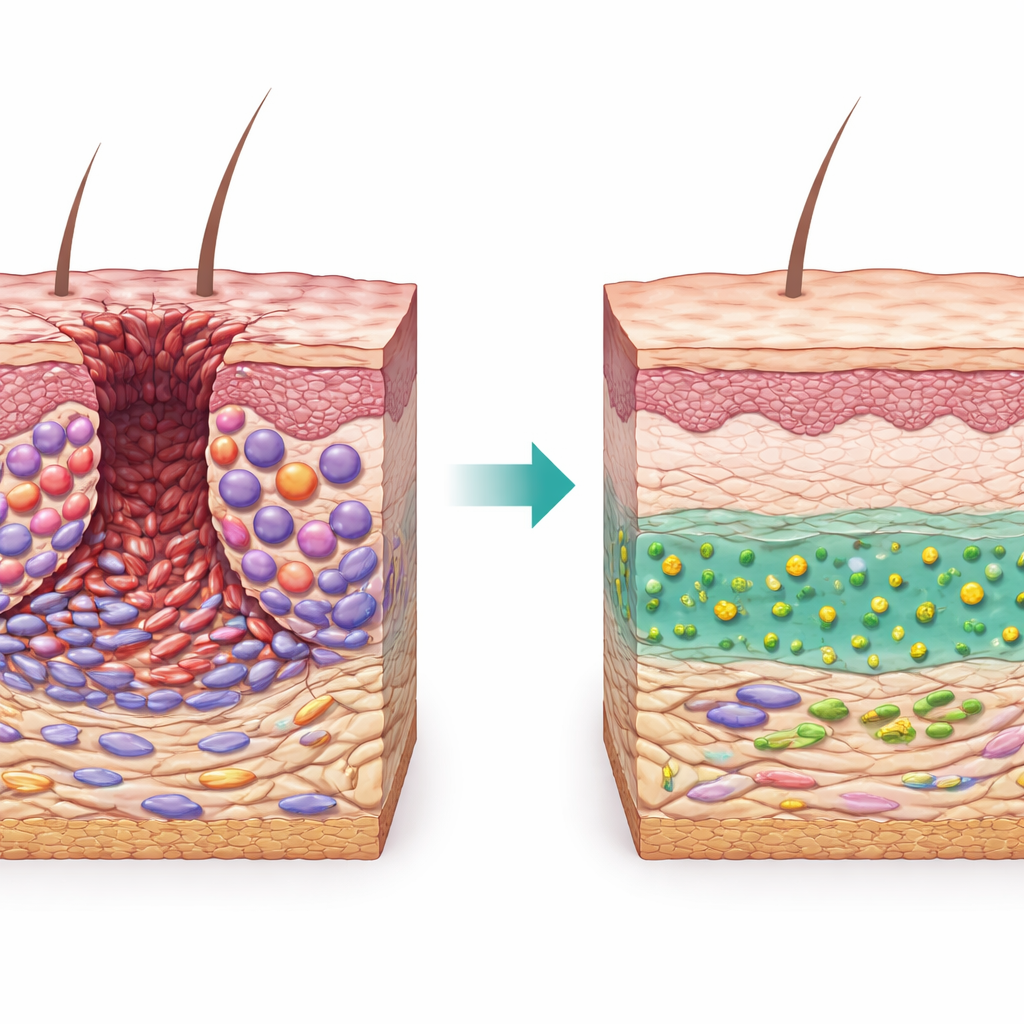
When Good Healing Goes Wrong
Normal wound healing is a balancing act between cleaning up damage and rebuilding tissue. In deep skin injuries, this balance often tilts toward long-lasting inflammation. Certain connective-tissue cells, called fibroblasts, can become “inflamed” and pump out signals that call in waves of immune cells. While initially helpful, this prolonged activity leads to dense, rope-like scar tissue instead of flexible skin. The team focused on a signaling protein called GAS6, which helps immune cells clear away dead cells and cool down inflammation in other organs. By analyzing human scars, healing wounds, mouse models, and cell cultures, they found that GAS6 levels consistently drop after skin injury, especially in key players like macrophages (immune cells) and fibroblasts. Blocking GAS6 in mice made wounds heal more slowly, with wider scars, more dead cells left behind, and stronger inflammatory signals—clear signs that lack of GAS6 pushes healing toward fibrosis.
A Gene Message Packed in Tiny Carriers
Instead of giving GAS6 protein directly, the researchers turned to messenger RNA (mRNA)—the same kind of temporary genetic code used in recent vaccines. They chemically synthesized mRNA that instructs cells to make GAS6, then wrapped these fragile strands inside tiny fat bubbles called lipid nanoparticles. Lab tests showed that these particles are uniform, stable, and efficiently deliver their mRNA cargo into macrophages and fibroblasts, prompting both cell types to produce extra GAS6 for several days without harming them. In dishes, macrophages with boosted GAS6 shifted into a more soothing, “cleanup” state. They more actively engulfed dying cells and released anti-inflammatory signals that, in turn, dialed down the inflammatory behavior of nearby fibroblasts. Interestingly, directly treating fibroblasts with the mRNA had little effect—the benefits came mainly through reprogrammed macrophages.
A Smart Gel That Knows Where and When to Act
Delivering this therapy into real wounds posed another challenge: the injured skin environment is wet, mobile, and constantly changing. A simple injection of nanoparticles would quickly diffuse and lose effect. To solve this, the scientists embedded the mRNA-loaded nanoparticles into a special gel made from a biodegradable polymer. This material is liquid when cool but turns into a soft solid at body temperature. When applied to a fresh wound, it quickly gels in place, anchoring the nanoparticles within the deep layer of the skin where troublesome fibroblasts reside. As enzymes in the wound slowly break down the gel over several days, the nanoparticles are steadily released and taken up by nearby cells. Tests in mice confirmed that this setup keeps mRNA expression tightly localized to the wound and timed to match the early inflammatory phase, when steering the healing response is most effective.
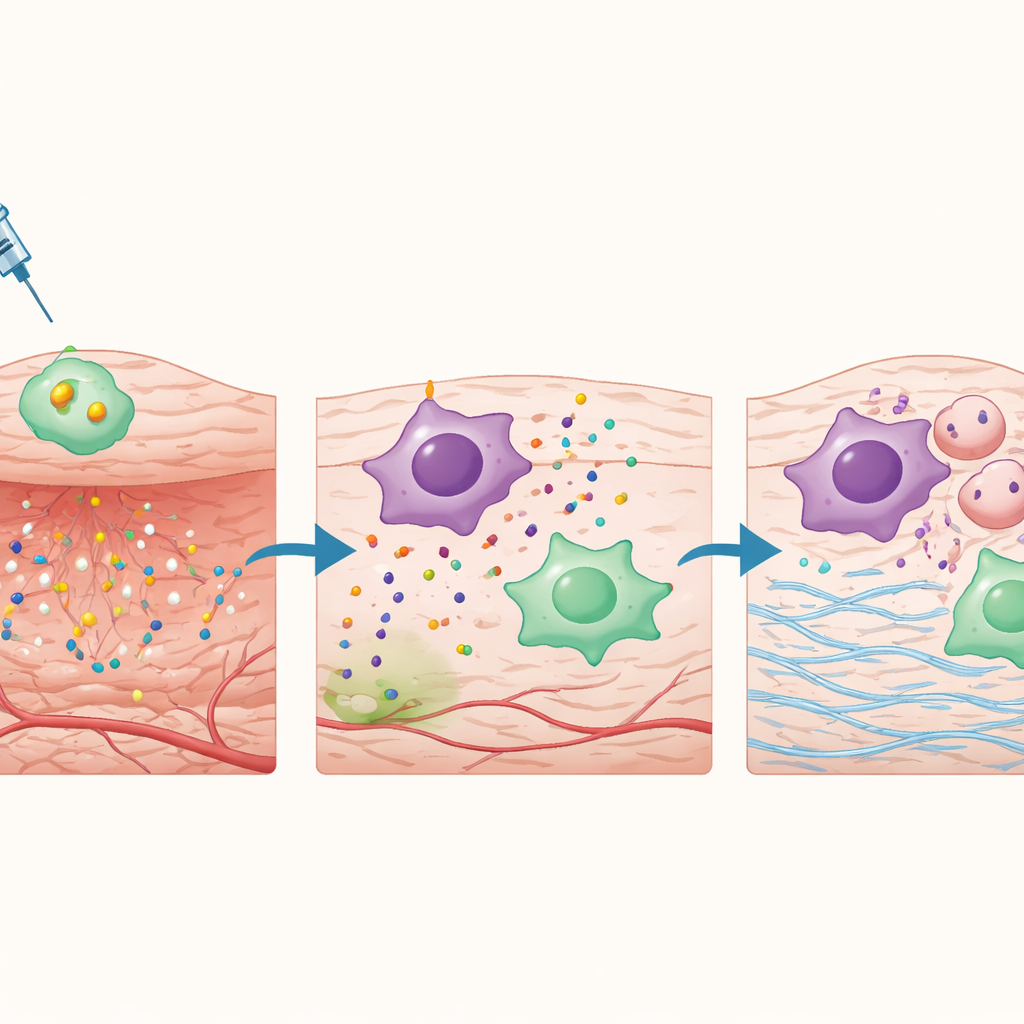
From Mice to Rabbits to Pigs
Armed with this smart delivery system, the team treated full-thickness wounds in mice, rabbits, and Bama minipigs—animals whose skin structure and scarring patterns increasingly resemble human skin. In mice, a single dose of the GAS6 mRNA gel sped up wound closure and, a month later, left scars that were dramatically narrower and more skin-like, with collagen fibers arranged in a loose, basket-weave pattern rather than in tight bands. Compared to GAS6 protein alone, the mRNA gel produced longer-lasting benefits, likely because it sustained local GAS6 production during the crucial early days. The treatment also reduced the buildup of dead cells and dampened inflammatory signals in the deeper dermis. In a rabbit ear model that reliably forms raised, hypertrophic scars, the treated wounds healed flatter and showed more normal collagen organization. Finally, in minipigs, the GAS6 mRNA gel shrank scar areas by more than half and outperformed a clinically used epidermal growth factor gel, while maintaining normal organ health and blood markers.
What This Could Mean for Future Care
Together, these findings suggest that restoring GAS6 at the right time and place helps immune cells clear damage more efficiently and prevents fibroblasts from getting stuck in a pro-scarring mode. By targeting the upstream conversation between immune cells and structural cells, rather than only blocking individual scarring molecules later, this approach appears to nudge the entire healing program toward regeneration instead of fibrosis. Although more work is needed before use in people, the study offers a blueprint for locally delivering mRNA medicines to reshape wound healing—and possibly other fibrotic diseases—so that serious skin injuries might someday heal with little or no visible scar.
Citation: He, Y., Ye, K., Zhang, Y. et al. Spatiotemporally controlled restoration of GAS6 signaling via mRNA therapy promotes scarless healing in preclinical models. Nat Commun 17, 3171 (2026). https://doi.org/10.1038/s41467-026-69540-8
Keywords: scarless wound healing, mRNA therapy, lipid nanoparticles, macrophage fibrosis crosstalk, hydrogel drug delivery