Clear Sky Science · en
Endemism and regionalization patterns of squamate reptiles in Amazonia
Why these hidden reptiles matter
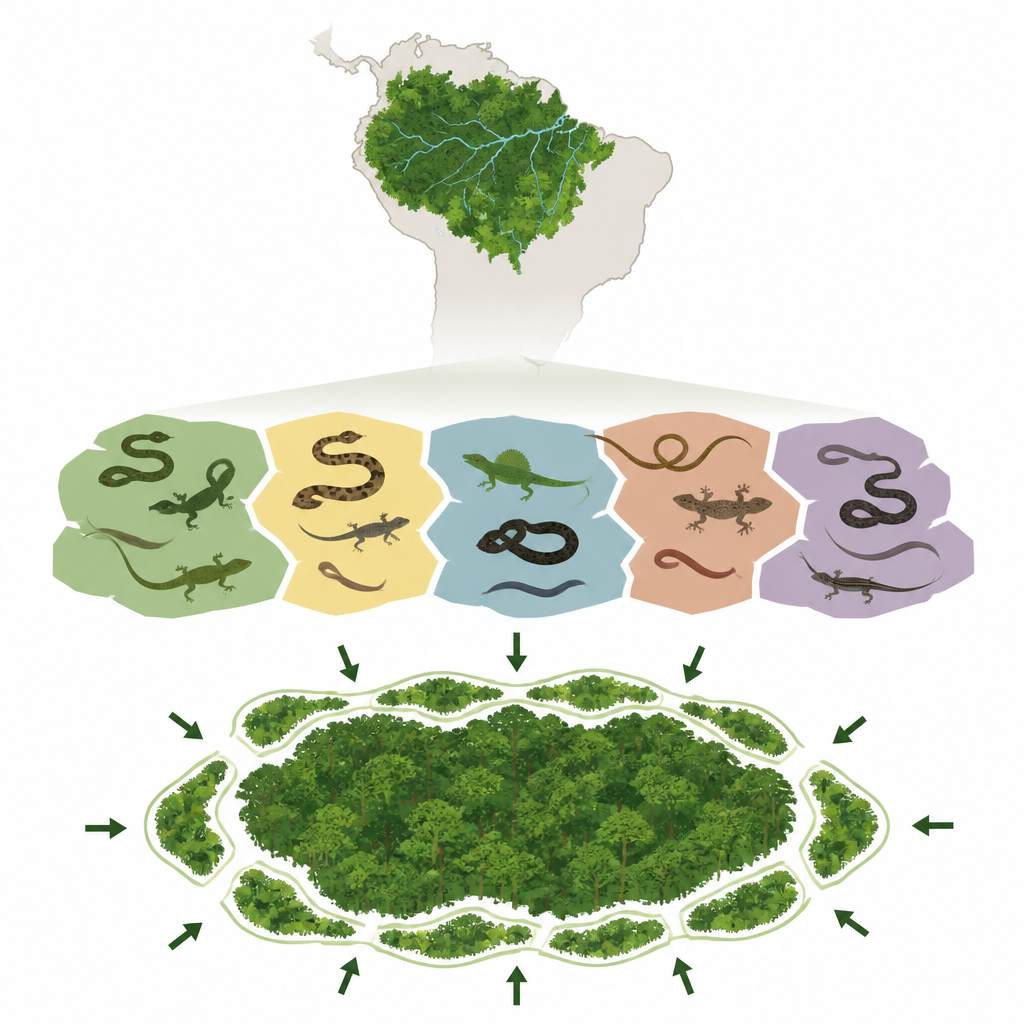
The Amazon rainforest is famous for its dazzling wildlife, but many of its residents remain poorly understood. Among them are squamate reptiles, the lizards, snakes, and wormlike amphisbaenians that quietly weave through the forest floor, rivers, and tree canopies. This study asks a deceptively simple question with big consequences for conservation: where exactly do these reptiles live, and which parts of Amazonia are most crucial for protecting their unique diversity?
Mapping a secret reptile world
To uncover these patterns, the researchers assembled an enormous, carefully checked database of more than 100,000 reptile records from museum collections, field surveys, and scientific literature. They focused on 780 species that occur in Amazonia, and found that around 69 percent are found nowhere else on Earth. By overlaying species ranges on a regular grid across the basin, they could see how many species occur in each area, and how the mix of species changes from place to place. This let them move beyond simple species counts and instead describe how reptile communities are organized across the entire region.
Rich heart, patchy borders
The maps revealed that the greatest number of reptile species cluster along the main Amazon River and some of its large tributaries, as well as in parts of the Guiana Shield to the north. These zones tend to be warm, wet, flat, and densely forested, with very green, productive vegetation. In other words, places with lots of energy and moisture support the most reptile species. But when the team looked only at species that are unique to Amazonia, they saw a different picture: many of these endemics peak toward the south and west, especially in transition areas near the Andes and along ancient geological formations. Species richness and endemism overlap only partly, showing that the busiest places are not always the most irreplaceable.
Hidden strongholds of unique species
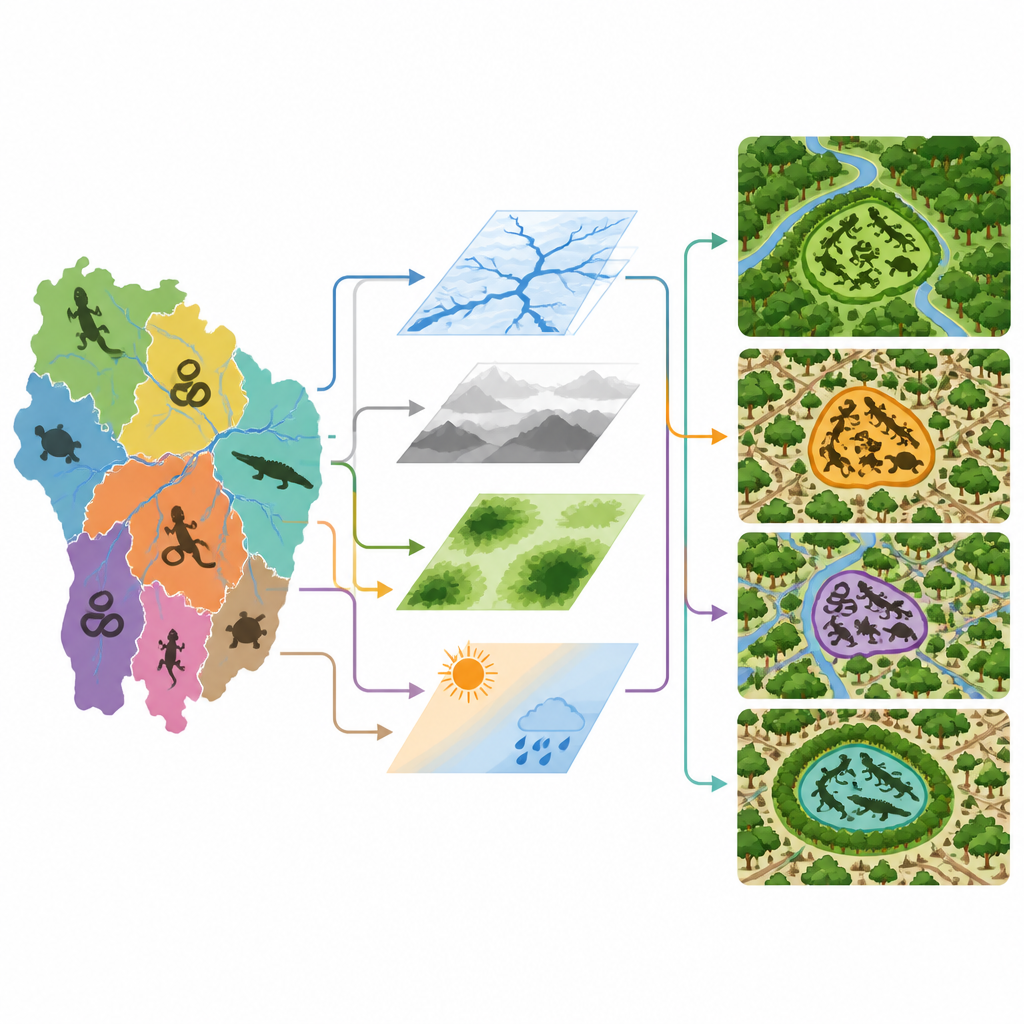
By combining three independent analytical methods, the authors identified 14 areas of endemism, places where several range-restricted reptile species share the same limited space. Surprisingly, almost all of these areas hug the borders of Amazonia, especially the Guiana Shield to the north and the Andean foothills to the west and south. Only one lies entirely within the lowland forest interior. Contrary to a long-standing idea that major rivers carve the forest into distinct faunal blocks, these endemism areas do not line up neatly with river banks. Instead, they are shaped by a mix of geology, rugged terrain, vegetation, and climate. Some of these areas harbor older, evolutionarily distinct lineages linked to ancient rock formations, while others seem to be centers of more recent speciation.
Threats and weak protection
The study also evaluates how well these biologically important regions are protected. Several southern and southwestern bioregions, and endemism areas such as Guaviare and Guaporé, have already lost more than one fifth of their forest cover, much of it outside formal reserves. At the same time, many threatened, poorly known, or very rare reptile species occur entirely outside protected areas. Other zones, like Neblina Mountain and parts of the Guiana Shield, still retain most of their forest and enjoy relatively high protection, yet host many rare species that scientists barely understand.
What this means for saving the forest
For a general reader, the key conclusion is that Amazonian reptiles tell a more complex conservation story than simple species counts or river boundaries suggest. The forest interior holds huge numbers of species, but many of the most unique and vulnerable reptiles are concentrated around the edges of the basin, where deforestation is advancing fastest. The authors argue that protecting a connected belt of conservation areas along these borders could both safeguard endemism hotspots and act as a living shield, slowing the march of habitat loss toward the core of the Amazon. Their work shows that detailed, data-rich maps of where species live are essential tools for choosing which parts of a threatened landscape we cannot afford to lose.
Citation: Ribeiro-Júnior, M.A., Azevedo, J.A.R., Nogueira, C.d.C. et al. Endemism and regionalization patterns of squamate reptiles in Amazonia. Nat Commun 17, 4256 (2026). https://doi.org/10.1038/s41467-025-67554-2
Keywords: Amazon reptiles, endemism, biodiversity hotspots, deforestation, conservation planning