Clear Sky Science · en
Updating an allocentric goal from lateralised egocentric visual memories
How Tiny Brains Solve a Big Navigation Problem
Ants routinely cross featureless deserts and cluttered forests, leave food behind, and then march home with uncanny precision. This study asks how such small brains pull off a task that still challenges our GPS-free robots: combining what an animal sees from its own viewpoint with a stable sense of direction tied to the outside world. By uncovering how ants turn patchy snapshots of the landscape into a reliable internal heading, the work sheds light on general principles of navigation that may apply far beyond insects, from other animals to autonomous machines.
Looking Sideways to Find the Way
For years, researchers assumed that navigating insects memorise the view straight ahead when they leave their nest or a feeder, and later recognise that same view to know that “home is in front.” But field experiments with two very different ant species reveal a surprising twist: ants rely on memories formed while looking to the sides, not straight at their goal. Using a trackball system in the ants’ natural habitat, the authors fixed homing ants at various body orientations and measured how they tried to turn. No matter how their bodies were rotated, when the surrounding scene was familiar, the ants turned toward the correct route direction. Even when they were facing exactly toward or exactly away from home, their behaviour was best described as choosing “left” or “right,” not “go straight.” This shows that recognising a familiar view tells the ant whether the route lies to its left or right, rather than simply saying that the goal is directly ahead. 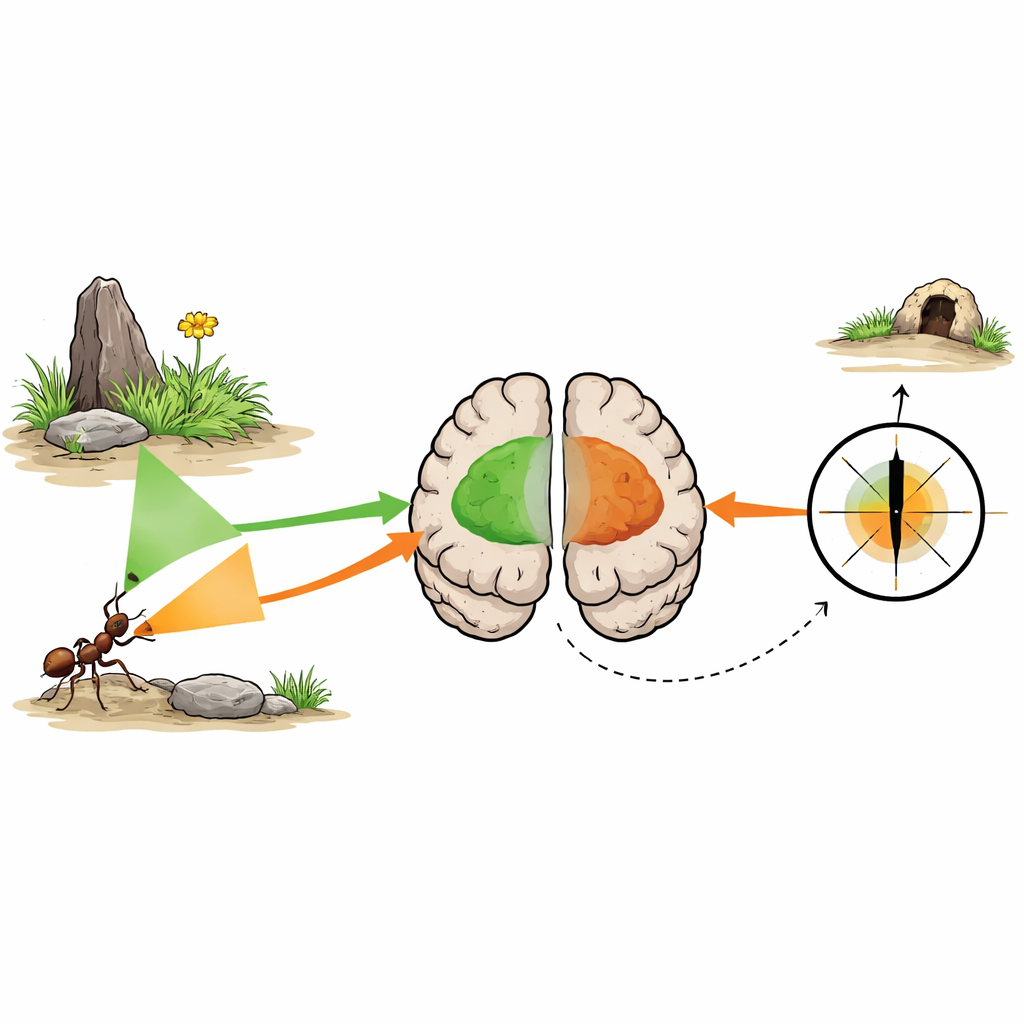
Mixing Landmarks with a Sun Compass
The next question was how these left–right signals are used to steer. One possibility is that recognising a familiar lateral view directly triggers the legs to turn in that direction. The alternative is a two-stage process: the visual memories first update an internal desired heading, which is then compared with information from the sun and other sky cues to produce steering. To distinguish between these options, the researchers mirrored the apparent position of the sun by 180 degrees while ants stood on the trackball in familiar surroundings. When the sun was flipped, ants immediately reversed their preferred turning direction, but only when the ground scene was familiar. This indicates that the sideways visual memories do not directly drive the turn; instead, they set a desired direction that is read by a central “compass” system, which in turn controls the ant’s movements.
A Brain Hub That Integrates Left and Right Clues
The team then turned to computer models grounded in known insect brain wiring. In ants, long-term visual memories are thought to reside in structures called mushroom bodies, while a central brain region known as the central complex holds an internal compass and a representation of the current goal direction. The model assumes that each brain hemisphere receives stronger signals when the ant is oriented slightly to one side of the true goal. These uneven left and right inputs update a stored goal direction in the central complex, which is then compared with the current compass heading to generate left or right turns. Because real visual recognition is noisy and only works at certain gaze angles, inputs to the model were made intermittent and imprecise. Yet the simulated agent still produced stable, straight routes as long as the left and right cues roughly matched “goal is to your left” and “goal is to your right.” If these associations were inverted, the model reliably followed the route in the wrong direction, just as predicted from the sun-flip experiments.
When the Sky Lies, the Ground Puts You Back on Track
To test the model further, the researchers simulated what happens when the internal compass is suddenly shifted while an ant walks along its familiar route. They compared this with real ants whose view of the sun was rotated by 135 degrees using mirrors. Both in simulation and in the field, the ants briefly veered off, then curved back toward the correct path, and finally walked straight again after a short period of meandering. In the model, this behaviour arises because the old goal direction stored in the central complex briefly overlaps with the updated goal tied to the shifted compass, creating a tug-of-war that resolves once the older memory trace fades. This close match between model and behaviour strengthens the idea that navigation results from an ongoing dialogue between noisy landmark recognition and a more stable, compass-based heading. 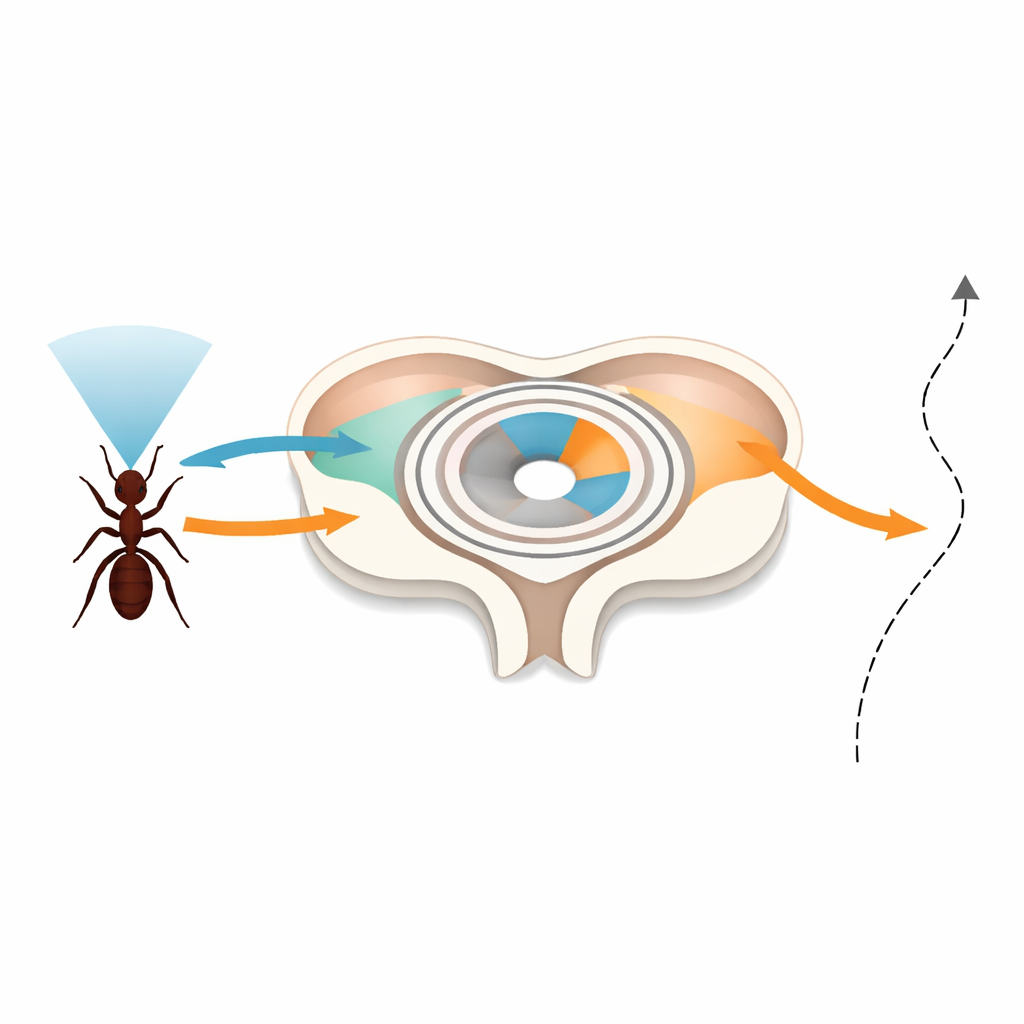
From Ant Trails to General Navigation Principles
In simple terms, the study shows that ants do not steer by matching a perfect mental photograph of the scene in front of them. Instead, they compare how familiar the world looks when they are slightly left or right of the ideal direction, feed those signals into a central guidance hub, and let a sky-based compass smooth out the noise. This lateral, two-stage design appears in distantly related ant species and echoes the broader idea that many animals, including humans, combine viewpoint-bound and world-centred maps of space. By revealing how compact brains turn side-looking snapshots into a robust sense of “where to go,” the work offers a blueprint for building more capable and efficient navigation systems in artificial agents.
Citation: Wystrach, A., Le Moël, F., Clement, L. et al. Updating an allocentric goal from lateralised egocentric visual memories. Nat Commun 17, 3594 (2026). https://doi.org/10.1038/s41467-025-67545-3
Keywords: ant navigation, spatial memory, visual landmarks, neural circuits, sun compass