Clear Sky Science · en
Oculocutaneous albinism variants in 28 consanguineous families and functional classification of a pathogenic deep intron variant in TYR
Why this research matters
Albinism is often recognized by very light skin, hair, and eye color, but behind this visible difference lie many questions for affected families: What type of albinism do we have, will it affect other organs, and can our children inherit it? This study of Pakistani families sheds light on those questions by revealing which genes are involved, how often a serious syndromic form appears, and how a previously overlooked type of DNA change can disrupt pigment production. The work helps refine diagnosis, guides medical follow up, and hints at future ways to correct some genetic errors.
Families with shared roots
The researchers focused on 28 large Pakistani families in which parents were related to each other and several family members had albinism. Such families are especially useful for genetic studies because affected individuals are more likely to carry the same inherited DNA changes. In total, 136 people with albinism took part. By carefully collecting clinical information and blood samples, the team could link visible traits like skin and hair color with the underlying genetic causes. This approach allowed them to solve the genetic puzzle in every family they studied, which is unusually high compared with previous work in mostly European groups.
Finding the genes behind the condition
Using next generation DNA sequencing, the team screened each family for changes in 20 known albinism-related genes. They also looked for larger missing pieces of genes, called copy number variants. Most families had changes in two major pigment genes: TYR, which instructs cells how to make a key pigment enzyme, and OCA2, which helps pigment-producing compartments in cells function properly. Together, these two genes explained almost four out of five families. 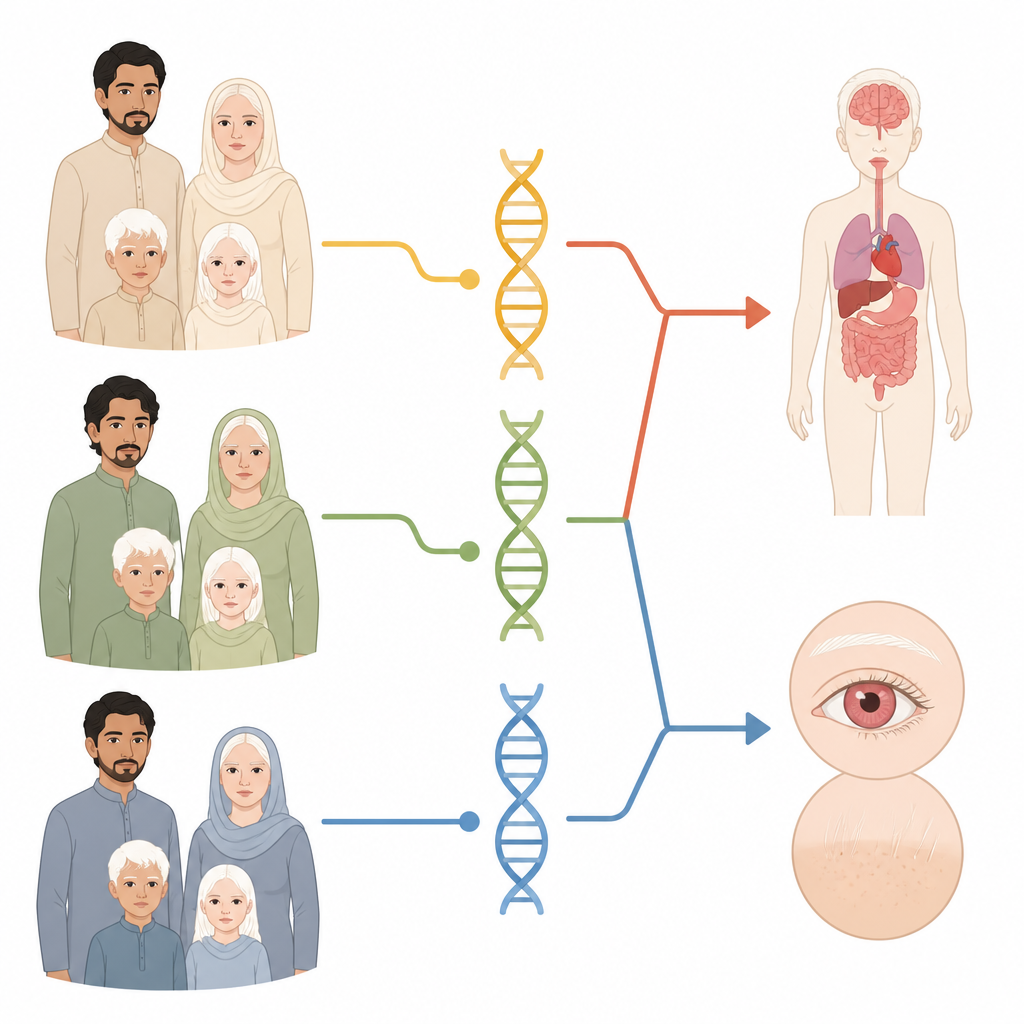
Hidden risks for whole-body disease
Not all albinism affects only the eyes, hair, and skin. Some forms, grouped under Hermansky Pudlak syndrome, also disturb blood clotting, immunity, and lungs or bowel. In this study, five of the 28 families carried harmful changes in Hermansky Pudlak genes. That means nearly one in five families with albinism in this group actually had a syndromic form that can lead to serious complications. Because skin and hair color alone cannot reveal this, the authors stress that people with albinism should be offered broad genetic testing that includes these syndromic genes, so that doctors can monitor for bleeding problems, infections, and other issues.
A hidden glitch deep inside a gene
One family did not show any obvious damaging changes in the usual coding parts of pigment genes, even after careful screening. To go further, the team sequenced the entire genomes of several family members and searched for shared stretches of DNA. This pointed to the TYR gene, but the suspicious change lay far inside one of its introns, the stretches of DNA normally removed when cells process genetic messages. Laboratory experiments using a miniature version of the gene revealed that this deep intron change creates a new “pseudoexon,” an extra fragment that is mistakenly inserted into the message. 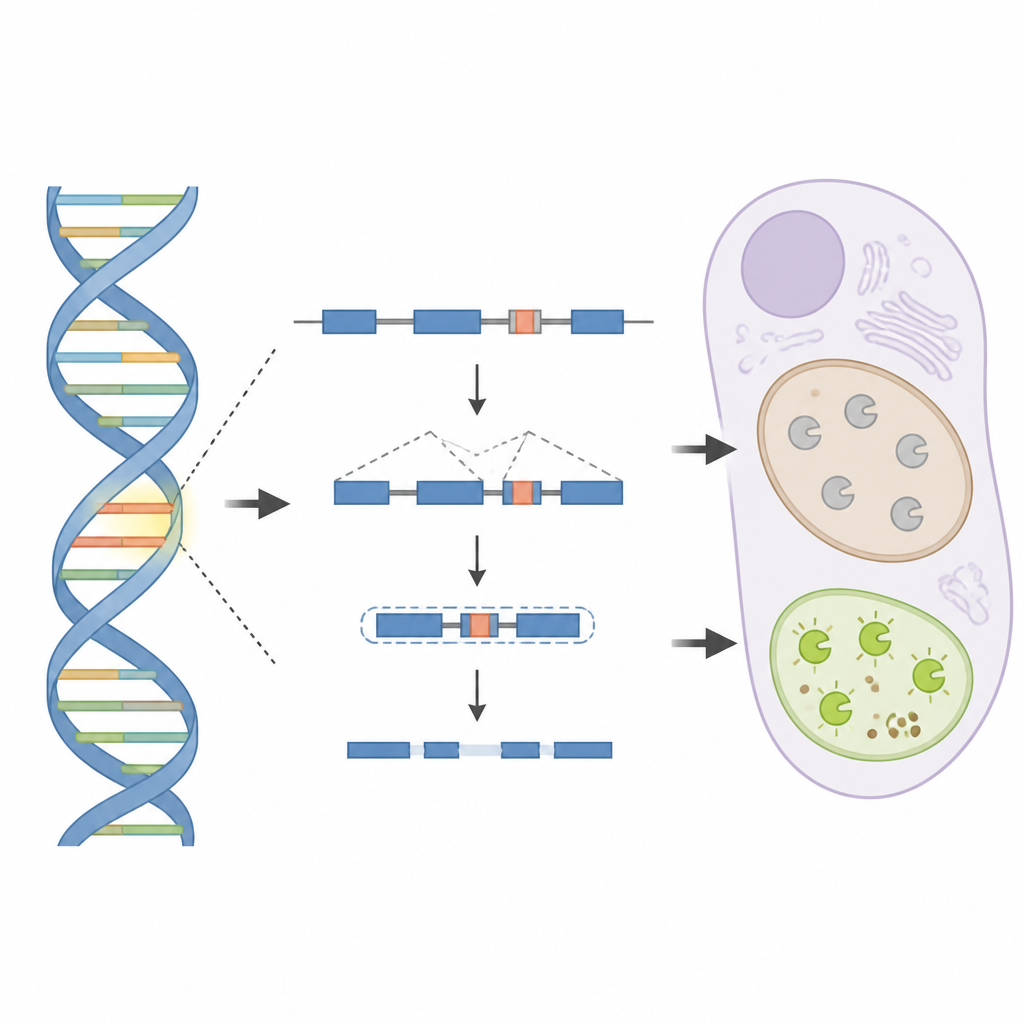
Testing ways to repair genetic messages
Intriguingly, the researchers did not stop at identifying the fault. They designed short synthetic RNA pieces that bind to the faulty splice sites around the pseudoexon and block their use. When added to cells carrying the mutant mini gene, these splice-switching molecules reduced the inclusion of the extra fragment and restored a more normal pattern of gene processing. While this work is still at an early, experimental stage, it shows that some deep intron errors might one day be partially corrected at the RNA level, potentially boosting the activity of pigment enzymes even in individuals who still carry the underlying DNA change.
What this means for people with albinism
In everyday terms, this study shows that careful genetic testing can reveal not only which gene causes a person’s albinism, but also whether they are at risk for complications beyond skin and eye changes. It also demonstrates that disease-causing variants are not confined to the well-known parts of genes, but can hide deep in noncoding regions that subtly disturb how genetic messages are assembled. By mapping these hidden glitches and testing ways to bypass them, researchers are laying the groundwork for more precise diagnoses and, in the longer term, targeted therapies that may improve pigment function in some forms of albinism.
Citation: Farooq, M., Bruun, G.H., Sarusie, M.V.K. et al. Oculocutaneous albinism variants in 28 consanguineous families and functional classification of a pathogenic deep intron variant in TYR. Eur J Hum Genet 34, 603–608 (2026). https://doi.org/10.1038/s41431-026-02070-5
Keywords: oculocutaneous albinism, TYR gene, Hermansky Pudlak syndrome, pseudoexon, genetic diagnosis