Clear Sky Science · en
Caspase-3/Drice as a critical regulator of actin dynamics through its dual control of small RhoGTPase family and Gelsolin in the Malpighian tubules of Drosophila
Why cell scaffolds matter for tiny kidneys
Every cell in our body relies on a microscopic scaffold made of actin filaments to keep its shape, move, and build organs. This study looks at how a well known “death enzyme” in fruit flies unexpectedly moonlights as a builder, keeping this scaffold in balance so that their kidney like tubes grow and work properly. Because similar systems operate in higher animals, including humans, the work hints at new ways in which cell death enzymes could shape healthy development and disease.
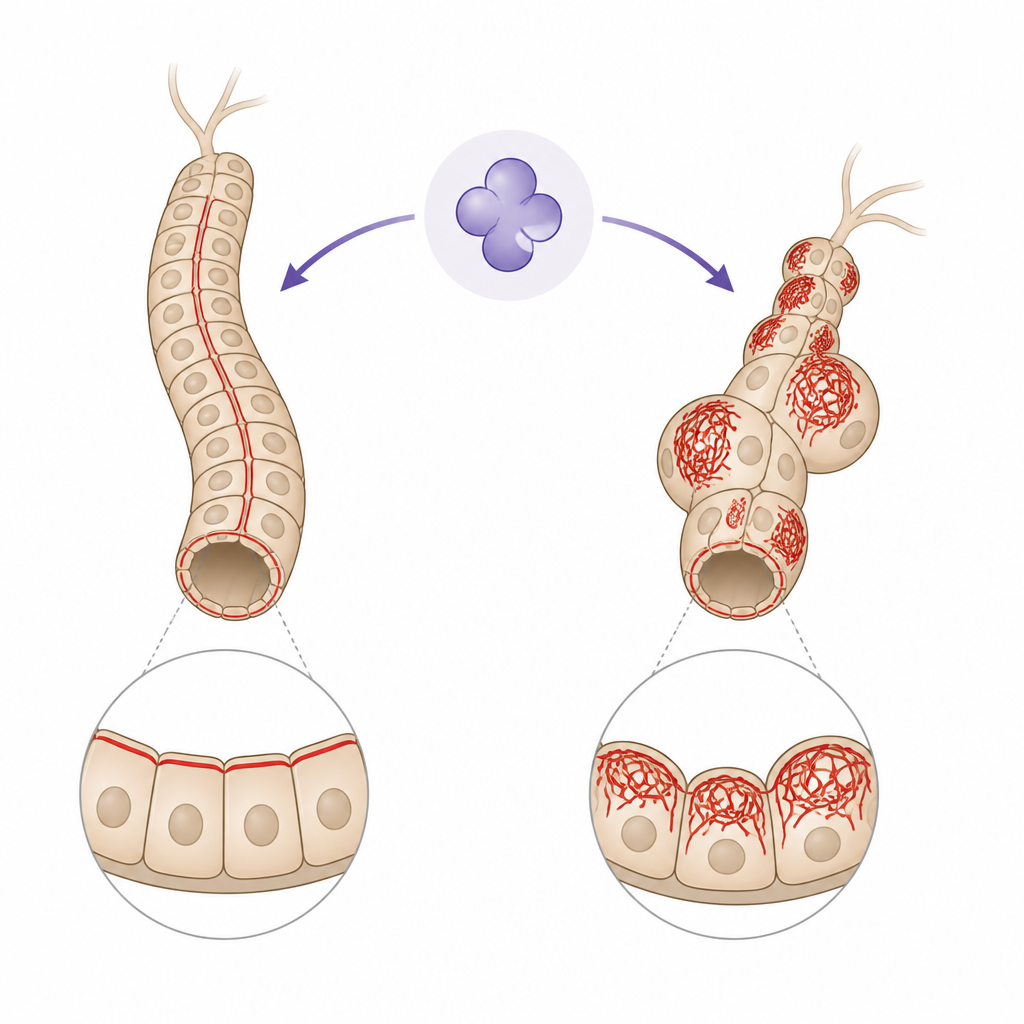
A surprising job for a death enzyme
Caspases are usually cast as molecular executioners that dismantle cells during programmed cell death. The authors focus on Drice, the fruit fly version of caspase 3, in Malpighian tubules, a set of narrow tubes that act like insect kidneys. These tubes keep working through major life changes without being destroyed, even though they contain active Drice. Earlier work showed that when Drice is missing, the tubes become shorter, studded with fluid filled cysts, and packed with overly dense actin filaments. The new study asks how Drice prevents this structural chaos and which signaling pathways connect it to the actin network.
Keeping actin strands orderly
Actin constantly switches between free building blocks and assembled filaments, and this balance is controlled by many helper proteins. One key hub is the Rho family of molecular switches, which tune where and when actin forms. In normal tubules, one of these switches, Rho1, activates a partner called Rok to help organize thin, regularly aligned actin along the cell surface. In Drice mutant flies, Rok levels drop, actin filaments lose their tidy arrangement, and the tissue’s top to bottom polarity breaks down. When the researchers restored Rok in the mutant background, both actin organization and tube shape improved, showing that Drice helps maintain orderly scaffolds in part by supporting the Rho1 Rok route.
When growth signals run too hot
The team then examined another Rho family member, Cdc42, which normally promotes branching of actin filaments through a partner complex called Arp2/3. In tubules lacking Drice, Cdc42 and both Arp components were boosted. This surge led to thicker, more heavily branched actin along the cell cortex. Dialing down Arp2 or Arp3 made the filaments thinner and more like those in healthy tubes, and partially restored overall alignment even in Drice mutants. These results suggest that without Drice, one arm of the system that grows actin branches becomes overactive, contributing to a dense, tangled network that distorts cell shape.
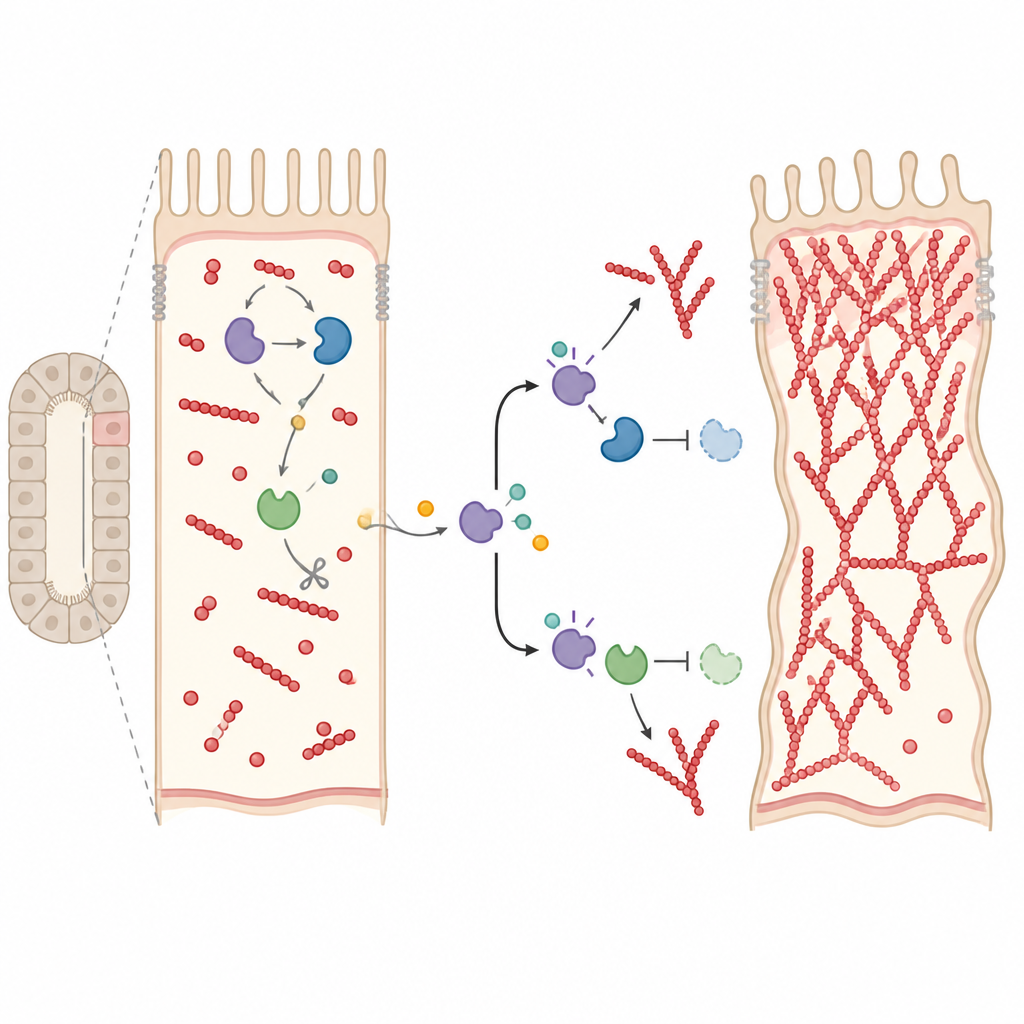
A broken brake on filament growth
To understand how Drice ties into these switches, the authors searched for proteins that physically interact with Rho1 in normal and mutant tubules. They found that Gelsolin, a protein that normally cuts and caps actin filaments to stop further growth, associates with Rho1 only when Drice is present. Drice also activates Gelsolin by cutting it, a step that was much reduced in the mutants. In both Drice and Gelsolin knockdown tubules, the ratio of assembled filaments to free actin shifted strongly toward the filament side, indicating runaway polymerization. Remarkably, boosting Rok in Drice mutants brought this ratio back near normal, suggesting that Drice coordinates both the “go” and “stop” signals on actin growth through Rok, Cdc42 Arp2/3, and Gelsolin.
How this changes our view of cell death proteins
By following changes in signaling, protein interactions, and actin structure, the study shows that Drice is not just a destroyer but also a caretaker of cell architecture in fruit fly kidney like tubules. When Drice is absent, growth promoting pathways overshoot, brakes on filament length fail, and the fine balance between free and assembled actin is lost, leading to misshapen, poorly functioning tubes. For a lay reader, the key message is that enzymes famous for killing cells can also be vital for building and maintaining living tissues, and similar control systems may influence how our own organs develop, repair, and respond to stress.
Citation: Sagar, S.C., Tapadia, M.G. Caspase-3/Drice as a critical regulator of actin dynamics through its dual control of small RhoGTPase family and Gelsolin in the Malpighian tubules of Drosophila. Cell Death Discov. 12, 214 (2026). https://doi.org/10.1038/s41420-026-03061-7
Keywords: actin cytoskeleton, caspase-3, Rho GTPases, Gelsolin, Drosophila Malpighian tubules