Clear Sky Science · en
Junction-mediating and regulatory protein (JMY) is a promoting protein for radial migration of cortical neurons
How a Single Protein Helps Build a Thinking Brain
The human-like abilities of mice—such as learning a maze or remembering a hidden platform in water—depend on how precisely their brain cells are born, move, and connect during early life. This study explores a little-known protein called JMY and shows that it quietly guides young nerve cells into the right layers of the brain’s cortex. When JMY is missing or reduced, the brain’s wiring pattern is subtly disturbed, and the animals struggle with tasks that rely on memory and spatial navigation.
Setting the Stage for Brain Layers
In mammals, the outer part of the brain, the cerebral cortex, is built in layers. New neurons are generated deep inside, then migrate outward along narrow paths to reach their final positions. The authors first asked when and where JMY appears in this process. They found that JMY is strongly produced in the developing mouse brain, especially before and shortly after birth, and mainly in regions that generate new neurons. It is present both in immature dividing cells and in more mature neurons, and is seen in key brain areas such as the cortex and hippocampus. Over time, its levels fall to much lower values in adulthood, hinting that JMY’s main job is during early brain construction. 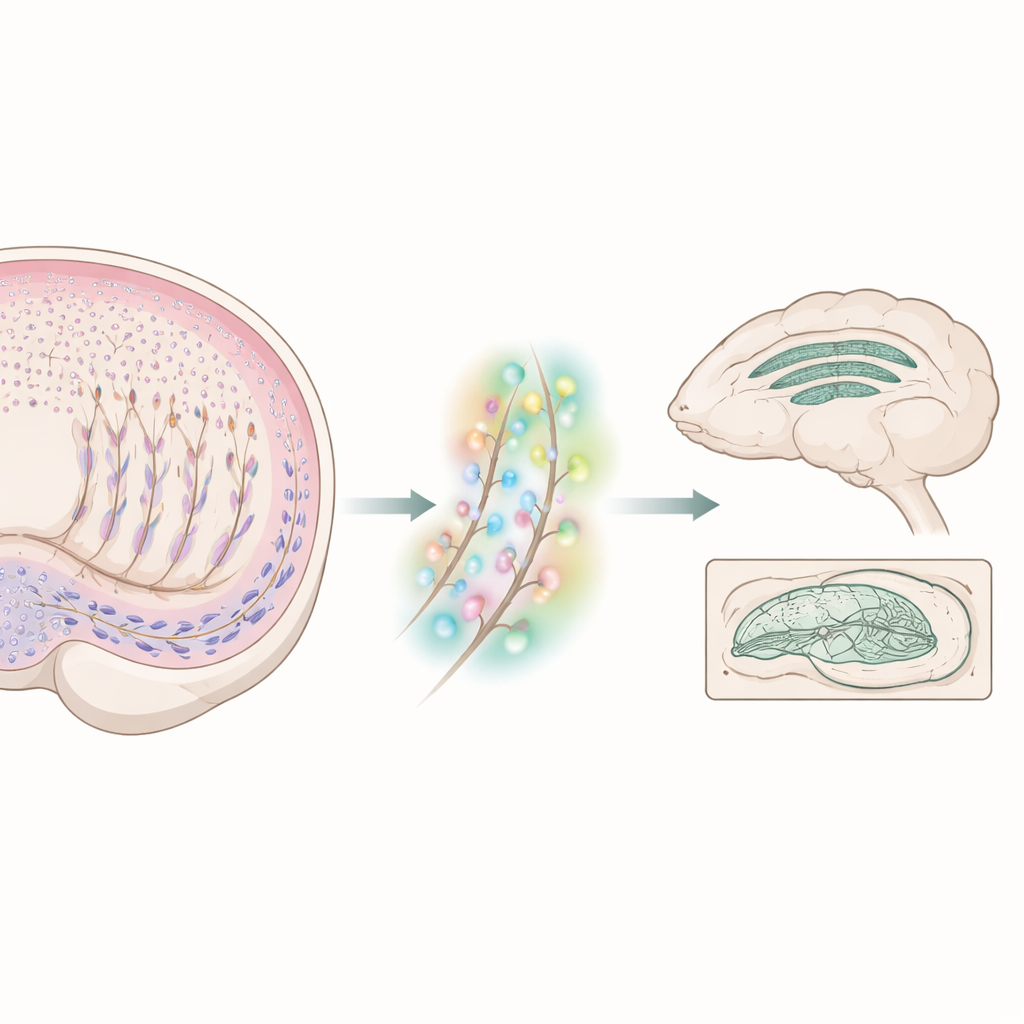
Helping Young Neurons Move to the Right Place
Because JMY is abundant where new neurons are born, the team tested whether it affects their migration. Using a technique that introduces DNA directly into the brains of mouse embryos, they either reduced JMY or boosted it in selected cortical cells. When JMY was knocked down, many labeled neurons failed to travel outward on schedule and instead piled up in the deeper germinal zones. When JMY was overproduced, more neurons successfully reached the outer cortical plate. Although some delayed cells eventually caught up after birth, the early slowdown during a critical window left lasting marks on how the cortex was organized.
Balancing Cell Birth and Maturation
Neurons must stop dividing before they can migrate and mature. The researchers showed that JMY helps cells make this transition. In embryos with reduced JMY, more progenitor cells remained in a dividing state, and fewer exited the cell cycle to become neurons. Markers of stem-like cells stayed high, indicating that the pool of undifferentiated cells was not shrinking as it should. JMY is known to work with the famous guardian of the genome, p53, which controls cell-cycle brakes and DNA repair. Proteomic and gene-expression analyses revealed that in JMY-deficient brains, several components of this control system—especially a p53 target called Gadd45α, important for pausing the cycle before division—were disturbed. This shift likely allows progenitor cells to keep cycling longer, delaying their conversion into migrating neurons.
Shaping Neuron Branches and Layer Patterns
The story did not end with migration. When the team examined the brains of older mice in which JMY had been deleted specifically in neural progenitors or in the cortex and hippocampus, they found that certain upper cortical layers were disorganized. A subset of neurons that normally settle near the brain surface were stranded in deeper regions. At the single-cell level, neurons lacking JMY developed simpler, shorter branches, suggesting that their structural maturation was compromised. These alterations in layering and dendritic complexity occurred even though the overall size and shape of the cortex looked roughly normal, underscoring that relatively subtle changes in the brain’s internal layout can have significant functional effects. 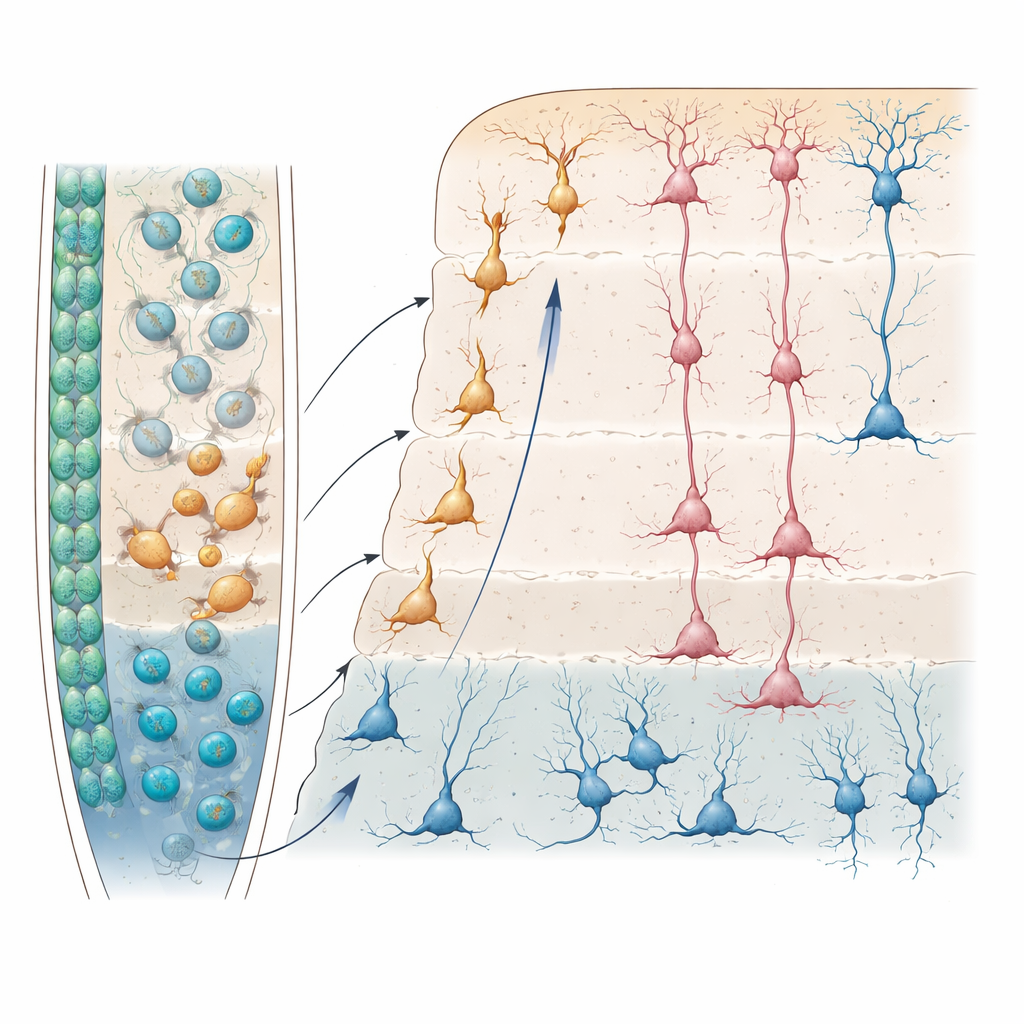
From Developmental Glitches to Memory Problems
To find out whether these structural changes matter for behavior, the authors tested adult JMY-deficient mice in classic memory tasks. In the Morris water maze, the knockout mice took longer to learn the location of a hidden platform and later spent less time searching in the correct area when the platform was removed. In a Y-shaped maze that probes recognition of a new route, they showed weaker preference for the novel arm and less focused exploration. Importantly, their swimming speed and general movement were normal, indicating that the deficits were truly cognitive. Together, the results connect JMY’s role in controlling neuron production, migration, and branching with the brain circuits that support spatial learning and memory.
Why This Protein Matters
This work reveals JMY as a key coordinator of early cortical development. By helping neural progenitor cells stop dividing, start differentiating, and migrate outward on time, JMY contributes to forming well-organized layers and elaborately branched neurons. When JMY is absent or reduced, these steps are mistimed and misaligned, leaving the cortex subtly miswired and weakening memory performance in adulthood. Because disruptions in similar developmental processes have been linked to conditions such as intellectual disability and autism, understanding JMY and its partnership with p53 may offer new clues to how early molecular events shape lifelong brain function.
Citation: Chen, Xr., Chen, Zy., Qi, Sy. et al. Junction-mediating and regulatory protein (JMY) is a promoting protein for radial migration of cortical neurons. Cell Death Discov. 12, 123 (2026). https://doi.org/10.1038/s41420-026-02974-7
Keywords: cortical development, neuronal migration, JMY protein, p53 signaling, spatial memory