Clear Sky Science · en
RAN-S100A10-EGFR axis facilitates papillary thyroid cancer metastasis by PI3K/AKT signaling
Why this thyroid cancer study matters
Papillary thyroid cancer is often seen as a “good prognosis” cancer, yet many patients still develop spread to neck lymph nodes and beyond. This study looks inside individual tumor cells to uncover a hidden chain of proteins that helps these cancers travel, opening doors for more precise ways to predict and possibly slow their spread.
Looking at tumors one cell at a time
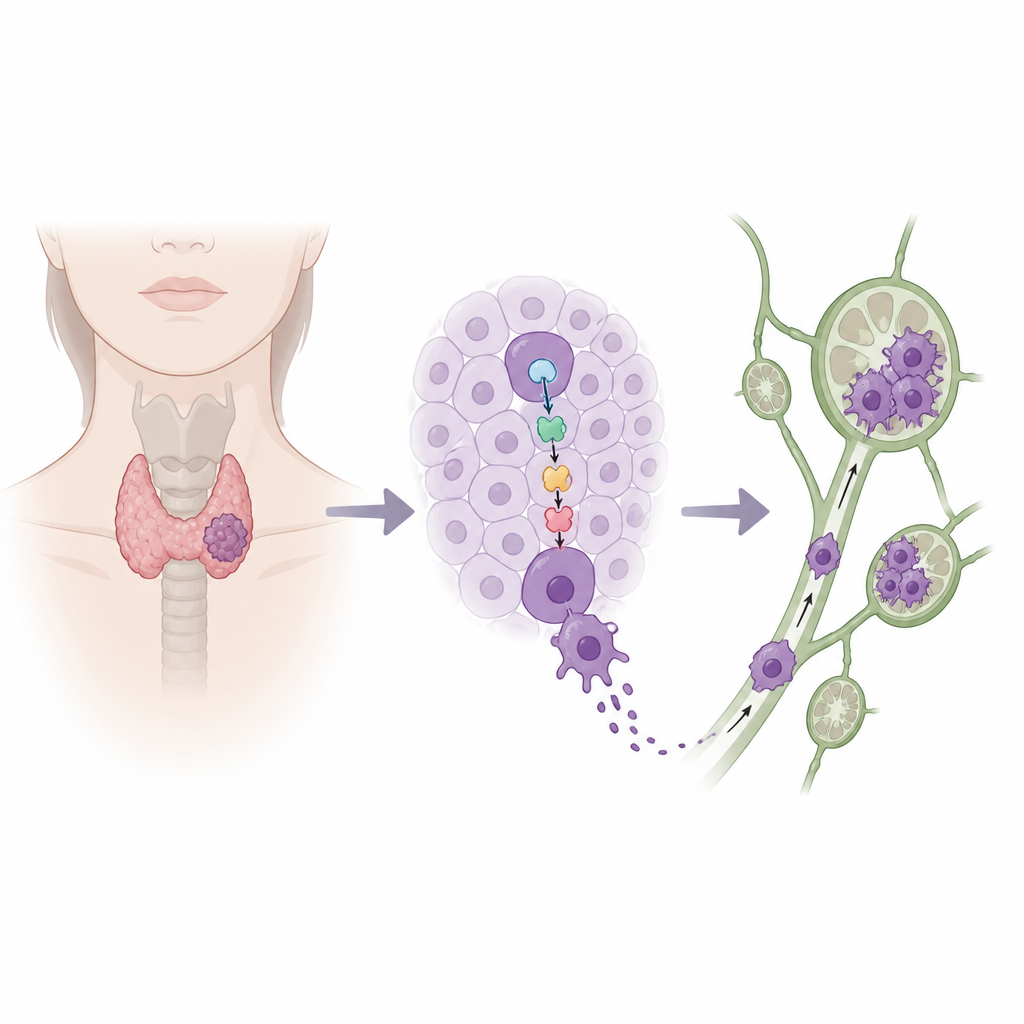
Instead of averaging signals across whole pieces of tumor, the researchers used single-cell RNA sequencing to read out gene activity in nearly 65,000 individual cells from papillary thyroid cancers and their lymph node metastases. This allowed them to sort cells into major types such as immune cells, blood vessel cells, supporting tissue cells, and the thyroid tumor cells themselves. By tracing how normal thyroid cells gradually changed into primary tumor cells and then into metastatic cells, they built an “evolutionary map” that shows how some subgroups of tumor cells become especially prone to breaking away and spreading.
Finding the most dangerous tumor cell groups
Within the thyroid cancer cells, the team identified nine distinct subgroups, each with its own behavior. Three of these groups showed strong signals linked to cell movement and invasion, including pathways that loosen cell-to-cell contacts and help cells remodel their surroundings. Patients whose tumors contained more of these three subgroups tended to have worse outcomes, suggesting these cells act as the main drivers of early lymph node spread. Further network analysis highlighted a set of tightly co-expressed genes involved in cell migration, which the authors suspected might hold key “master switches” for metastasis.
Spotlighting a helper of tumor spread
By comparing primary tumors with their metastatic counterparts and intersecting those findings with the migration gene network, the researchers pinpointed one standout gene: S100A10. This molecule belongs to a family of small proteins already tied to aggressive behavior in other cancers. Here, S100A10 was found at higher levels in papillary thyroid tumors than in normal thyroid tissue, and even higher in advanced stages and in patients with lymph node involvement. Laboratory tests in multiple thyroid cancer cell lines confirmed that increasing S100A10 made cells more invasive and mobile, while reducing it had the opposite effect. Animal experiments echoed these results: tumors with lower S100A10 grew more slowly and produced far fewer lung metastases.
A protein chain that turns on a growth signal
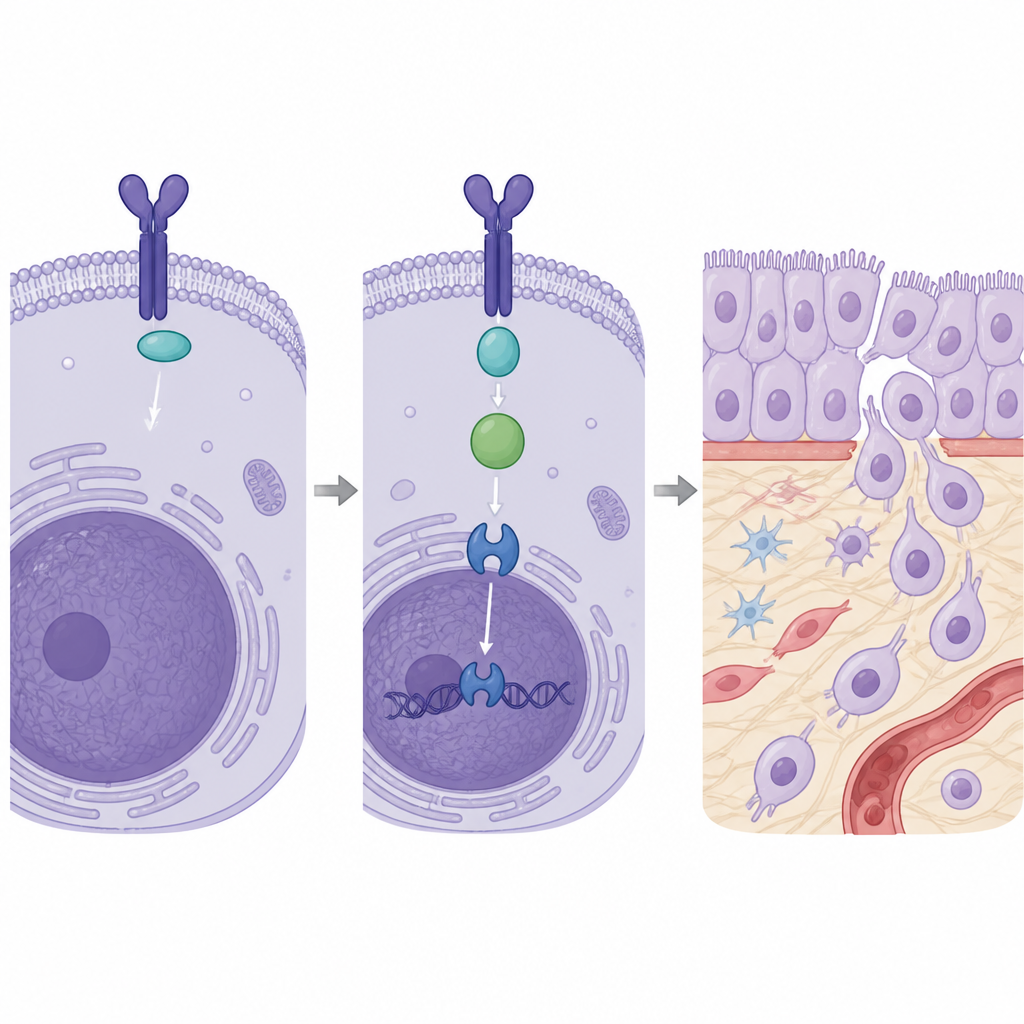
Diving deeper, the team showed that S100A10 boosts a well-known growth and survival route inside cells called the PI3K/AKT pathway, which is often active in cancers. When S100A10 was abundant, proteins that mark this pathway as switched on were elevated, and cells underwent a shift known as epithelial–mesenchymal transition, in which they lose tight connections and gain a more mobile, invasive shape. Blocking PI3K signaling with a drug blunted the extra movement and invasion driven by S100A10, tying its effects directly to this pathway. The researchers also discovered that S100A10 forms a complex with another protein, RAN, and works together with the cell-surface receptor EGFR. RAN increased S100A10 production and helped guide EGFR into the cell nucleus, where this chain of events further fueled PI3K/AKT signaling and invasive behavior.
What this means for patients
For a lay reader, the takeaway is that the study identifies a specific “signal relay” inside papillary thyroid cancer cells that encourages them to detach and spread. The RAN–S100A10–EGFR chain acts like a hidden accelerator pedal for tumor movement by turning on internal growth signals and reshaping cells so they can travel. Because S100A10 levels are higher in more advanced tumors and in those that have reached lymph nodes, it could help doctors better judge which cancers are likely to behave aggressively. In the future, treatments that interrupt this protein chain might offer new options for patients with metastatic papillary thyroid cancer.
Citation: Song, W., Liu, Z., Shi, C. et al. RAN-S100A10-EGFR axis facilitates papillary thyroid cancer metastasis by PI3K/AKT signaling. Cell Death Dis 17, 510 (2026). https://doi.org/10.1038/s41419-026-08649-6
Keywords: papillary thyroid cancer, cancer metastasis, single-cell sequencing, EGFR signaling, PI3K AKT pathway