Clear Sky Science · en
Chemogenetic modulation of the prelimbic cortex to the nucleus accumbens core pathway reduces cocaine-induced increase of risk preference
Why risky choices matter
Why do some people slide into risky habits like heavy drug use or problem gambling while others steer clear, even when exposed to the same temptations? This study uses rats to probe that question, focusing on how a specific brain pathway shapes risky decision-making after cocaine exposure and how dialing that pathway down can nudge choices back toward safer options. 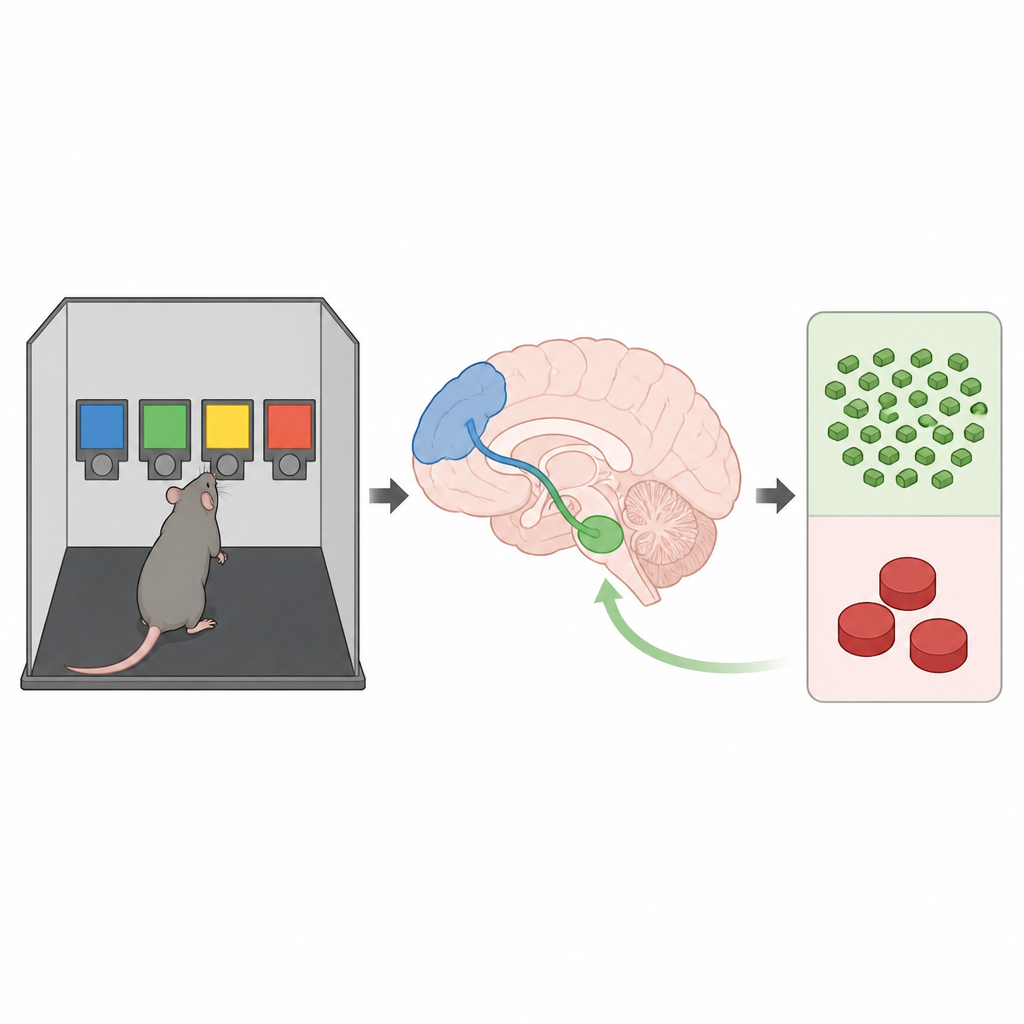
A gambling game for rats
To model real-world choices, the researchers used a rat gambling task that mimics human casino-style decisions. Rats chose among four options, each offering different amounts of sugary pellets and different chances of getting a time-out penalty. One option delivered the best overall payoff over time and counted as the “safe” but still rewarding choice, while the others were more tempting in the short term but worse in the long run. Based on how strongly rats favored the best option, they were grouped as risk-averse or risk-seeking before any drug exposure.
Cocaine tips the balance
After this baseline test, the team gave some rats a week of cocaine injections and later challenged them again with cocaine just before the gambling task. In previously risk-averse rats, cocaine pushed choices away from the long-term best option toward larger but riskier rewards, echoing how stimulant use in people can promote poor decisions. Interestingly, rats that were already risk-seeking did not change much with cocaine, suggesting that their decision style was more fixed. The researchers also tracked attention-related measures, such as how often a rat failed to respond, and found that cocaine increased these lapses.
Silencing a key brain pathway
The study zoomed in on a pathway connecting the prelimbic cortex, a part of the frontal brain involved in planning and control, to the nucleus accumbens core, a reward hub that helps weigh costs and benefits. Using chemogenetics, a tool that lets scientists turn specific neurons up or down with a designer drug, they selectively dampened or boosted activity in this pathway. Activating the inhibitory “Gi” switch in prelimbic neurons that project to the nucleus accumbens reduced cocaine-induced risky choices in risk-averse rats and lowered their attention failures. In contrast, activating an excitatory “Gq” switch, which further revved up this circuit, did not correct the cocaine-driven shift toward risk. In rats that never received cocaine, manipulating the same pathway had little effect on basic choice patterns, hinting that the intervention mainly interacts with drug-altered brain states. 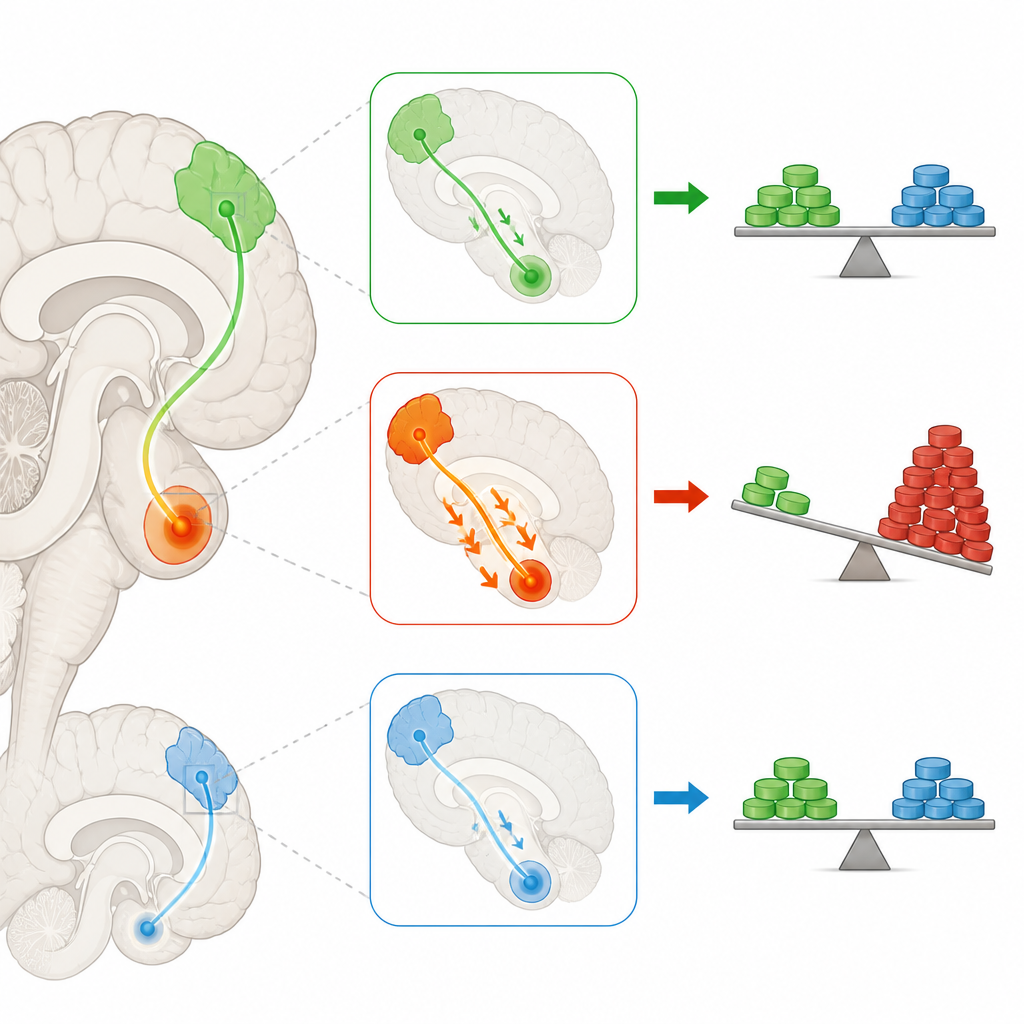
Changes inside the cells
The researchers also examined molecular changes inside prelimbic neurons. Cocaine raised levels of a particular calcium channel protein, CaV1.2, in risk-averse rats, which is known to influence how easily brain circuits become sensitized by drugs. It also altered the balance of a signaling protein called DARPP-32, shifting a specific phosphate tag on the protein toward a pattern normally seen in naturally risk-seeking rats. When the inhibitory Gi switch was turned on in the pathway, both CaV1.2 levels and the altered DARPP-32 signal returned toward baseline in risk-averse rats. Moreover, in these animals, the degree of this DARPP-32 shift tracked with how often they chose the safe option, linking the molecular signature to actual behavior. These effects were not seen in risk-seeking rats, underscoring that their brains may already be locked into a different state.
What this means for people
Taken together, the findings suggest that a specific frontal-to-reward brain pathway can be tuned to counteract cocaine-induced increases in risky decision-making and attention problems, but mainly in individuals who start out more cautious. By tying behavior to precise circuit activity and molecular markers, the work offers clues to why some people with substance use or gambling problems respond better to certain treatments than others. While chemogenetic switches are not a current therapy for humans, the principle is clear: targeting the right circuit, in the right subgroup, at the right time could help restore more balanced choices after drug exposure.
Citation: Han, J., Kwak, M.J., Kim, W.Y. et al. Chemogenetic modulation of the prelimbic cortex to the nucleus accumbens core pathway reduces cocaine-induced increase of risk preference. Transl Psychiatry 16, 245 (2026). https://doi.org/10.1038/s41398-026-04015-4
Keywords: risky decision making, cocaine, prefrontal cortex, nucleus accumbens, gambling behavior