Clear Sky Science · en
Distinct roles for MNK1 and MNK2 in social and cognitive behavior through kinase-specific regulation of the synaptic proteome and phosphoproteome
How Two Tiny Molecules May Shape Social Life and Memory
Why do some changes in the brain affect how we relate to others or remember events, while others do not? This study looks at two closely related proteins in brain cells, MNK1 and MNK2, and shows that each one plays a surprisingly different role in social behavior, learning, and the tiny protein factories that keep synapses working.
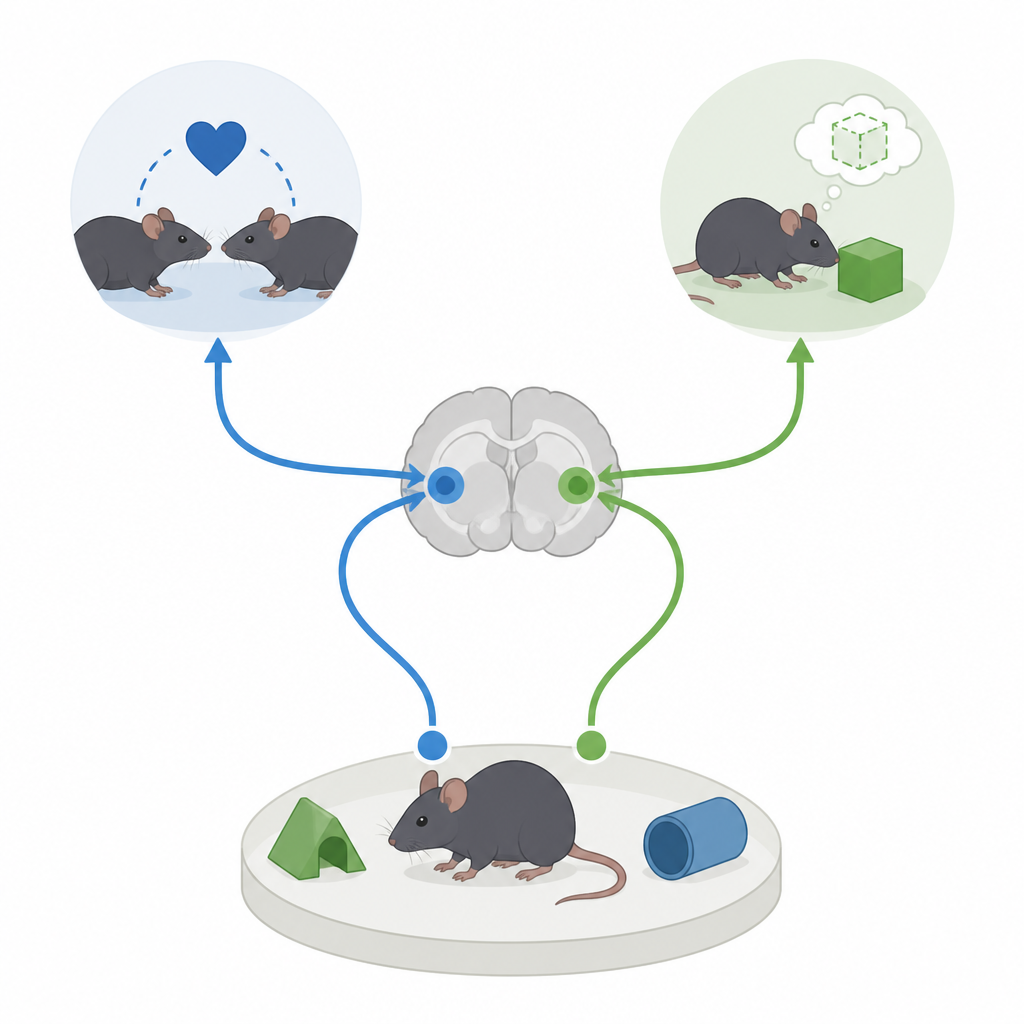
Two Similar Proteins with Different Behavioral Footprints
The researchers used mice that were missing either MNK1, MNK2, or both, and put them through a battery of behavioral tests. These included how strongly mice approached and recognized other mice, how they reacted to new objects, and how much they explored an open arena. Mice lacking MNK1 showed weaker interest in new mice and in new objects, pointing to problems with social recognition and short-term memory. In contrast, mice without MNK2 were at least as sociable as normal mice and often paid more attention to new objects, suggesting a different shift in how they explore and evaluate novelty.
Unraveling Distinct Patterns of Social and Cognitive Changes
To make sense of these many behavioral measures, the team used computer-based motion tracking and a statistical method that groups animals by behavioral style. This analysis separated MNK1-lacking mice mainly by their poorer performance in memory-related tasks, while MNK2-lacking mice stood out for their altered patterns of social exploration and movement. Mice missing both MNK1 and MNK2 did not simply combine these traits; instead, they showed strong reductions in overall activity but relatively normal social and short-term memory. This pattern suggests that MNK1 and MNK2 each contribute in their own way to social behavior, cognition, and general activity, rather than acting as simple backups for one another.
How These Proteins Shape the Synaptic Toolkit
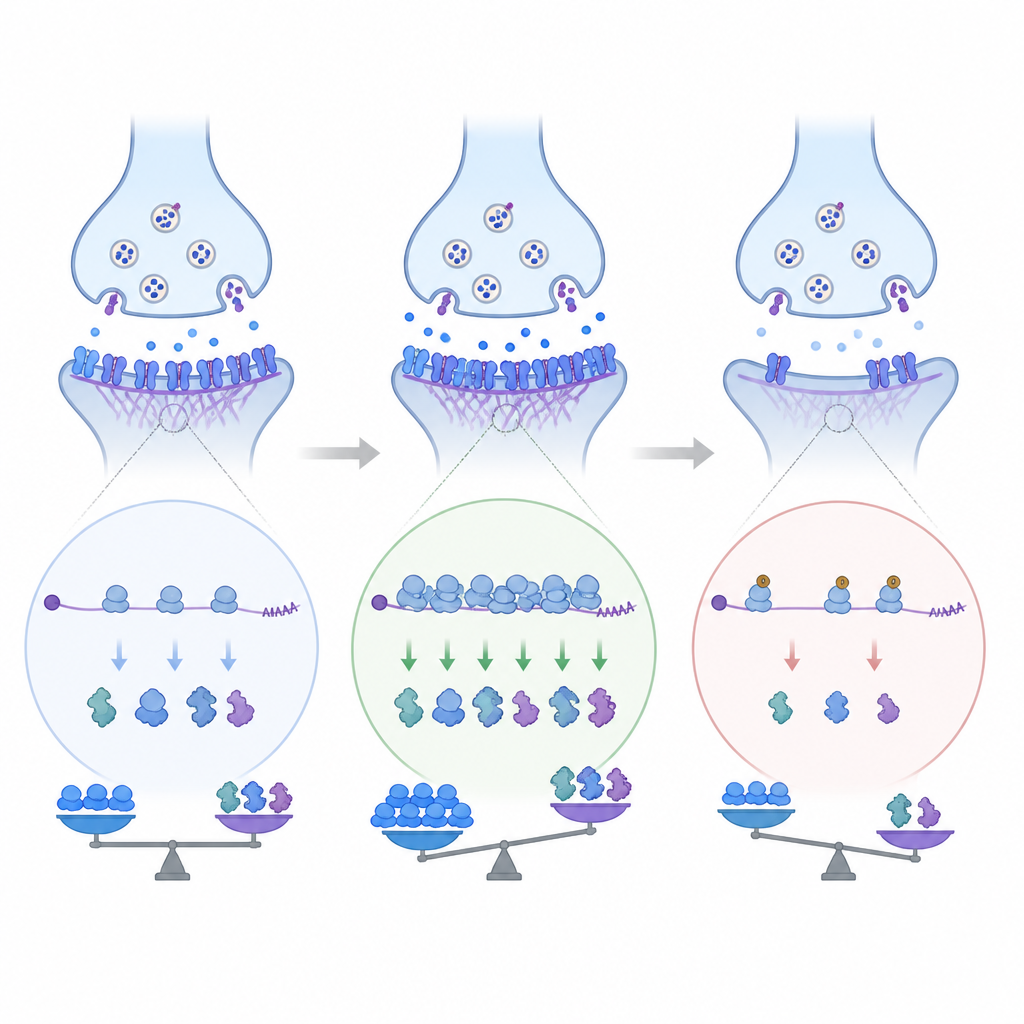
Behavior arises from microscopic changes at synapses, the contact points where neurons talk to each other. The scientists therefore compared the full sets of proteins in the cortex as a whole and in isolated synaptic particles. In the bulk cortex, removing MNK1 or MNK2 led to broadly similar and relatively modest shifts in protein levels. At synapses, however, the picture changed dramatically. Loss of MNK1 was linked to higher levels of many ribosomal proteins, the core components of the cell’s protein-making machinery. By contrast, loss of MNK2 led to lower levels of many synaptic proteins and altered patterns of chemical tags on these proteins, without the strong boost in ribosomal components.
Messages, Protein Factories, and Synaptic Structure
To test whether these synaptic changes came from altered supplies of genetic messages, the team sequenced mRNA from synaptic fractions. They found that MNK1 loss increased both ribosomal protein mRNAs and their encoded proteins at synapses, hinting at boosted local capacity for protein production. Yet the overall protein synthesis rate in synaptic compartments stayed roughly stable, suggesting that the extra ribosomal material may change which proteins are made rather than how much is made in total. Meanwhile, MNK2 loss mainly reduced synaptic protein levels and their phosphorylation states, and was tied to changes in signaling pathways, including those related to the mTOR system, a central regulator of growth and metabolism. Electron microscopy revealed that both knockouts slightly altered the size and thickness of postsynaptic densities, with more pronounced structural changes in MNK2-lacking mice.
What This Means for Brain Health and Future Treatments
The study paints MNK1 and MNK2 as specialized regulators at synapses. MNK1 appears to tune the availability of ribosomal components that can influence local translation and memory-related plasticity, while MNK2 more strongly shapes the amount and modification of synaptic proteins themselves. Because many experimental drugs block both MNKs at once, these results suggest that more selective targeting of MNK1 or MNK2 could allow finer control over social and cognitive functions while limiting unwanted effects. In plain terms, two nearly twin molecules turn out to fine-tune different sides of synaptic life, and understanding their distinct roles could eventually help design more precise therapies for brain disorders that involve disrupted protein production at synapses.
Citation: Proce, R.O., Steinecker, M., Giacomelli, C. et al. Distinct roles for MNK1 and MNK2 in social and cognitive behavior through kinase-specific regulation of the synaptic proteome and phosphoproteome. Mol Psychiatry 31, 3446–3461 (2026). https://doi.org/10.1038/s41380-026-03483-w
Keywords: synaptic translation, MNK1, MNK2, social behavior, memory