Clear Sky Science · en
Selective laser-induced etching process-enabled double-cavity glass MEMS hydrogen sensor at room-temperature sensitivity
Why Watching Hydrogen Matters
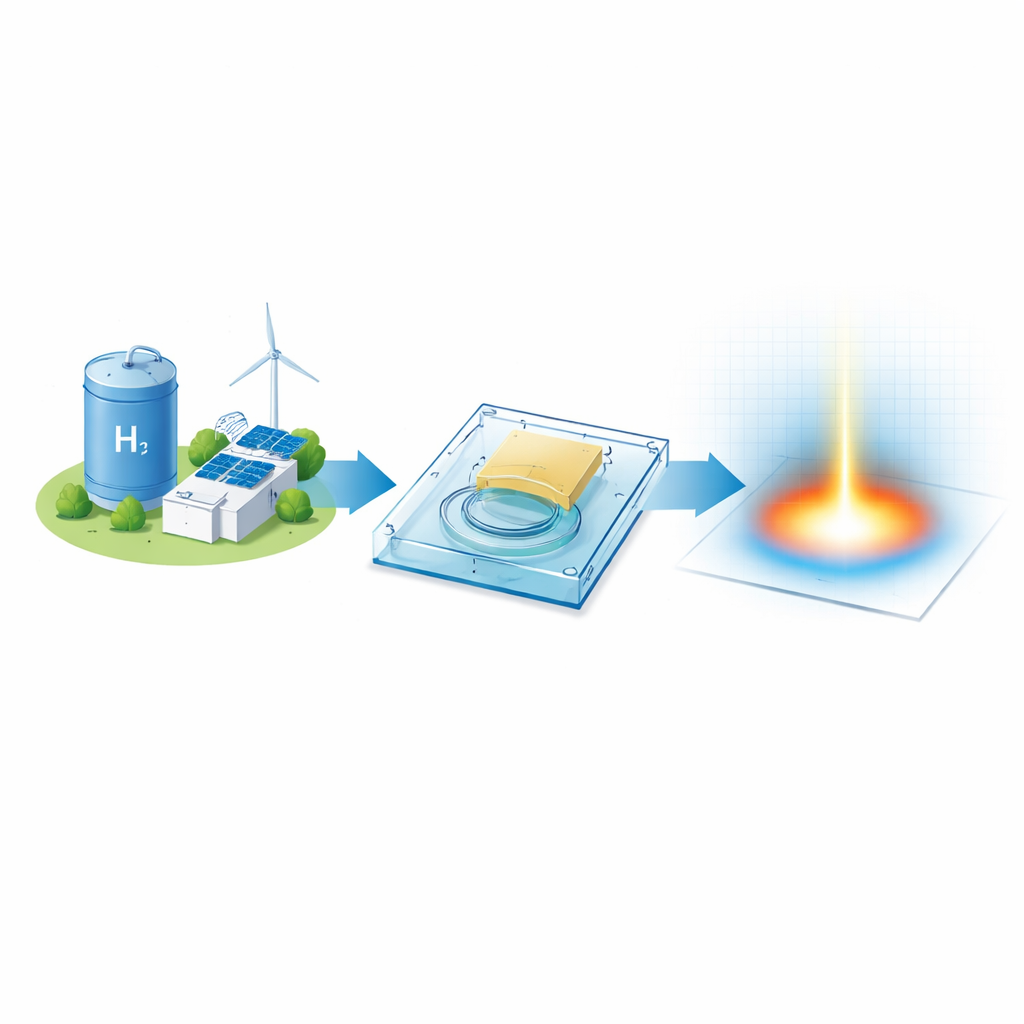
Hydrogen is moving from laboratory curiosity to everyday fuel, powering cars, backup generators, and even future homes. But hydrogen is also tricky: it can leak easily, it burns over a wide range of concentrations, and it’s hard to see or smell. This paper describes a new tiny hydrogen sensor, built in glass and smaller than a fingernail, that can spot leaks at room temperature while using very little power. By cleverly shaping empty spaces inside the glass and using a smart catalyst coating, the authors turn waste heat from chemical reactions into a clear electrical signal—making hydrogen monitoring safer and easier to integrate into portable electronics and miniature devices.
Tiny Device, Big Safety Job
Conventional hydrogen sensors often need to run hot—above 200 °C—and draw more than 100 milliwatts of power just to stay sensitive, which makes them bulky, energy-hungry, and hard to embed in phones, wearables, or compact industrial systems. The team behind this work set out to tackle that problem by rethinking both the material and the geometry of the sensor. Instead of using a traditional silicon base, which conducts heat very well and tends to drain warmth away from the sensing region, they turned to glass, a naturally poor heat conductor. Inside this glass platform, they built a microscopic suspended “membrane” that hosts the sensing elements and is exposed to hydrogen in the surrounding air. The goal: keep the sensing spot slightly warmer than its surroundings using only the heat released when hydrogen reacts on its surface, and then read that tiny temperature rise electrically.
Carving Hidden Cavities in Glass
At the heart of the device is a clever way of sculpting 3D structures inside a single glass wafer. The researchers use ultra-short laser pulses to weaken narrow paths within the glass, then bathe the wafer in a chemical etchant that dissolves only those laser-marked regions. Over time, many small holes grow sideways and merge into smooth, buried cavities beneath the sensing membrane. By writing two carefully placed patterns, they can create a “double cavity”: a deeper pocket directly under the membrane and an upper ring-shaped pocket that surrounds it. This stacked void structure disrupts sideways heat flow and acts like thermal insulation for the active area. Metal traces and comb-shaped platinum electrodes are then deposited through laser-cut openings, and a thin polymer film is patterned so that part of it becomes a suspended bridge over the cavities. Finally, small platinum catalyst islands are added exactly above the void region, where gas can reach them easily and heat cannot escape quickly.
Turning Hydrogen Heat into an Electrical Signal
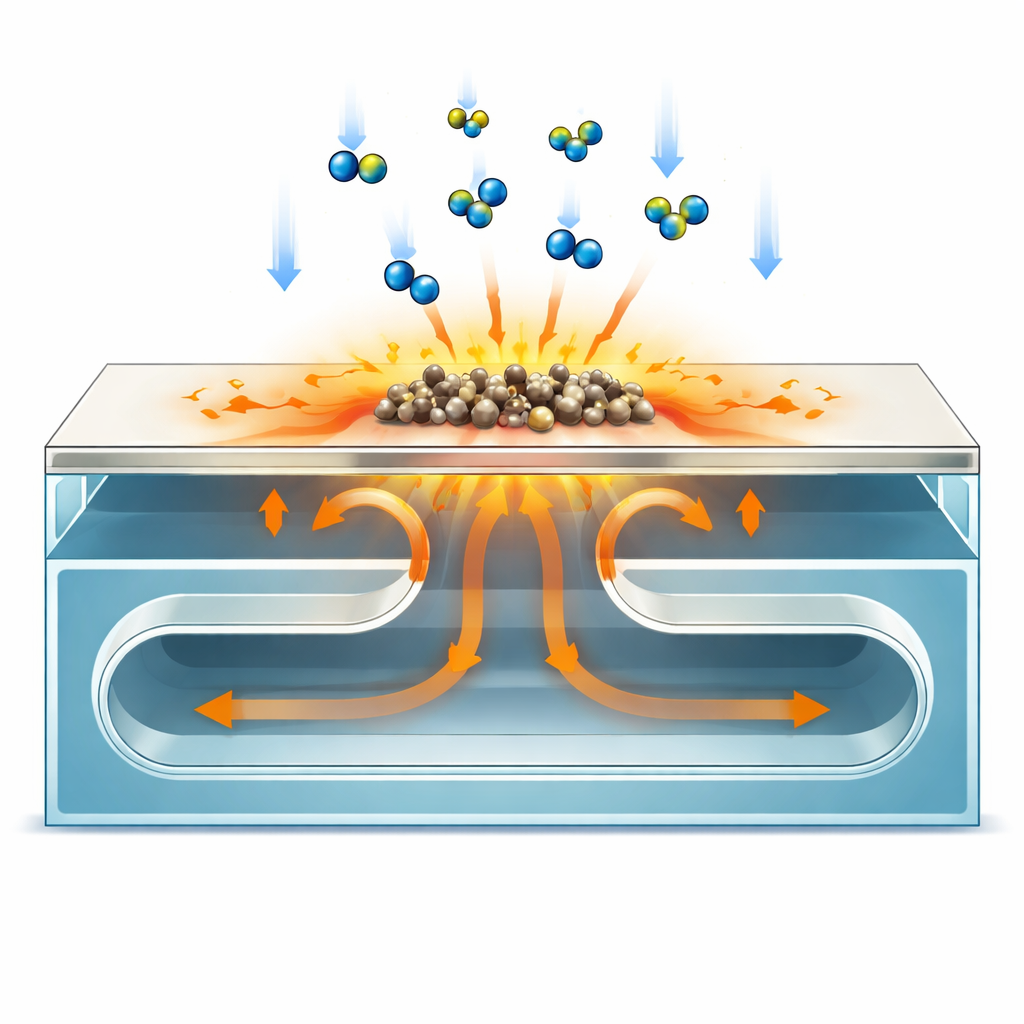
The sensing principle relies on a well-known reaction: hydrogen burns, even at very low levels, when it meets oxygen on a catalyst surface, releasing heat. On the membrane, platinum nanoparticles sit on specially designed nitrogen-doped carbon spheres, whose surface chemistry helps break hydrogen molecules apart and stabilize the resulting atoms. These atoms move—or “spill over”—from the metal onto the carbon support and react with oxygen adsorbed there, forming water vapor and releasing extra heat right at the sensor surface. A platinum resistor underneath responds to this micro-heating by slightly changing its electrical resistance. Because the double cavity and glass substrate trap this warmth instead of letting it leak away, the sensor’s temperature at the active spot climbs by about 10 °C compared with an otherwise identical flat structure. That modest boost translates into roughly ten times higher sensitivity at room temperature without adding more catalyst or power.
Designing a Better Catalyst Support
To further enhance performance, the authors tuned the microscopic carbon spheres that hold the platinum particles. These spheres are made by carefully heating melamine–formaldehyde resin so that it shrinks into nitrogen-rich, porous carbon without collapsing. By adjusting the starting recipe, they produced several versions with different pore sizes, surface areas, and chemical groups. Measurements showed that one version, labeled NCS-1, combined very high surface area, small pores, and a high content of particular nitrogen and oxygen sites that are especially good at stabilizing hydrogen atoms. When loaded with platinum, this support produced stronger and more linear responses to hydrogen than other variants. It also showed clear preference for hydrogen compared with common interfering gases such as ethanol, methanol, acetone, sulfur dioxide, and nitrogen dioxide, highlighting its selectivity.
How Much Better Is the New Sensor?
The team compared three otherwise similar sensor chips: one on a flat glass wafer, one with a single cavity under the membrane, and one with the full double-cavity design. Simulations and infrared imaging confirmed that the double-cavity chip held onto heat the best: after a brief heating impulse, its center cooled the slowest and stayed warmest. When coated with the optimized platinum-on-carbon catalyst, the double-cavity chip produced the largest resistance changes per unit of hydrogen concentration, about seven times higher than the flat chip for the same gas dose and roughly ten times more sensitive overall in the key concentration range. It did so while using less platinum than many other state-of-the-art hydrogen sensors and still delivered rapid, reversible responses at room temperature, demonstrating that smart thermal design can substitute for brute-force heating or heavy catalyst loading.
What This Means for Everyday Hydrogen Use
For non-specialists, the takeaway is simple: by carving tiny empty spaces inside glass and pairing them with a finely tuned catalyst, the authors have built a very small hydrogen alarm that runs “warm” without an external heater. This design allows the sensor to detect hydrogen leaks more effectively at normal room temperatures while using less power and less precious metal. Because it is made from a single glass wafer with laser-based steps, the process is also suitable for scaling up and integrating into many kinds of microsystems. As hydrogen becomes a more common energy carrier, such compact, low-power, and highly sensitive sensors will be essential for making its use as safe and practical as today’s familiar fuels.
Citation: Park, J.Y., Jang, B., Kim, J.Y. et al. Selective laser-induced etching process-enabled double-cavity glass MEMS hydrogen sensor at room-temperature sensitivity. Microsyst Nanoeng 12, 142 (2026). https://doi.org/10.1038/s41378-026-01265-6
Keywords: hydrogen gas sensor, MEMS, glass microcavity, catalytic combustion, room-temperature sensing