Clear Sky Science · en
Full-space inverse-designed meta-optics for complex vector field shaping of intracavity landscapes
Seeing Tiny Patterns with Sharper Eyes
Modern chips, sensors, and quantum devices all rely on arranging structures far smaller than the width of a human hair. Making and probing such tiny patterns pushes light to its limits, because ordinary lenses blur details below a certain size. This paper introduces a new way to sculpt light inside ultra-thin optical cavities so that they can faithfully "draw" and read out features far below the usual resolution limit, promising sharper nanofabrication and better control of light in future photonic technologies.
Why Small Details Are So Hard to Capture
Light behaves differently up close than it does at a distance. When it travels in open space, the finest details of an image are carried by fragile ripples called evanescent waves, which fade away before reaching a conventional lens. Engineers have learned to partially recover these details outside devices using carefully shaped surfaces called metasurfaces. But shaping the light field inside a closed cavity—such as the thin film where a pattern is recorded—has been much harder. In these cramped spaces, light bounces back and forth between boundaries, creating a tangled web of multiple reflections and polarized components that standard design methods struggle to tame.
A New Way to Design Light-Shaping Surfaces
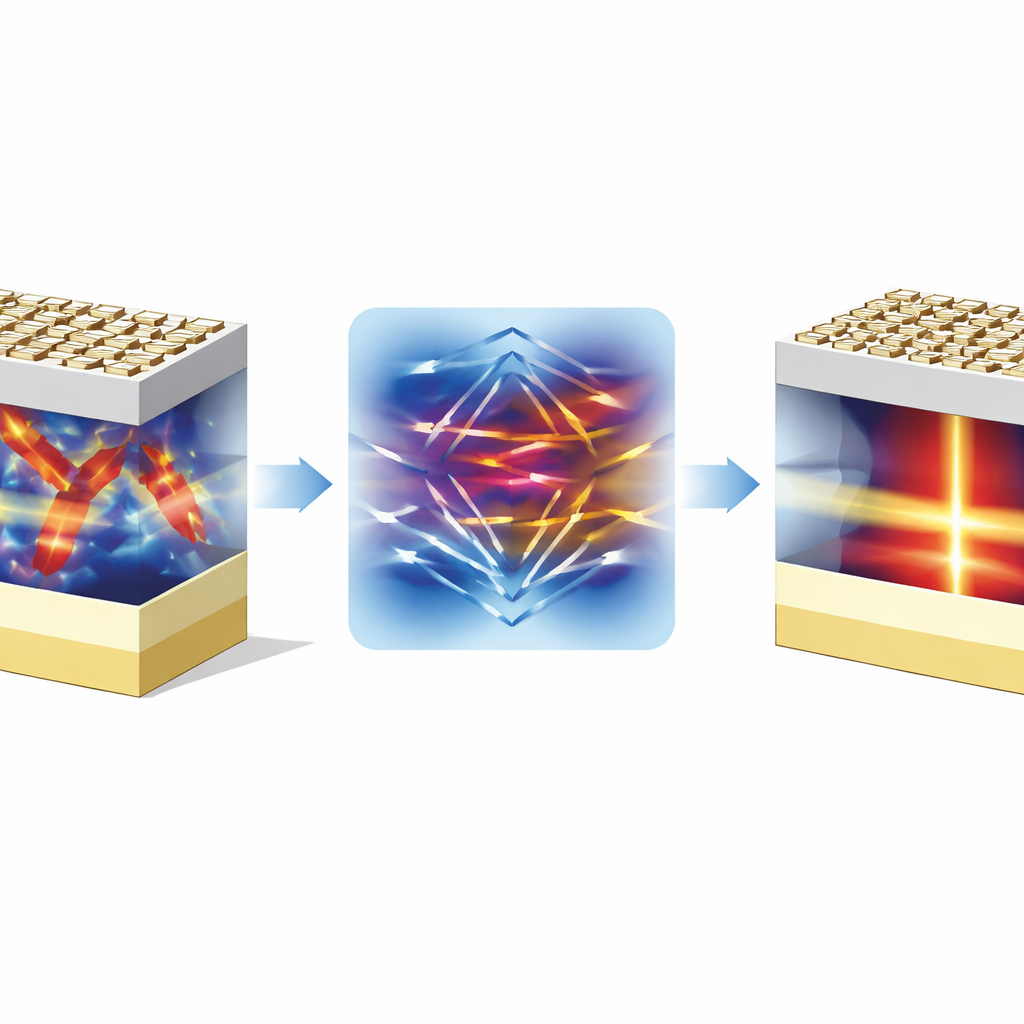
The authors present a general design framework that treats this tangled light field as something that can be guided on purpose, rather than endured as a nuisance. They use a mathematically efficient inverse-design strategy known as an adjoint method, extended here to what they call full-space operation. Instead of only considering waves that travel outward from a device, their method tracks all waves—those moving forward and backward, and in all relevant directions inside the cavity—while simultaneously accounting for the full vector nature of light. With just two cleverly chosen simulations per design step, the algorithm learns how small changes to a freeform metasurface mask will reshape the entire three-dimensional light landscape inside the cavity.
Turning a Plasmonic Superlens into a Precision Tool
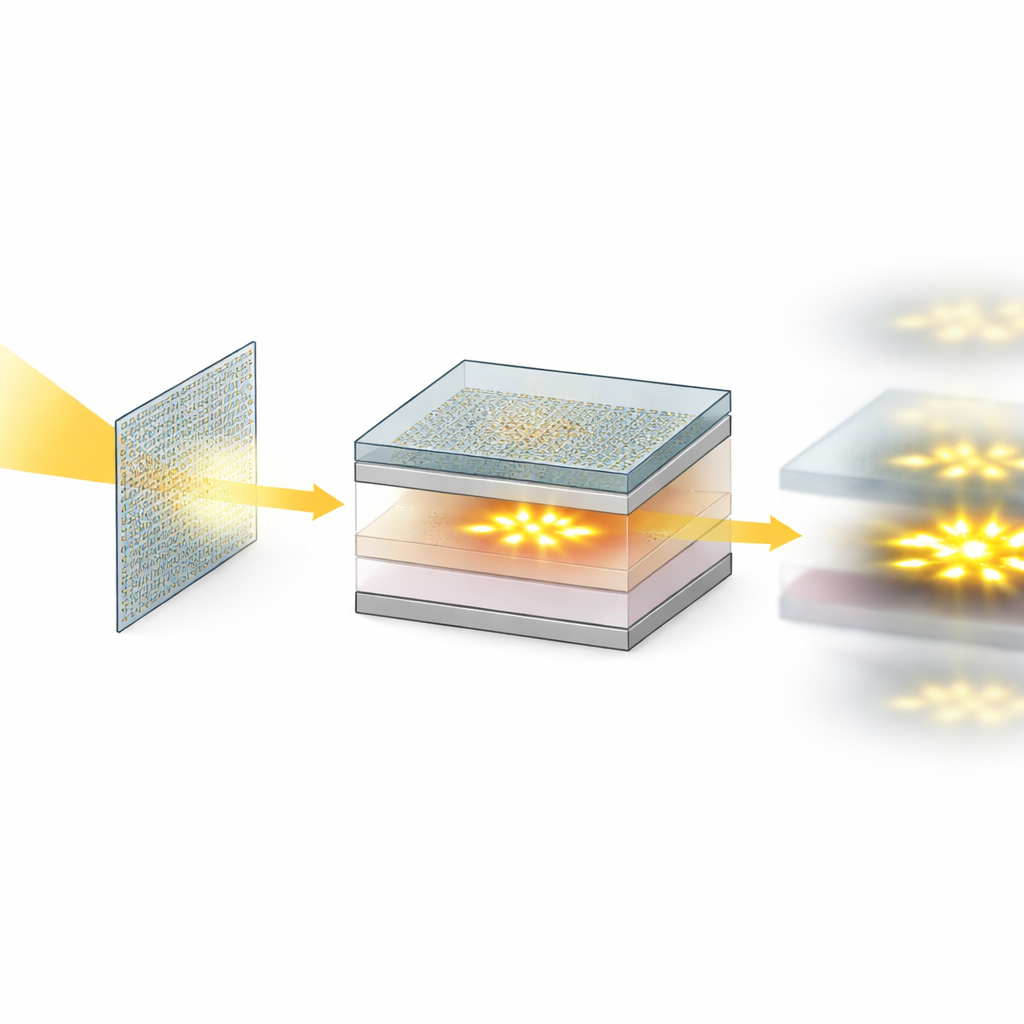
To demonstrate the power of the method, the team focuses on a plasmonic "superlens" system used for near-field lithography, a technique that can print patterns smaller than the wavelength of light. The setup consists of a patterned metal mask, a tiny air gap, a thin light-sensitive film, and a reflective metal layer beneath. Metals at certain colors can boost the fading evanescent waves at the film, in principle enabling super-resolution. In practice, however, existing models fail to predict all the subtle distortions caused by strong coupling and vector effects, leading to blurred edges, shrunken corners, and unintended extensions in the printed patterns. By iteratively adjusting the nanoscale layout of the mask with their full-space adjoint optimization, the authors train the superlens to correct these errors from within the cavity itself.
Sharper Patterns Beyond the Diffraction Limit
Using both simulations and experiments, the researchers show that their optimized masks dramatically improve how well the printed pattern matches the intended design, for a wide variety of shapes—from simple lines and crosses to stars, rings, and even complex text. A key performance measure, the area error ratio, drops on average by a factor of five compared with the initial designs, all while preserving a resolution of about one-fifth of the illumination wavelength, or roughly 70 nanometers at the violet color used here. Edges become cleaner and more accurately placed, and the approach proves robust against modest fabrication imperfections and alignment errors.
Opening Doors to New Light-Based Technologies
In esssence, this work shows that it is possible to algorithmically sculpt the full three-dimensional vector field of light inside a closed optical cavity, rather than merely shaping the wavefront entering it. That capability not only yields crisper, super-resolved images for nanofabrication, but also points toward finely controlling how light interacts with quantum emitters, tiny lasers, and exotic photonic structures. By providing a practical recipe for full-space inverse design, the study lays groundwork for a new generation of meta-optical devices that can manage light with unprecedented precision at the smallest scales.
Citation: Xu, M., Sang, D., Pu, M. et al. Full-space inverse-designed meta-optics for complex vector field shaping of intracavity landscapes. Light Sci Appl 15, 187 (2026). https://doi.org/10.1038/s41377-026-02258-w
Keywords: meta-optics, inverse design, near-field imaging, plasmonic cavity, super-resolution lithography