Clear Sky Science · en
National development pathways shape climate stress at cultural world heritage sites globally
Why our shared past is at risk
From ancient temples to historic city centers, many of the world’s most treasured places are quietly being damaged by a changing climate. Heat waves, damp air, and wild swings between hot and cold can slowly crack stone, warp wood, and weaken the buildings that hold our shared history. This study asks a deceptively simple question with global consequences: how much do a country’s development choices—its health systems, social safety nets, economies, and environmental policies—change the climate stress its heritage sites are facing?
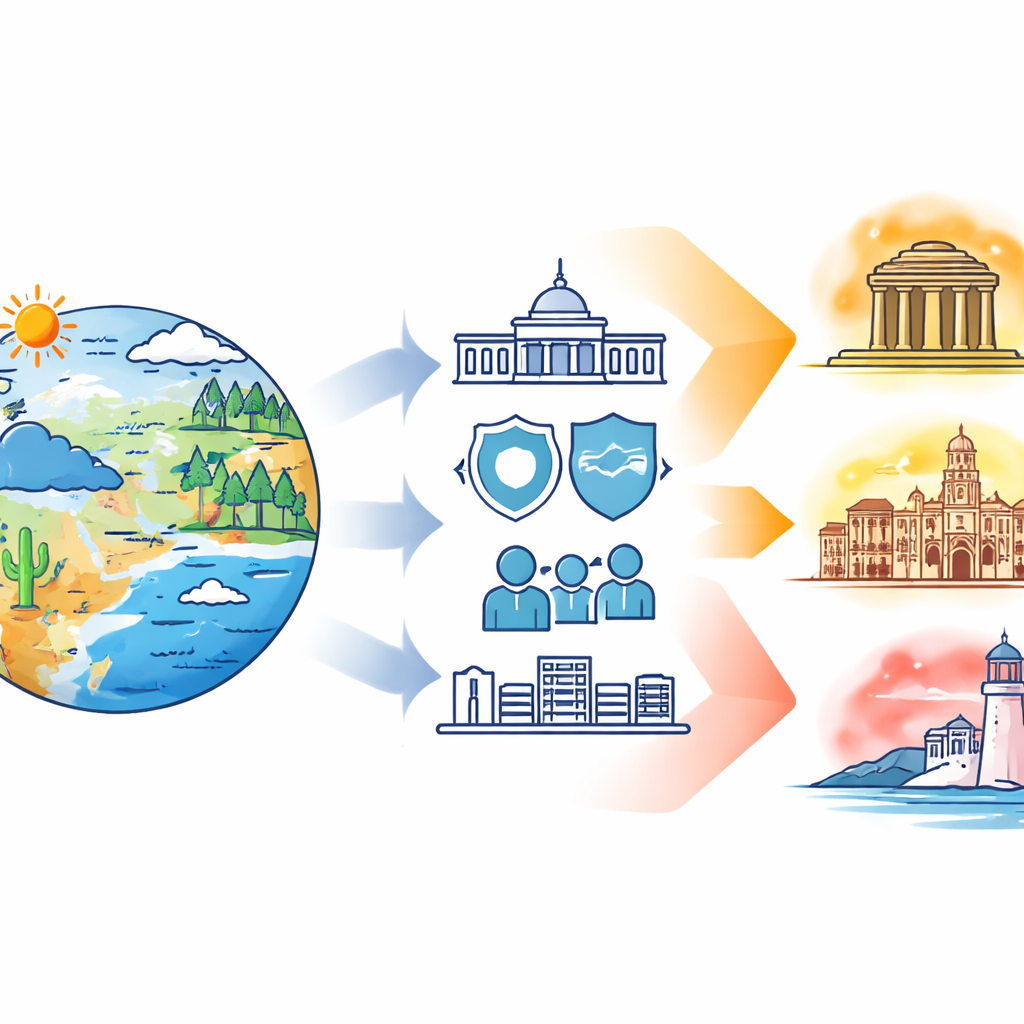
Looking at heritage through a new global lens
The authors introduce the Global Heritage Adaptation Portfolio Framework, or GHAPF, a tool that treats heritage climate risk as part of a bigger human–environment story. Instead of focusing only on what happens at each individual site, the framework looks at nearly 1,000 cultural and mixed World Heritage properties worldwide and connects their changing climate stress to broader national patterns. Climate-induced stress here means how often temperature and humidity swing beyond what typical building materials like stone and wood can safely tolerate, multiplied by how much of those buildings’ surfaces are exposed. This gives a measure of the “risk environment” around heritage, rather than a direct tally of cracks or corrosion.
Measuring invisible climate wear and tear
To build this picture, the team first combined high-resolution 3D maps of buildings inside UNESCO site boundaries with detailed climate records. For two 30‑year periods—1961–1991 and 2010–2040—they calculated how often short bursts of heat and moisture exceeded known damage thresholds for wood and stone, then adjusted for how much wall and roof area was exposed to outdoor air. The change between the past and present windows is their key outcome: if this number rises, heritage in that country is living in a harsher climate envelope; if it falls or stays flat, the external stress is stable or easing. On average, the world has seen a clear increase in such stress, meaning many sites are now facing more frequent harmful temperature–humidity swings than in the late 20th century.
Connecting national choices to heritage stress
Next, the researchers asked how national development pathways might shape this changing stress. They drew on about 1,500 World Bank indicators—covering health, education, environment, trade, governance, and more—from 1995 to 2020. Using an interpretable machine‑learning approach, they identified which patterns in these indicators are most strongly linked to higher or lower climate stress at heritage sites. Although the model explains about one‑third of the differences between countries, a clear signal emerges: in many places, better environmental management, stronger health systems, broader social protection, higher labor participation, and more effective public institutions are consistently associated with lower predicted climate stress around heritage. In other words, when societies invest in people’s well‑being and in fair, functioning institutions, their historic buildings tend to face less damaging climate pressure.
Uneven protections and hidden gaps
The study also reveals a striking contrast between richer and poorer nations. Developing countries often show a wider mix of helpful policy areas—many domains each contributing a little to reducing stress—yet the total impact per domain is modest. High‑income countries, by contrast, tend to lean on fewer domains, but each of those has a stronger stress‑reducing association. Some countries, especially in Central Asia and parts of the Global South, experience far higher climate stress than their development records alone would suggest, hinting at extra pressures such as harsher local climates, fragile building materials, or weak on‑the‑ground site management. Others, especially in high latitudes, fare better than expected, potentially reflecting lower exposure or more resilient conservation practices. These patterns point to a form of climate injustice: many low‑ and middle‑income countries host vulnerable heritage yet have fewer resources to safeguard it.

Turning development into a shield for history
For non‑specialists, the main message is that protecting the world’s cultural treasures is not just about scaffolds, stone repairs, or museum climate control. The study suggests that healthier populations, stronger social safety nets, fairer labor markets, and capable public institutions can all act like a national “buffer” against climate damage to heritage. The Global Heritage Adaptation Portfolio Framework offers governments a way to see which parts of their development strategy quietly help—or hurt—their historic sites, and where closing gaps in health, governance, and environmental policy could deliver the biggest resilience gains. While local conservation work remains essential, aligning it with broader climate‑smart development may give our shared heritage a better chance of surviving in an increasingly unstable climate.
Citation: Cui, H., Chen, Z., Wang, Z. et al. National development pathways shape climate stress at cultural world heritage sites globally. npj Herit. Sci. 14, 255 (2026). https://doi.org/10.1038/s40494-026-02529-0
Keywords: cultural heritage, climate change, world heritage sites, sustainable development, adaptation policy