Clear Sky Science · en
Climate risk assessment of China’s Cultural World Heritage highlights urgent need for adaptation
Why Ancient Places Face Modern Weather
From the Great Wall to mountain temples and cliff-side grottoes, China’s cultural treasures were built to last centuries. But they were not designed for the rapid, human‑driven climate changes now unfolding. This study asks a simple yet unsettling question: how will hotter temperatures and more violent rainstorms reshape the future of these irreplaceable places, and what must be done now to protect them?
Taking the Measure of Threats
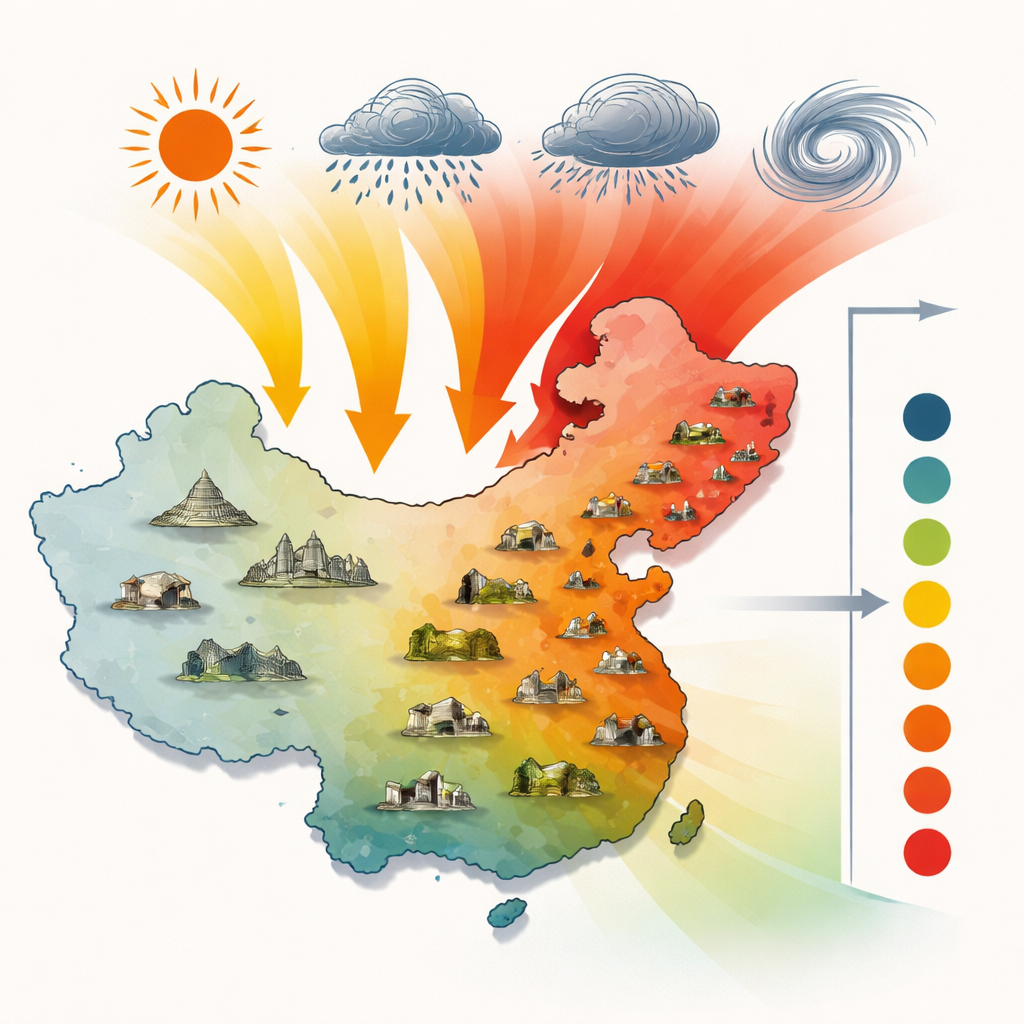
The researchers examined 39 Cultural World Heritage properties across China, covering 148 individual sites and their surrounding buffer zones. These places include ancient wooden temples, stone grottoes, historic towns, and iconic cultural landscapes such as lakes and rice terraces. Using the latest climate model projections, they looked at both gradual shifts in average temperature and rainfall and spikes in extremes: sweltering heat, intense downpours, and prolonged wet or dry spells. They then combined these projections with expert judgments about how vulnerable each type of building material and landscape is to different kinds of weather stress.
From Gentle Wear to Sudden Damage
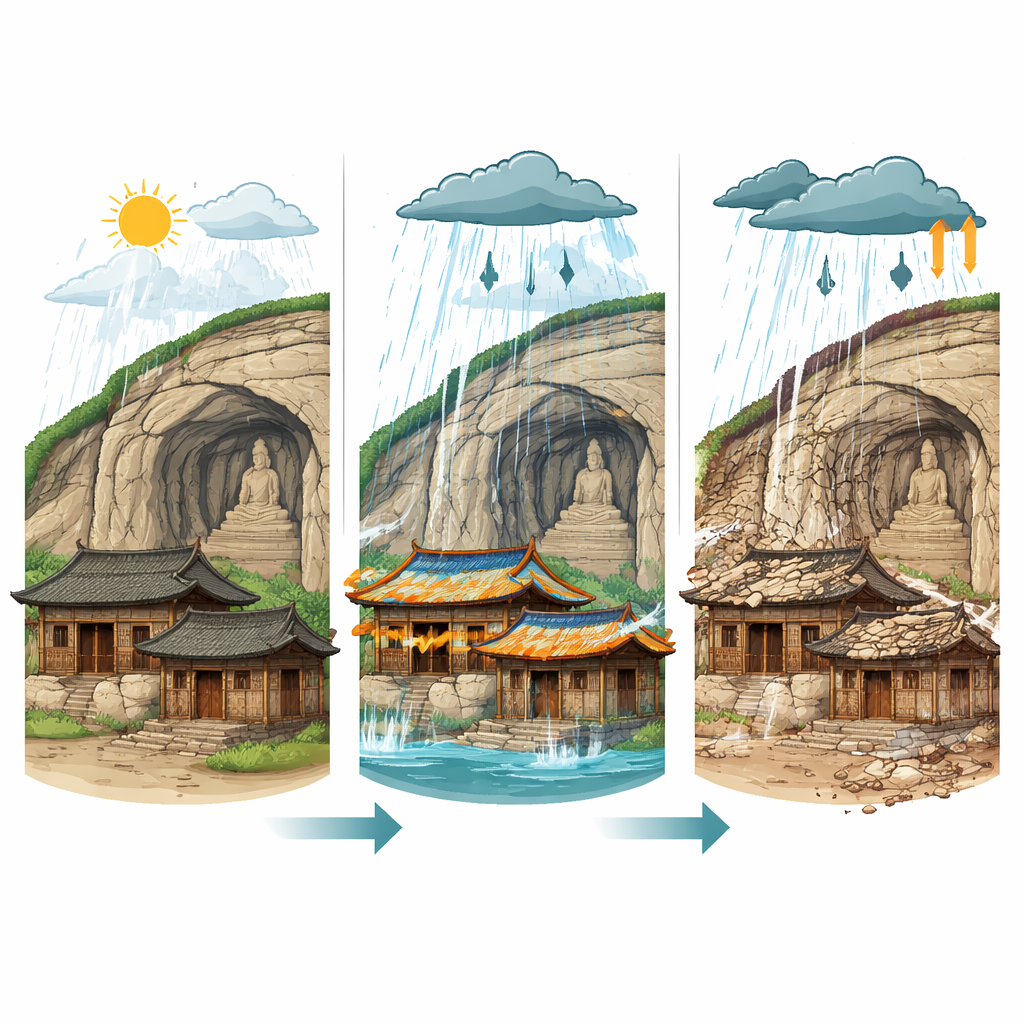
Why focus so much on rain and heat? Moisture seeping into bricks, tiles, wood, and rock can cause a cascade of problems: swelling, cracking, erosion, and biological growth like moss and microbes that slowly eat away at surfaces. When heavy rains arrive in short bursts, they can trigger floods, landslides, and debris flows that stain, fragment, or even collapse parts of a site. Large swings between freezing and thawing, or between cool nights and scorching days, make these effects worse by repeatedly expanding and contracting materials. The team found that, overall, extreme events—such as very wet days and warm spells—pose more serious dangers than gradual shifts in average climate.
How Risk Climbs Across China
Even under a moderate emissions pathway, the outlook is sobering. By the middle of this century, climate risk is projected to rise for more than four out of five sites studied. By the late 2100s, every one of the 39 properties reaches at least a moderate risk level, and about one‑third move from little or no risk today into high or even extreme risk. Ancient Architectural Structures—wooden halls, tiled roofs, and stone platforms—are especially exposed, with two‑thirds of these sites seeing sharp increases in risk. Mount Wutai and the Yungang Grottoes, both in Shanxi Province, are highlighted as near‑term hotspots: already affected by roof leaks and rock weathering from heavy rains, they are expected to face moderate to high risk within decades and high to extreme risk by century’s end.
Cities, Crowds, and Compounding Pressures
Over half of the heritage properties lie in cities or their outskirts, where climate change interacts with air pollution, dense development, and heavy tourism. Nine urban sites are projected to reach extreme risk by 2100 regardless of how quickly emissions fall. For example, the palace‑garden complex at Chengde, classical gardens in Suzhou, the West Lake landscape in Hangzhou, and the Potala Palace in Lhasa all face intensifying threats from extreme rainfall, heat, and related ecological changes. Some sites have begun responding through better drainage, afforestation to stabilize slopes and cool the surroundings, fire‑prevention systems, careful visitor management, and the use of improved traditional materials, such as more durable clay roof tiles that better resist soaking rains and freeze–thaw cycles.
Planning Ahead, Not Just Patching Up
The study does more than sound an alarm; it also points to gaps in current practice. The authors note that their risk maps are a first, broad‑scale screening and do not yet fully capture local details such as the exact strength of materials, existing reinforcements, or the benefits of ongoing conservation work. Still, the patterns are clear enough to guide priorities: managers should quickly follow up with site‑specific assessments, integrate climate projections into everyday planning, and expand monitoring to track how damage evolves over time. They also argue that thousands of lesser‑known sites beyond the World Heritage list likely face equal or greater danger, often with fewer resources to cope.
Saving Stories Written in Stone and Wood
For a general reader, the message is straightforward: climate change is not only about sea ice and coral reefs; it is also about temples, villages, gardens, and rock carvings that carry the stories of civilizations. This research shows that, without both rapid cuts in greenhouse gas emissions and thoughtful adaptation—such as smarter drainage, stronger yet sensitive repairs, and community‑based care—many of China’s most treasured places could suffer irreversible harm within a human lifetime. Acting now can help ensure that these cultural landmarks, and the memories they embody, survive the century ahead.
Citation: Lei, T., Wang, J., Jiang, Y. et al. Climate risk assessment of China’s Cultural World Heritage highlights urgent need for adaptation. npj Herit. Sci. 14, 257 (2026). https://doi.org/10.1038/s40494-026-02512-9
Keywords: cultural heritage and climate change, China World Heritage risk, extreme weather impacts on monuments, heritage adaptation planning, historic sites conservation