Clear Sky Science · en
Portable XRF for paintings and metals authentication: a critical guide to some practical limitations and multi-technique integrations
How Science Helps Spot Fake Art
When we admire a painting or an ancient bronze in a museum, we quietly trust that it is real. But the art market is awash with clever forgeries, and even experts can be fooled. This article explains how a pocket-sized scientific tool—portable X-ray fluorescence, or pXRF—has become a favorite weapon against fakes, and why it must be used with care. By walking through real investigations on coffins, paintings, and metal objects, the authors show both the power and the pitfalls of this technology, and why a team of specialists and multiple methods are needed to tell truth from trickery.
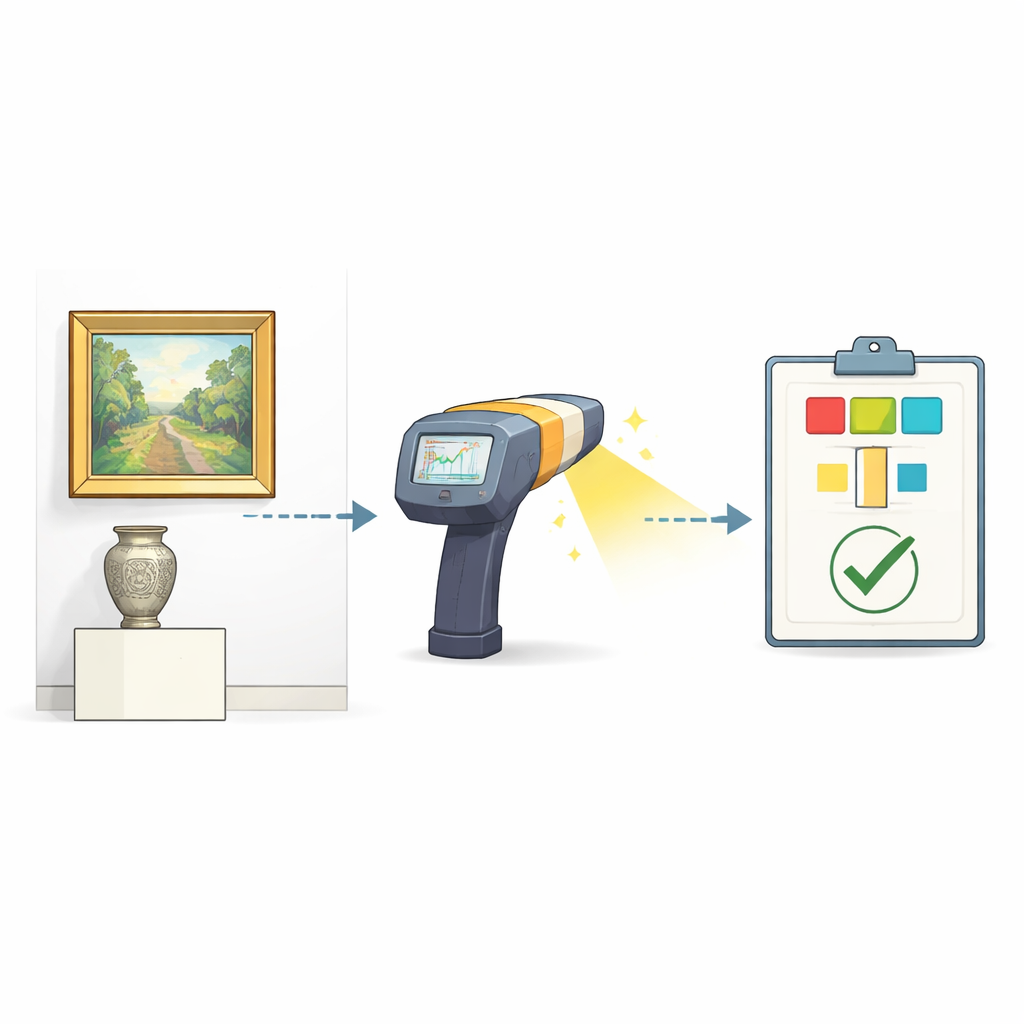
A Handheld X-Ray for Art
At the heart of the story is X-ray fluorescence, a method that reveals which chemical elements are present in a material. An X-ray beam excites atoms in the object; as they relax, they emit their own characteristic X-rays that act like elemental fingerprints. Over the past century, engineers have shrunk bulky lab instruments into portable and even handheld devices. These tools can be taken directly to paintings, statues, or coins, shining X-rays on the surface without cutting or sampling. That portability has transformed museum work and police investigations, but it has also tempted users to overtrust quick readings that are, in reality, only a first glimpse into complex materials.
Why Quick Readings Can Mislead
The article stresses that pXRF results are easy to misinterpret. The device reports which elements are present and roughly how much of each, but it does not tell us how they are combined or how they are layered in depth. Light elements and organic materials, common in many pigments and binders, are nearly invisible to the technique. Layers of paint, dirt, restoration coatings, or burial corrosion can all blur the signal. Without careful reference materials and an understanding of how X-rays are absorbed in different substances, even experienced users can mistake one pigment for another or misread a surface treatment as part of the original artwork. Regulations on X-ray power and differences between generations of instruments further complicate comparisons with older studies.
Real Cases: From Coffins to "Old" Paintings
To make these issues concrete, the authors present case studies. On an ancient Egyptian sarcophagus, pXRF detected elements like calcium, iron, and arsenic. At first glance this suggested certain red and yellow pigments. But dust, conservation treatments, and multiple hidden layers could all produce similar signals, making any single reading uncertain. In another case, a charming oil painting on glass, said to be from the 18th century, contained a modern white pigment rich in titanium, revealed clearly by pXRF. Here, the elemental fingerprint exposed a forgery: titanium-based whites simply did not exist in fine-art paints of that period. Other examples show how blue areas in a painting can be misread, with one region colored not by a blue pigment at all, but by a subtle mixture of white, black, and red, and how a once-rare ancient blue pigment unexpectedly reappearing in Renaissance works can serve as a strong sign of authenticity rather than fraud.
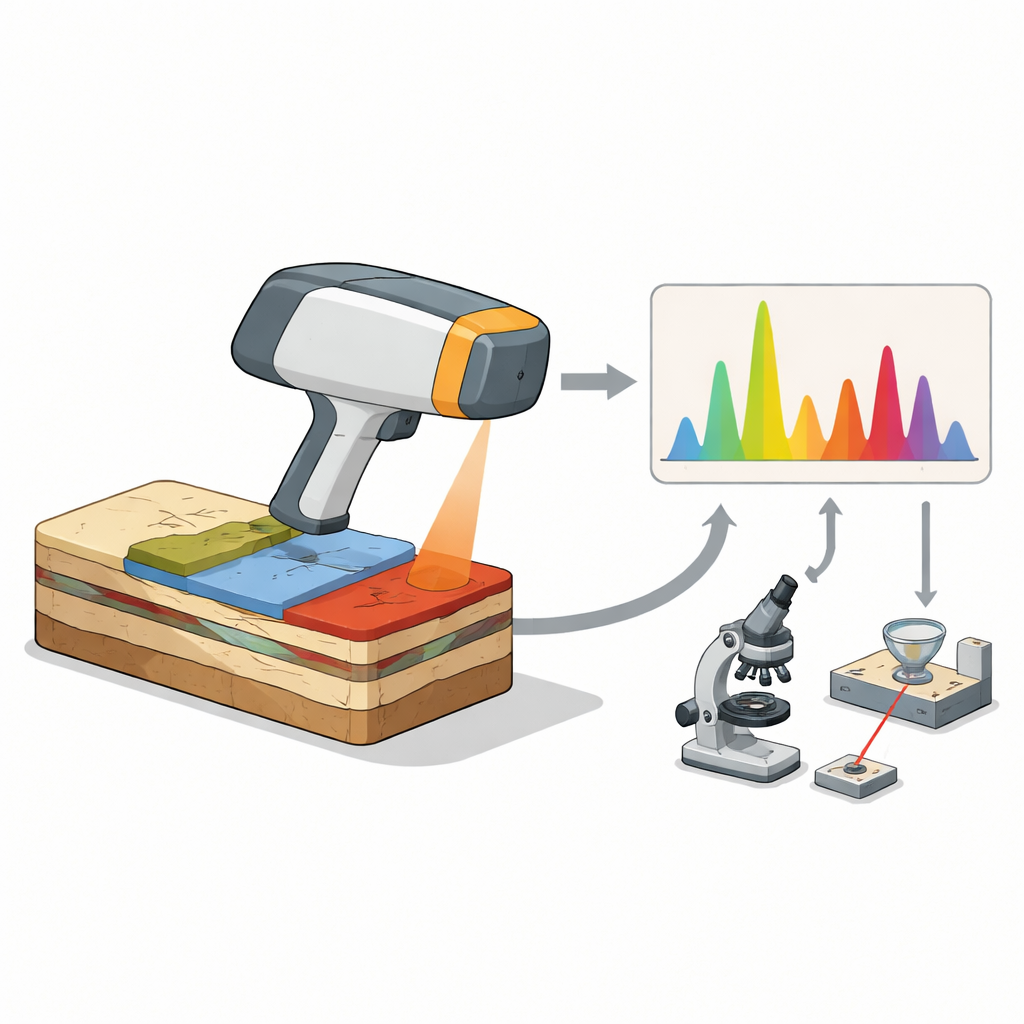
Metals, Surfaces, and Hidden Histories
The discussion then turns to metal artifacts, which might seem simpler to analyze because they are more uniform than layered paintings. Yet even here, pXRF can be deceptive. The surface of a bronze or brass object may be enriched or depleted in certain elements by centuries of corrosion or past cleaning methods, so surface readings often do not reflect the original alloy. For example, an Etruscan vessel once appeared suspicious because of unusually high zinc levels at the surface, only for deeper tests to show that treatment residues, not the original metal, were responsible. Thresholds such as “too much zinc must mean a fake” can therefore be dangerous when based only on handheld surface scans.
Why Many Eyes and Many Tools Are Essential
To make pXRF truly reliable for authentication, the authors argue it must be embedded in a broader “multi-analytical” strategy. Other techniques—such as microscopes that examine cross-sections of tiny paint chips, light-based methods that map pigments over a whole surface, and high-resolution spectroscopies that identify exact compounds—can confirm or correct what the handheld device suggests. Equally important are legal standards, radiation safety rules, and professional qualifications, especially when findings may appear in court. Looking ahead, richer scanning modes and artificial intelligence may help decode complex XRF data, but only if they are trained on carefully vetted studies that avoid past misinterpretations.
What This Means for Art Lovers
In the end, the article concludes that portable X-ray fluorescence is an indispensable but limited tool. It can swiftly reveal telling clues—such as a modern pigment in a “centuries-old” painting or unusual elements in a coin—but its readings are never the whole story. To decide whether an artwork is genuine, experts must combine pXRF with other scientific methods and with deep historical knowledge. For the public, this means that behind every authenticity verdict lies not a single magic gadget, but a careful, collaborative detective process that respects both science and art.
Citation: Nicola, M., Matullo, L., Marello, A. et al. Portable XRF for paintings and metals authentication: a critical guide to some practical limitations and multi-technique integrations. npj Herit. Sci. 14, 256 (2026). https://doi.org/10.1038/s40494-026-02499-3
Keywords: art authentication, portable XRF, heritage science, painting pigments, metal artifacts