Clear Sky Science · en
Assessment of manufacturing processes and materials characterization on a collection of ancient Chinese Jades
Why these ancient stones still matter
Across thousands of years, people in China carved jade into rings, blades, pendants and tiny animals that signaled power, belief and beauty. Today, museums must decide whether such treasures are truly ancient masterpieces or clever modern imitations. This study follows a set of 14 supposed ancient Chinese jades in the Museum of Oriental Art in Turin, Italy, showing how scientists can peer beneath polished surfaces without taking a single chip, and how their findings reshape what we think we know about the past.
What the museum had behind closed doors
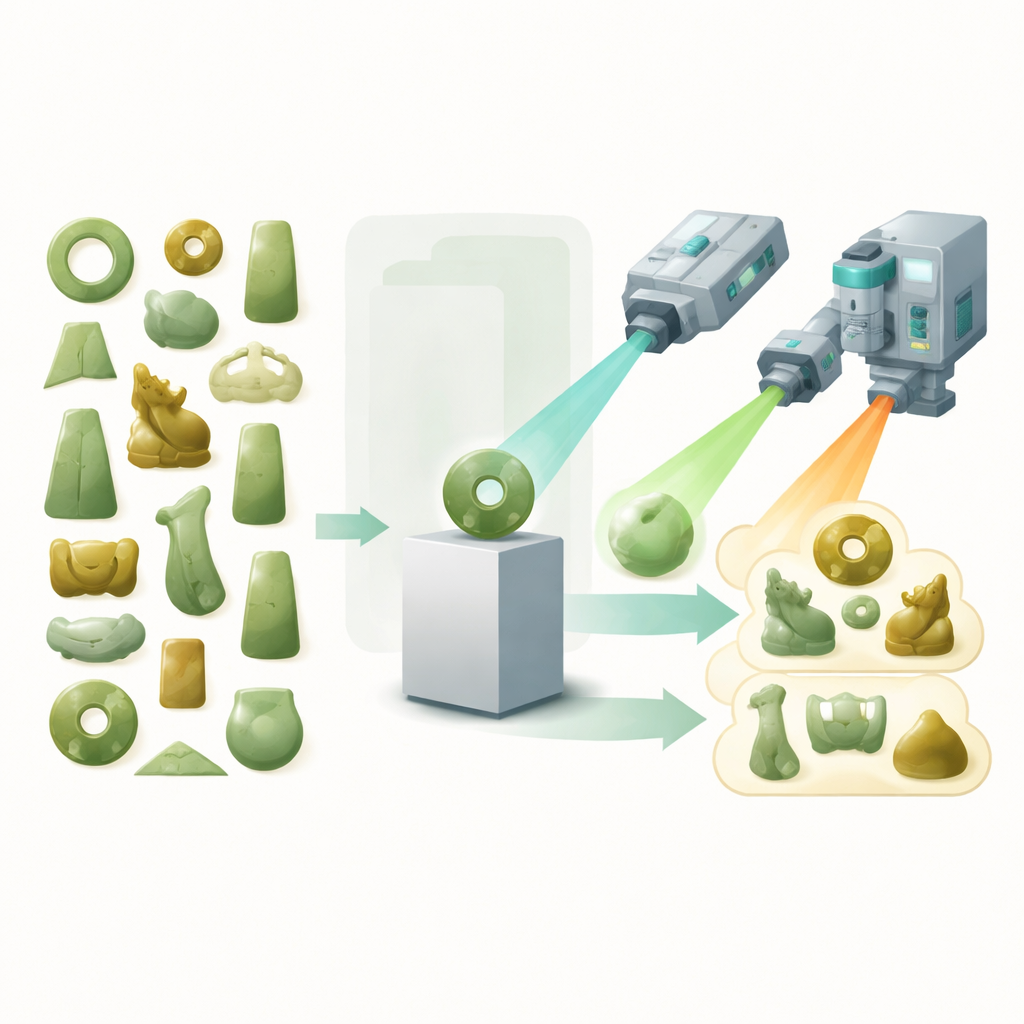
The collection includes a small but varied group of objects, all bought on the legal art market and never shown to the public. There are three flat rings with central holes, ritual blades and axe heads, a model halberd, and several three-dimensional pieces: delicate dragon pendants, a feline-shaped buckle, a spiral creature, and a cicada-shaped amulet once meant for the tomb. Stylistic clues suggested dates from the Neolithic era through the Han dynasty, a span of more than two thousand years. Yet curators were uneasy: some stones did not feel hard enough, tool marks looked odd, and colored coatings raised suspicions that several pieces might not be what they claimed.
How science looks inside a carved stone
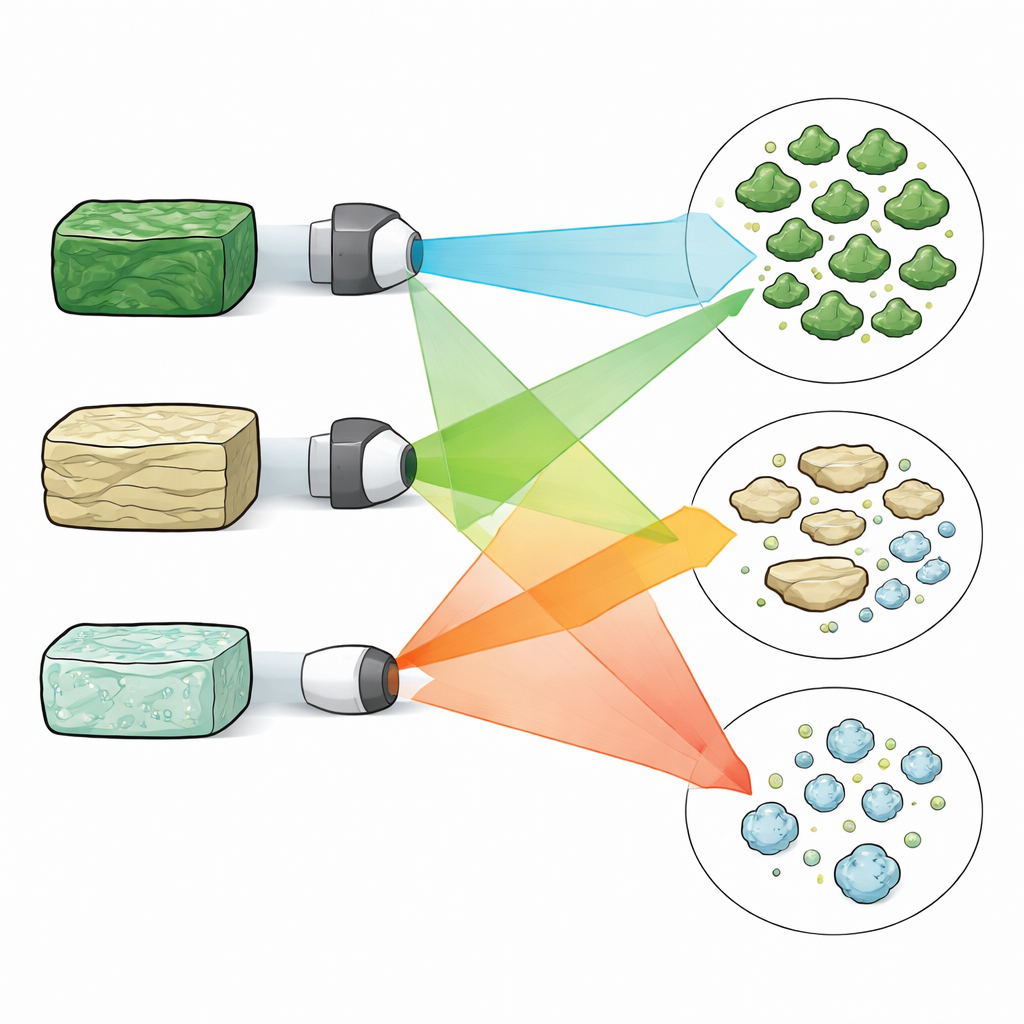
Because these artefacts are precious, the team used only non-destructive methods. Under strong incident and raking light, optical microscopes revealed faint grooves, circular drill traces and polishing patterns that record how a hand once moved across the stone. Portable X-ray fluorescence measured which elements—such as magnesium, calcium, iron or lead—were concentrated in each piece. Raman and infrared spectroscopy probed the vibrational “fingerprints” of minerals, while micro X-ray diffraction identified their crystal structures. Statistical tools then compared all these signals, grouping objects that shared similar compositions and separating those that clearly differed.
Sorting true jade from look‑alikes
The analyses showed that eight objects are carved from nephrite, the tough, interwoven mineral that underlies most early Chinese jade. Their chemistry, fine structure and surface traces match what is known from excavated pieces: green “spinach” varieties from specific regions, traditional drilling and string-saw marks inside pierced holes, and painstaking hand-finishing on openwork designs. In several dragon pendants and a spiral creature, the scientists also detected tiny grains of cinnabar, a bright red pigment long used to decorate ritual jades, further tying these pieces to ancient practices. In contrast, six items turned out to be made from much softer or unusual materials such as talc, magnesite, calcite, dickite, serpentine and even a likely lead-rich glassy substance hidden beneath a crumbling outer crust.
When fakes and later copies leave clues
These non-jade materials do not automatically prove forgery, because ancient artisans sometimes used more modest stones when true jade was rare or expensive. However, several pieces raised red flags when composition, craftsmanship and style were considered together. Two axe-like blades carved mostly from talc—a mineral softer than a fingernail—show chemical signs that parts of the surface may have been heated or altered, and there is little historical evidence that such soft talc was widely used to imitate jade weapons. A halberd-shaped piece in dickite shows sharp machine-like cuts and engraving errors in its characters, hinting at a modern workshop. The cicada amulet is the most puzzling: its brittle, layered body, lead-rich chemistry, glassy fractures and embedded bubbles resemble ancient lead glass that once imitated jade, but heavy corrosion and new crystalline crusts make its original nature and age hard to pin down.
What this means for museums and visitors
By combining close visual inspection with gentle beams of light and X-rays, the researchers could confirm that eight artefacts are consistent with genuine ancient nephrite jades, both in material and in the way they were carved. The remaining six pieces likely include later copies, experiments with cheaper stones, or heavily altered glass imitations. For a layperson, the message is straightforward: science can help museums tell honest stories about their treasures, distinguishing true witnesses of early Chinese craftsmanship from objects that only pretend to share that past. This careful work not only protects cultural heritage but also helps visitors appreciate how much knowledge—and uncertainty—can lie within a single shining green stone.
Citation: Giustetto, R., Berruto, G., Curetti, N. et al. Assessment of manufacturing processes and materials characterization on a collection of ancient Chinese Jades. npj Herit. Sci. 14, 292 (2026). https://doi.org/10.1038/s40494-026-02497-5
Keywords: Chinese jade, artefact authenticity, museum science, nephrite analysis, archaeometry