Clear Sky Science · en
A pilot study evaluating challenges using handheld XRF for provenance studies of bronze sculptures
Tracing Artworks Without Leaving a Scratch
When a bronze sculpture changes hands—or suddenly appears on the market—curators and collectors need to know: is it an authentic cast from the artist’s lifetime, or a later, unauthorized copy? Traditional laboratory methods can answer this, but they often require removing a small sample of metal, which is rarely acceptable for valuable art. This study explores whether a simple handheld scanner, already common in the mining industry, can read the metal and surface layers of bronze sculptures well enough to help pinpoint where they were cast, without damaging them.
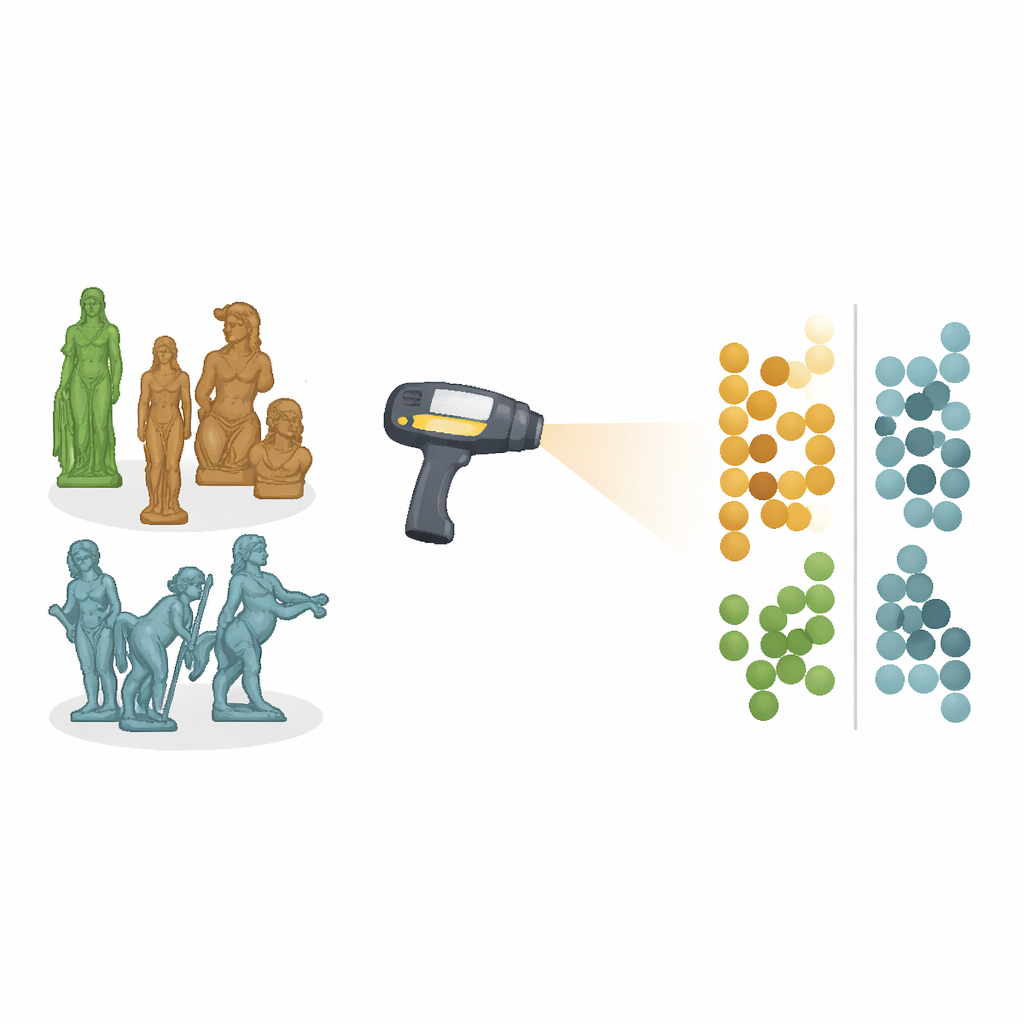
A Sculptor, His Foundries, and the Problem of Copies
The research focuses on Anton van Wouw, a leading early twentieth-century sculptor whose works are central to South African cultural history. Because his studio and many of his sculptures were left to the University of Pretoria, the collection’s ownership history is unusually well documented. Van Wouw also relied on only a few bronze foundries in Italy and Britain, which makes it an ideal test case: if differences in metal recipe and surface treatment between foundries can be detected reliably, they might form a kind of “material signature” that ties each sculpture to the workshop that produced it. That, in turn, could help distinguish original casts from later imitations.
Using a Portable Scanner on Complex Surfaces
The team used a handheld X-ray fluorescence (XRF) spectrometer, a device that fires X-rays into the metal and measures the energies of the fluorescent X-rays that come back. These energies reveal which elements are present and in what approximate proportions. Unlike more precise laboratory techniques, XRF does not require cutting or drilling—an enormous advantage for artworks. But sculptures are not ideal samples: their undersides are uneven, difficult to reach, often dirty or covered with casting residues, and sometimes patched with screws or welds. Repeated measurements on nominally similar spots showed that these practical complications create noticeable variations in the readings, especially for elements present in small amounts.
What Lies Beneath the Colored Skin of Bronze
Bronze sculptures are almost always finished with a patina—an intentionally formed surface layer that gives them their color and character. Traditionally, foundries used mixtures based on sulfur compounds and iron salts, sometimes made from improvised recipes. Initially, the researchers tried to measure only the bare metal on the underside of the sculptures, but they found that access difficulties and hidden inclusions limited how well they could distinguish one foundry from another. By contrast, the patinated top surfaces were smoother and more uniform. X-rays could easily pass through the thin patina and sample both the surface layer and the underlying alloy at once. Because each foundry tended to use its own combination of metal composition and patina chemicals, this combined signal turned out to be a useful fingerprint.

Distinct Material Fingerprints Emerge
Analyses of nine sculptures from three foundries showed that, despite measurement noise, consistent differences were visible. For instance, bronzes from one British foundry contained more titanium, while certain Italian foundries showed chromium or higher lead levels, reflecting different metal recipes. Differences in the surface treatments were also apparent: some patinas clearly contained sulfur and potassium compounds, and in one foundry’s works the presence of chlorine pointed to a patina made with ferric chloride. When spectra from similar locations on the top and underside of the same sculpture were compared, the way X-ray peaks were partially absorbed by the patina confirmed that the instrument was indeed sensing metal from different depths. Together, these traits form reproducible patterns that can separate one foundry’s output from another’s.
From Pilot Study to Practical Tool
The authors conclude that handheld XRF, used thoughtfully, can provide meaningful material fingerprints for bronze sculptures without harming them. Rather than chasing perfect laboratory accuracy, they emphasize repeatable patterns and relative differences between elements—exactly the kind of information needed to train a machine learning model that can assist with provenance questions. Because thousands of such scanners already operate in African mining, conservators could potentially borrow or share instruments and still apply the same approach, provided that each model is built on data from a single device. This pilot study thus lays the groundwork for accessible, non-destructive tools that help museums and heritage institutions verify where and how treasured bronzes were made.
Citation: Loubser, M., Forbes, P. A pilot study evaluating challenges using handheld XRF for provenance studies of bronze sculptures. npj Herit. Sci. 14, 227 (2026). https://doi.org/10.1038/s40494-026-02448-0
Keywords: bronze sculpture, handheld XRF, art conservation, provenance, patina analysis