Clear Sky Science · en
Wind environment study and wind-induced hazard prevention of Yingxian Wooden Pagoda
When Wind Shapes a Thousand-Year-Old Tower
On the plains of northern China stands the Yingxian Wooden Pagoda, the world’s tallest surviving all-wooden pagoda, built nearly a thousand years ago. Today, this remarkable structure is slowly leaning, not just from age and earthquakes, but from something far more familiar: the wind. This study explains how everyday breezes and occasional gales around the pagoda add up over decades to bend and fatigue its ancient wooden frame—and how understanding the local wind pattern can help keep this global heritage landmark standing upright for centuries to come.

A Giant Wooden Tower in a Windy Basin
The Yingxian Wooden Pagoda rises more than 67 meters above the southern edge of the Datong Basin in Shanxi Province, a landscape where cold continental air and seasonal monsoon flows regularly sweep across open terrain. Built entirely of interlocking wooden components without modern fasteners, the pagoda has withstood wars, earthquakes, and weathering. Yet surveys now show that its second and third floors, especially the second, are tilting from southwest to northeast. Because wind is one of the few forces acting on the pagoda every single day, the authors set out to answer a simple but crucial question: are local winds just background weather, or are they a main driver of this slow structural drift?
Rebuilding the Wind at the Pagoda
To tackle this, the team did not rely on a single measuring mast at the monument. Instead, they pulled together almost 20 years of daily wind data and 10 years of hourly data from a network of eight weather stations around Yingxian County. Using standard methods, they adjusted wind speeds to a common height and elevation, then used distance-based weighting to “project” the winds from these stations onto the exact location of the pagoda. They filtered out suspicious readings and separated the data by year, season, and time of day, with special attention to strong winds—those at or above Level 6 on the commonly used wind force scale, speeds known to shake cornices, vibrate mid-level beams, and, at the strongest levels, threaten the upper floors.
How Often, When, and From Where the Strong Winds Blow
The reconstructed record reveals that the pagoda lives in a world ruled by westerly winds. For strong winds of Level 6, about half come from the west or west-southwest; for Level 7, this share rises to about 60 percent; for the most powerful gales, Level 8 and above, roughly 70 percent blow from these same western sectors. Over the last two decades, days with strong winds ebb and flow in distinct phases of “high–low–high–very low” activity, and recent years have seen several spikes in extreme gusts exceeding 23 meters per second. Seasonally, strong winds cluster from March to June, peaking in May, when shifting large-scale weather patterns, springtime temperature contrasts, and the funnel-like basin terrain conspire to speed up the flow. Diurnally, wind strength follows a clear daily rhythm: speeds are lowest from night through early morning, climb from late morning, and peak in mid-afternoon around 3–4 p.m., just as sunlight has made the lower atmosphere most turbulent.
Wind and a Leaning Pagoda: Cause and Effect
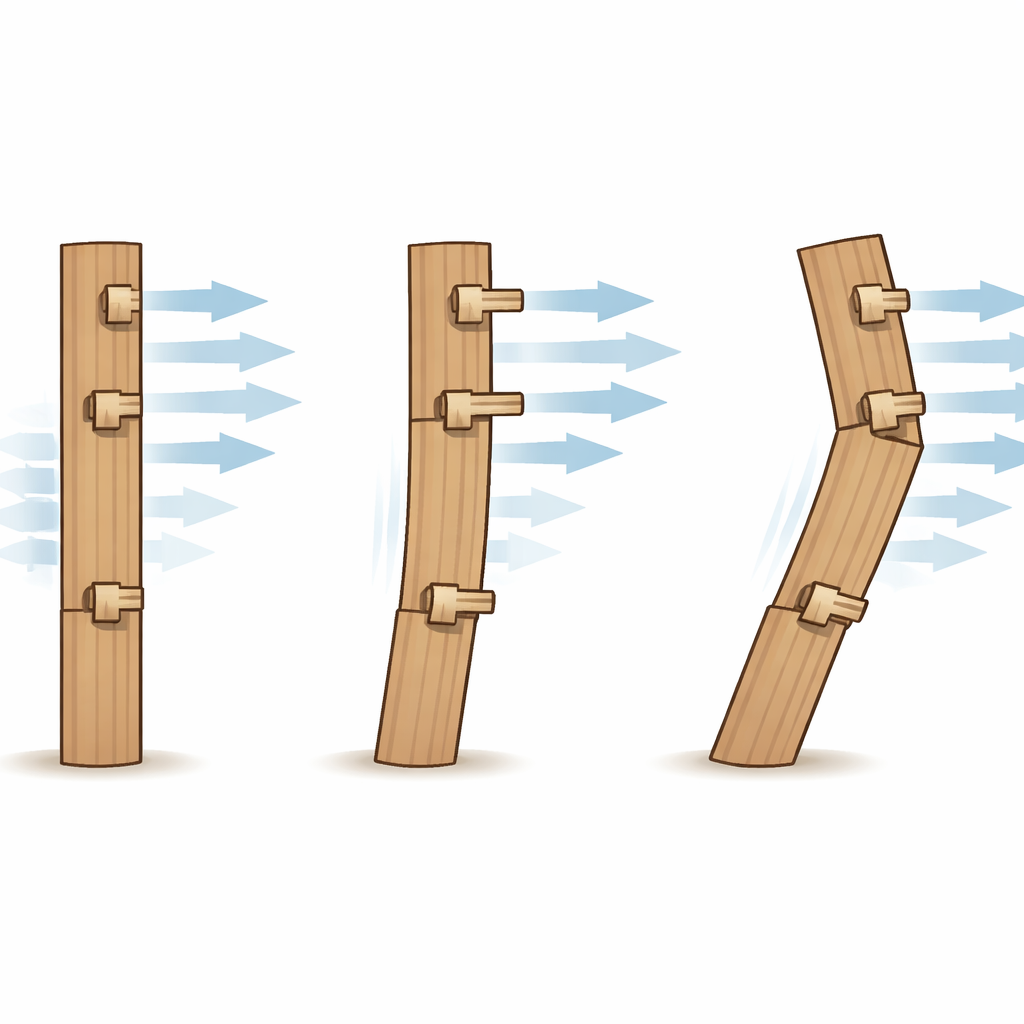
These patterns line up strikingly with how and where the pagoda is deforming. The columns on the second floor generally lean from southwest to northeast—the exact opposite of the dominant westerly and west-southwesterly winds that strike the tower’s western face. Monitoring of a key column on this floor shows that periods of strong westerly winds coincide with growth in its displacement, while intervals dominated by strong easterly winds temporarily reduce the tilt. The authors describe a two-step process: frequent moderate gales (Level 6–7) act like a hammer that never stops tapping, slowly loosening the wooden joints and causing small, permanent shifts; then, occasional extreme gales (Level 8 and above) deliver hard blows to an already weakened structure, pushing the tilt further. Because the strongest winds tend to occur in warm afternoons and during spring and autumn—times when temperature swings make the wood expand and contract—the material is more flexible, and the combined action of wind and thermal cycling speeds up deformation.
Safeguarding a Wooden Giant from Invisible Forces
By firmly linking the pagoda’s northeastward lean to a persistent pattern of strong westerly winds, this study turns abstract weather statistics into a practical protection roadmap. It argues that reinforcement and planning should focus on the western and southwestern sides of the tower, that real-time wind alerts could trigger temporary bracing before major gusts arrive, and that smarter regional planning—such as managing building heights or planting wind-breaking vegetation upwind—could gently tame the local airflow. While the authors note that their reconstruction still lacks ultra-detailed measurements right at different heights of the pagoda, their work already offers a clear message for non-specialists: the invisible push of wind, repeated day after day and season after season, is a key architect of the tower’s slow-motion tilt, and understanding that push is essential to keeping this rare wooden marvel standing.
Citation: Li, Z., Zhang, H., Wang, J. et al. Wind environment study and wind-induced hazard prevention of Yingxian Wooden Pagoda. npj Herit. Sci. 14, 253 (2026). https://doi.org/10.1038/s40494-026-02363-4
Keywords: Yingxian Wooden Pagoda, strong winds, cultural heritage protection, structural tilt, wind environment