Clear Sky Science · en
Topology-optimized reinforcement of Terracotta Warriors validated by shaking-table testing and finite-element analysis
Guarding a Fragile Army
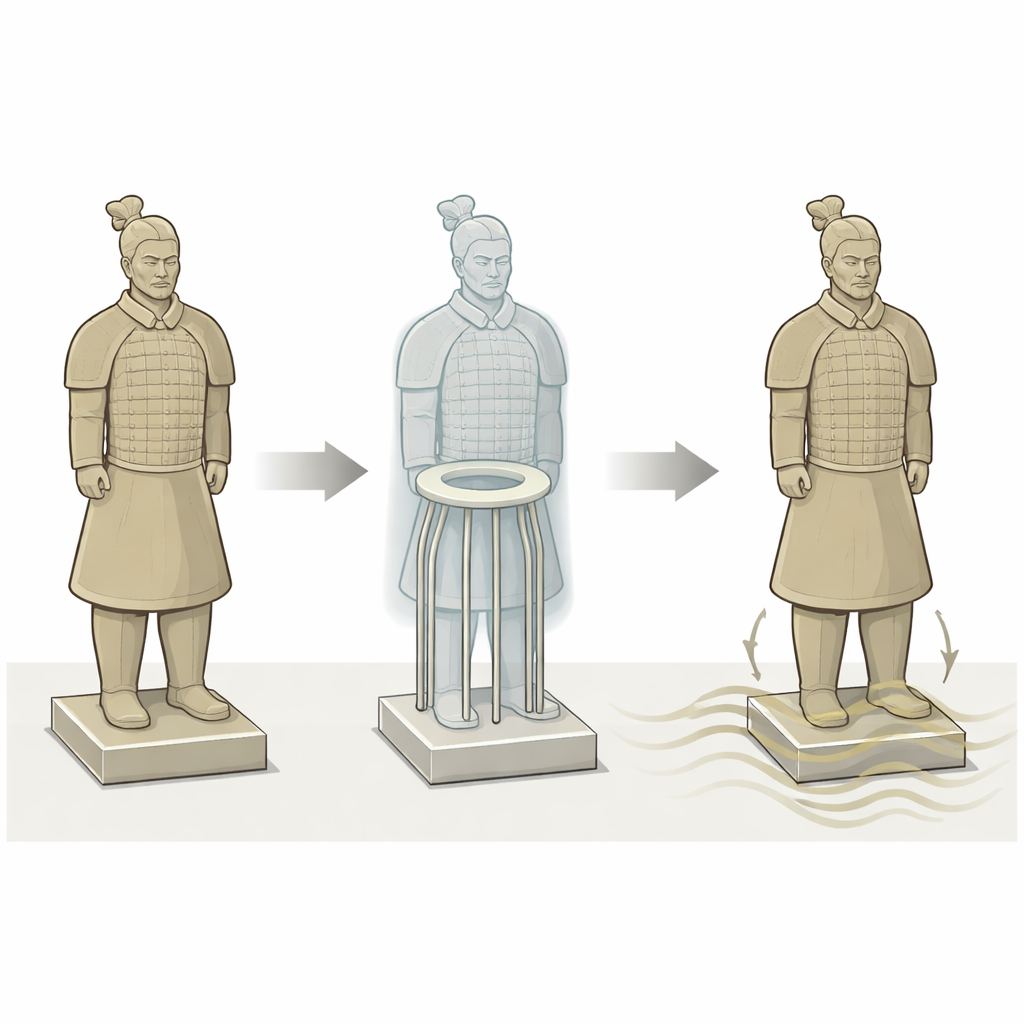
The Terracotta Warriors, buried for over two thousand years and often called the “Eighth Wonder of the World,” are far more fragile than their sturdy poses suggest. Today they stand in museums and excavation halls, exposed to gravity, aging materials, and the ever-present risk of earthquakes. This study explores how engineers can quietly hide smart, customized supports inside these hollow clay figures so they remain safe and stable without spoiling the visitor’s view.
Why Ancient Statues Need Modern Help
Unlike small objects kept in display cases, life-sized Terracotta Warriors are tall, heavy, and stand on relatively small bases. After centuries underground, their clay has weakened and developed hidden defects. When they are put back together and placed on show, their own weight and any shaking from the ground can concentrate forces around delicate areas such as the ankles and the lower edge of the robe. If those forces become too high, cracks can reopen or new damage can form, causing what conservators call “secondary damage” — harm that occurs after restoration. Preventing this kind of failure is crucial, because once these sculptures break again, the loss to history cannot be undone.
Designing Smart Supports with Digital Tools
The researchers used a full-scale replica warrior to test a new way of designing internal supports. They began by scanning the statue with a high-precision 3D laser, turning millions of surface points into a detailed digital model. That model was then used in computer simulations that calculate how the statue bends and where stresses concentrate under its own weight and during simulated earthquakes. The results confirmed that the most vulnerable areas lie around the lower skirt, the junction with the legs, and the ankles. Instead of relying on traditional, one-size-fits-all metal frames, the team defined a ring-shaped region under the skirt and asked the computer to “carve away” any support material that was not really needed.
Letting the Computer Carve the Best Shape
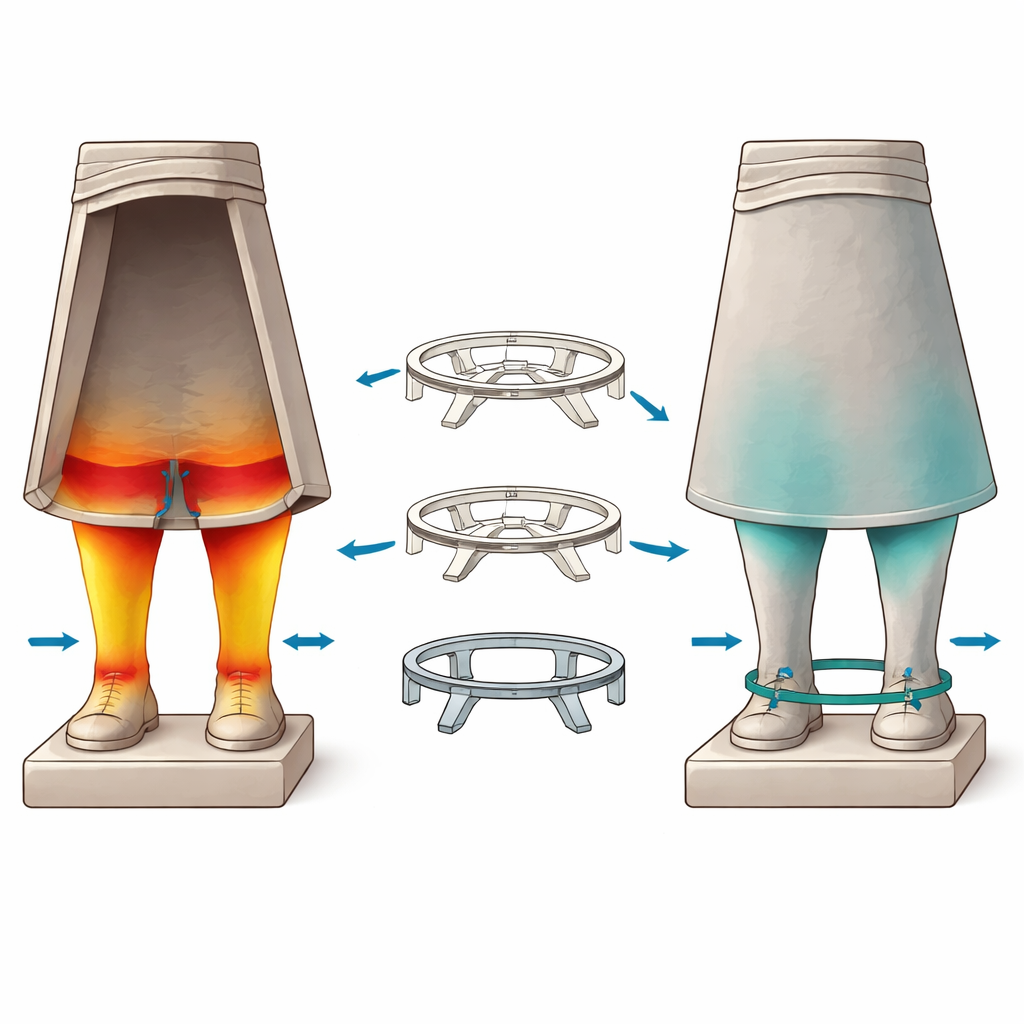
This carving process, called topology optimization, works like a highly disciplined sculptor. Starting from a simple hollow frustum-shaped ring, the software ran many cycles of analysis. In each cycle, it trimmed away the small pieces that carried the least load and kept those that worked hardest, while also tracking how much material and strength were gained or lost. Over dozens of steps, the shape evolved into an efficient, spidery support structure: an elliptical top ring connected to the base by eight slender legs, later simplified into four sturdy rods that are easier to manufacture and less visually intrusive. Computer models and a more conventional optimization method agreed that this arrangement gave the best overall support to the lower part of the statue while using relatively little material.
Testing the Hidden Shield Against Earthquakes
To see whether the optimized bracket truly protected the statue, the team built it from standard structural steel and placed it inside one replica, leaving a second replica unsupported as a control. Both were bolted to a shaking table and subjected to a well-known earthquake record at three different intensities, up to very strong shaking. Sensors mounted on the shoulders recorded how much each warrior moved and accelerated. With no bracket, the replica swayed noticeably at the higher level, and the accelerations at the shoulder were strongly amplified compared with the ground motion. With the bracket in place, those accelerations were typically cut in half and swaying was much less dramatic, all while stresses in the skirt area dropped by around forty percent. Importantly, neither replica suffered visible damage during testing, showing that the method protects without overloading the clay.
Making Supports That Almost Disappear
While steel brackets work well mechanically, they are hard and opaque, which can scratch fragile surfaces and distract from the sculpture. The team therefore explored an aerospace-grade plastic called polycarbonate, a clear, strong material often used in safety glass. Using the same optimization strategy, they designed a visually similar bracket but made it from this transparent plastic. Simulations showed that the polycarbonate version still reduced earthquake-related motions by about 39 percent—slightly less than steel, but enough to keep the statue stable in the tested scenarios. Because the plastic is much lighter, less abrasive, and allows around 90 percent of light to pass through, it offers a subtle support that visitors can barely see while still guarding the artwork.
New Ways to Protect Old Treasures
In everyday terms, this study shows that it is possible to give the Terracotta Warriors an invisible “exoskeleton” tailored precisely to their weak spots. By combining 3D scanning, computer simulations, and smart material choices, conservators can design supports that quietly share the load with the ancient clay, soften the impact of earthquakes, and lower the chance of future cracking. The same workflow could be extended to other large, brittle relics—such as ceramic statues, stone figures, or hollow wooden sculptures—offering a powerful new toolkit for keeping the world’s heritage standing safely for generations to come.
Citation: Zhu, L., Liu, X., Lan, D. et al. Topology-optimized reinforcement of Terracotta Warriors validated by shaking-table testing and finite-element analysis. npj Herit. Sci. 14, 231 (2026). https://doi.org/10.1038/s40494-025-02249-x
Keywords: Terracotta Warriors, cultural heritage conservation, earthquake protection, topology optimized supports, polycarbonate brackets