Clear Sky Science · en
Development and validation of an instrument for assessing aesthetic education
Why beauty in school life matters
When we think about school, we often picture exams and grades, not moments of beauty or inspiration. Yet experiences with art, music, stories, and nature can quietly shape how young people see themselves and the world. This study asks a simple but powerful question: how can we tell whether schools are really helping teenagers grow through such experiences of beauty, not just teaching them to pass tests?
Looking beyond art skills
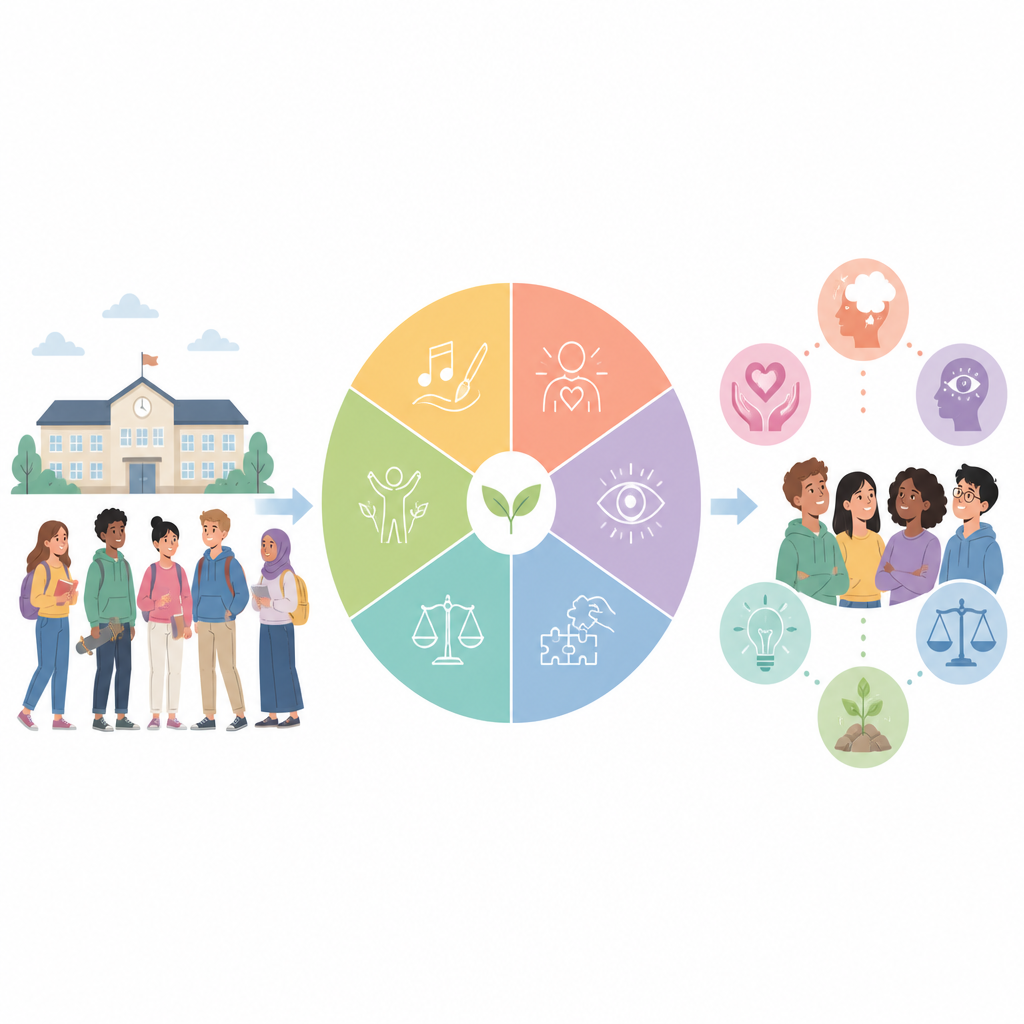
Many school programs treat aesthetic education as a matter of learning to draw well, play an instrument, or recognize famous paintings. The authors argue that this view is too narrow. Drawing on ideas from classic thinkers such as Kant, Schiller, Dewey, and Marx, as well as modern psychology, they see aesthetic education as a way to develop the whole person. Encounters with art and beauty can train attention, spark imagination, deepen moral reflection, and help young people handle emotion and stress. However, most existing tools for evaluation only capture technical skills or knowledge, and are not well suited to the developmental needs of adolescents.
A new model of inner growth
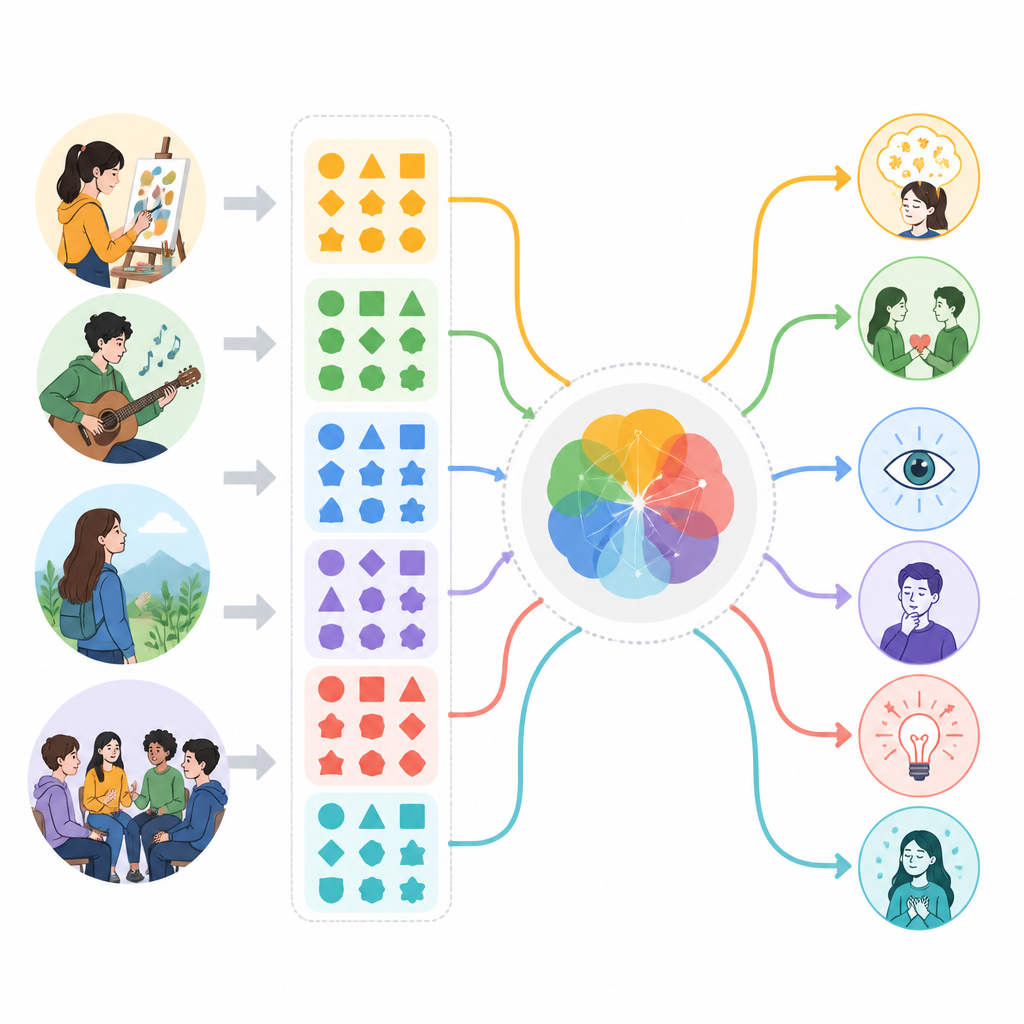
To fill this gap, the researchers created the IMPACT model, which breaks aesthetic development into six connected kinds of growth. Imagination covers the ability to picture new scenes and viewpoints. Moral Force reflects empathy, social responsibility, and a desire to act kindly. Perception is about noticing details and experiencing the world more vividly. Aesthetic Judgement involves forming one’s own opinions about what is moving or valuable in art and everyday life. Creativity refers to generating and refining ideas. Tenacity describes emotional resilience and the willingness to stay engaged, even when life is difficult. Rather than rating works of art, the model focuses on how young people experience aesthetic learning inside schools.
Turning ideas into a working scale
The team first wrote 54 simple statements that middle school students could agree or disagree with, each linked to one of the six dimensions. A panel of experts in education, psychology, statistics, and the arts reviewed these items, trimming and rewriting them to ensure they were clear, age appropriate, and balanced across the six areas. Teachers and students then took part in interviews to check whether the wording made sense in everyday classroom life. After this stage, the questionnaire contained 36 items, all phrased in accessible language that reflected real experiences of aesthetic activities in Chinese schools.
Testing the scale with teenagers
To see whether the IMPACT tool actually worked, the authors ran two large studies with over 950 middle school students in Chongqing, Shanghai, and Shenzhen. In the first study, they explored how the items naturally grouped together in student responses. A six-factor pattern appeared that matched the IMPACT design, leading to a slightly shorter, 34-item version. In the second study, with a fresh set of students, they tested this six-part structure more strictly. Statistical checks showed that the model fit the data well, each item strongly reflected its intended dimension, and all six dimensions were closely related yet still distinct. Measures of internal consistency were high, suggesting the scale is reliable.
What this means for schools and students
For a lay reader, the main message is that the authors have built a careful yardstick for something that previously felt vague: how school-based encounters with beauty shape teenagers’ minds and hearts. The IMPACT instrument does not claim that art automatically makes people better or happier. Instead, it captures how students themselves report changes in imagination, ethical awareness, attention, creativity, judgement, and resilience within real classroom settings. Policymakers can use it to see whether new aesthetic programs are doing what they intend, while teachers can use it to understand where their students are flourishing and where they may need more support. In this way, the study turns the often abstract ideal of “educating through beauty” into something that can be observed, discussed, and steadily improved.
Citation: Li, R., Gao, X., An, M. et al. Development and validation of an instrument for assessing aesthetic education. Humanit Soc Sci Commun 13, 747 (2026). https://doi.org/10.1057/s41599-026-07523-2
Keywords: aesthetic education, adolescent development, educational assessment, creativity, Chinese schools