Clear Sky Science · en
Individual differences in phonation types and their interaction with pitch range: Evidence from the five level tones in Hmu
How one village language stretches the limits of tone
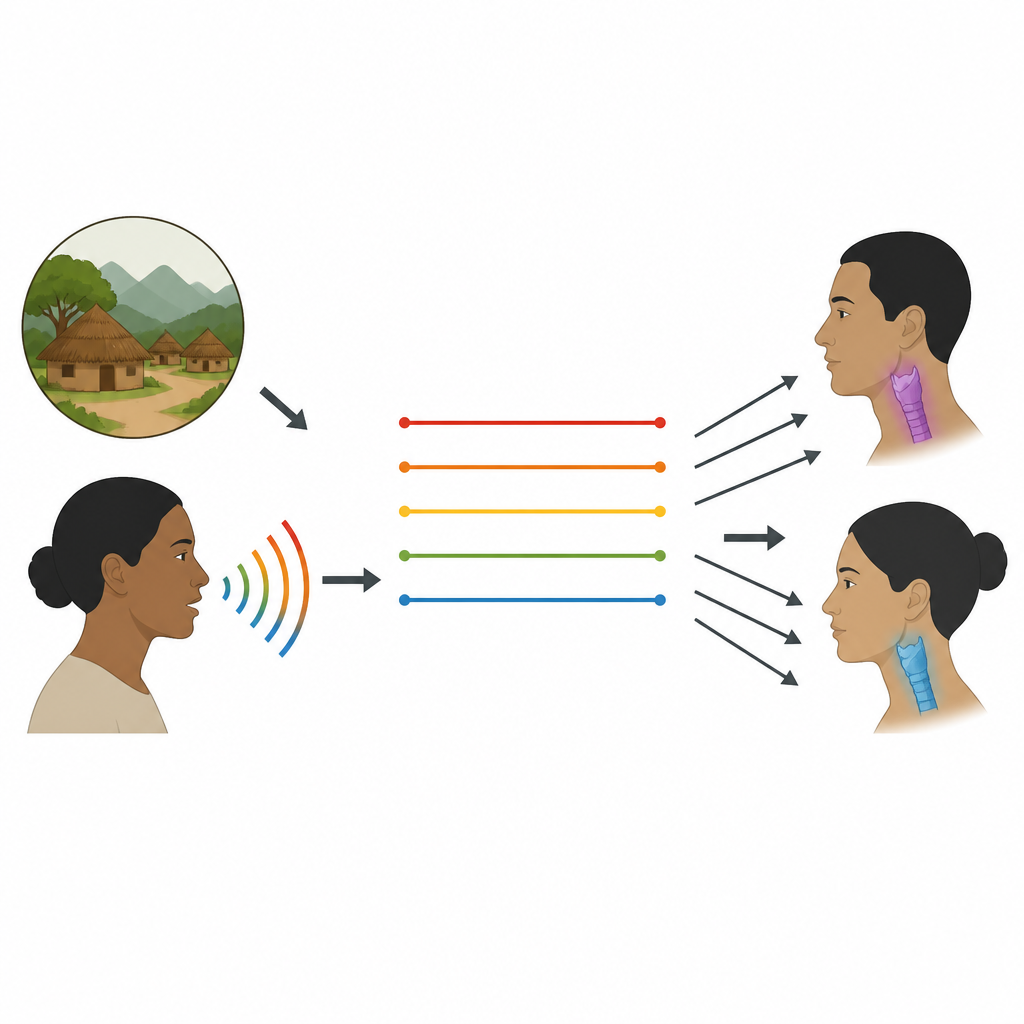
Imagine speaking a language where simply holding your pitch flat in five slightly different places can change what every word means. That is the daily reality for speakers of Hmu, a small Eastern Hmongic language in southwest China. This study asks how people manage to keep so many similar-sounding tones apart, and what happens when individual voices cannot easily reach all those pitch levels.
A rare system of flat tones
Hmu is spoken by about a thousand people in Xinzhai village. Unlike languages with rising or falling tones, Hmu has five distinct tones that are all level: low, mid-low, mid, mid-high, and high. Systems with five separate level tones are extremely rare. That raises a puzzle for linguists and psychologists who study sound systems: how do listeners reliably hear the difference between so many closely spaced pitch levels, and how do speakers keep those differences stable over generations?
Listening to how voices really behave
To tackle this puzzle, the researchers recorded 30 native speakers of Hmu while they pronounced many words carrying each of the five level tones. They captured not only the sound but also electroglottographic signals, which track how the vocal folds touch and separate during speech. From these recordings they measured pitch, timing, and several indicators of voice quality, such as how much energy lies in higher versus lower parts of the sound spectrum and how noisy or smooth the vibration is. They then used statistical models to see how tones differ on average and how much speakers vary from one another.
A special low tone with a fuzzy start
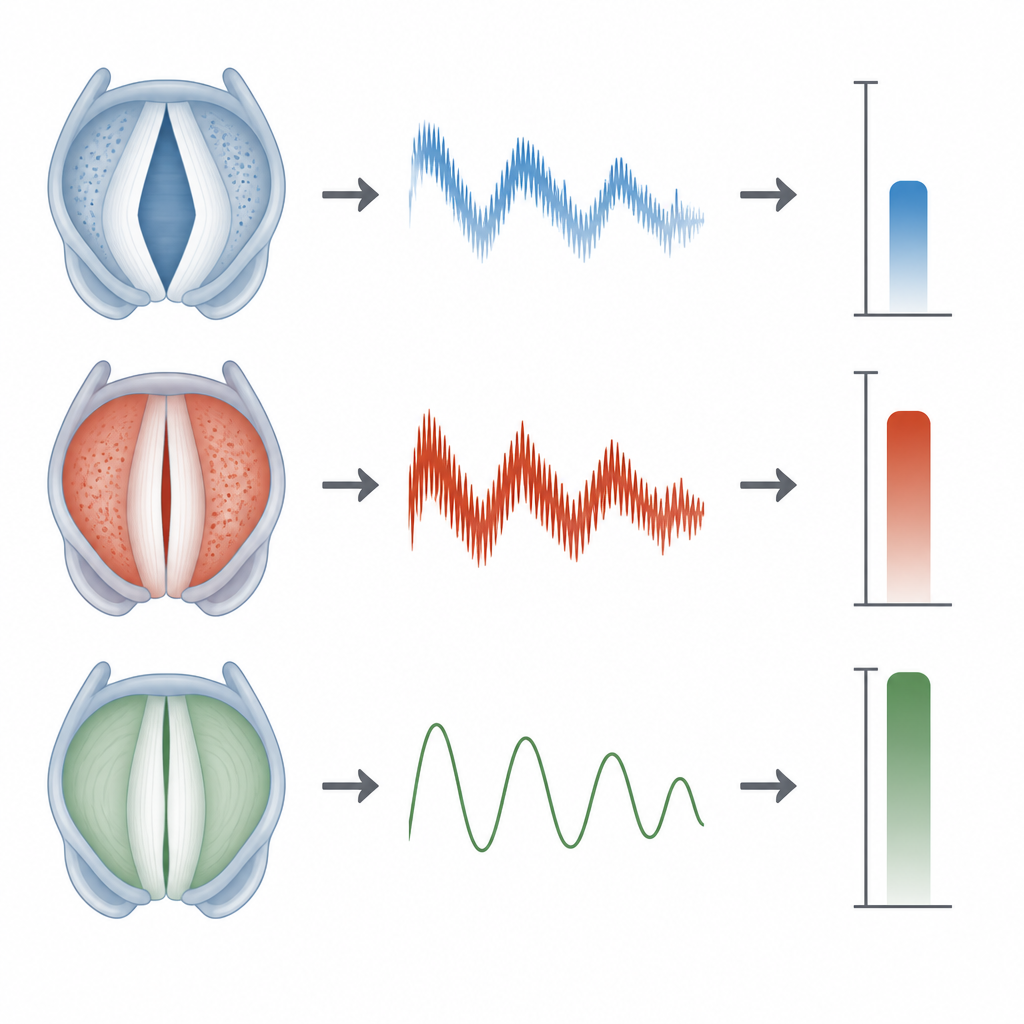
The analysis showed that four of the tones behave in a fairly straightforward way. The mid-low, mid, and mid-high tones are produced with what listeners perceive as a normal, steady voice, and are mainly set apart by pitch height. The very high tone also has a normal quality but, because it sits at the top of each speaker’s range, it can be thought of as a high-pitched voice. The lowest tone, however, stands out. At the beginning of its vowel, speakers tend to use a softer, leakier voice quality that lets more air escape and adds noise to the sound, a pattern often called breathy voice. Crucially, this special quality is concentrated in roughly the first third of the vowel and then fades into a more ordinary voice, giving the tone a brief but robust extra cue.
Different speakers, different voice tricks
Although the group pattern is clear, individuals do not all use exactly the same strategy. Some speakers match the classic breathy pattern for the low tone, with strong noise and weaker high-frequency energy at the start of the vowel. Others produce a harsher, more squeezed voice quality, with changes in how the throat above the vocal folds shapes the sound. A third group uses a voice that is very close to normal, relying mostly on pitch. Despite these differences, all speakers manage to keep the low tone distinct from the other four, suggesting there are multiple workable ways for a community to encode the same contrast.
When limited pitch range invites extra cues
The study also examined how wide a pitch range each person used across the five level tones. Some speakers spread their tones over a broad span of frequencies, so each level is clearly separated by pitch alone. Others had a narrower range, making the low and slightly higher tones hard to distinguish using pitch only. Statistical tests showed that speakers with narrower pitch ranges were more likely to use non-standard voice qualities such as breathy or harsh voice on the low tone. In effect, when pitch space is cramped, speakers seem to lean more on voice quality as an extra dimension of contrast.
What this means for understanding tone
For a general reader, the key message is that tone in language is not just about how high or low a voice is. In Hmu, and likely in many other tonal languages, speakers weave together pitch and voice quality to keep words apart. The low tone uses a short burst of unusual voice at its beginning, and different speakers fine-tune that burst in their own way, depending in part on how flexible their pitch range is. This shows that human sound systems can pack many meanings into small differences by recruiting several aspects of the voice at once, while still allowing room for individual voices to sound like themselves.
Citation: Liu, W., Hou, N. & Tang, H. Individual differences in phonation types and their interaction with pitch range: Evidence from the five level tones in Hmu. Humanit Soc Sci Commun 13, 707 (2026). https://doi.org/10.1057/s41599-026-07071-9
Keywords: tone languages, voice quality, pitch range, Hmongic languages, phonation