Clear Sky Science · en
Spatiotemporal evolution and predictive analysis of educational resource allocation efficiency in Shandong Province
Why school resources matter for every family
When parents think about their children’s future, they often focus on getting them into a good school. But behind each classroom lies a far bigger question: are teachers, classrooms, and education funds shared fairly and used wisely across an entire region? This study looks at Shandong, one of China’s most populous provinces, to see how well compulsory education resources are allocated over time, how this connects to the local economy, and what may happen in the coming years.
Different cities, different chances
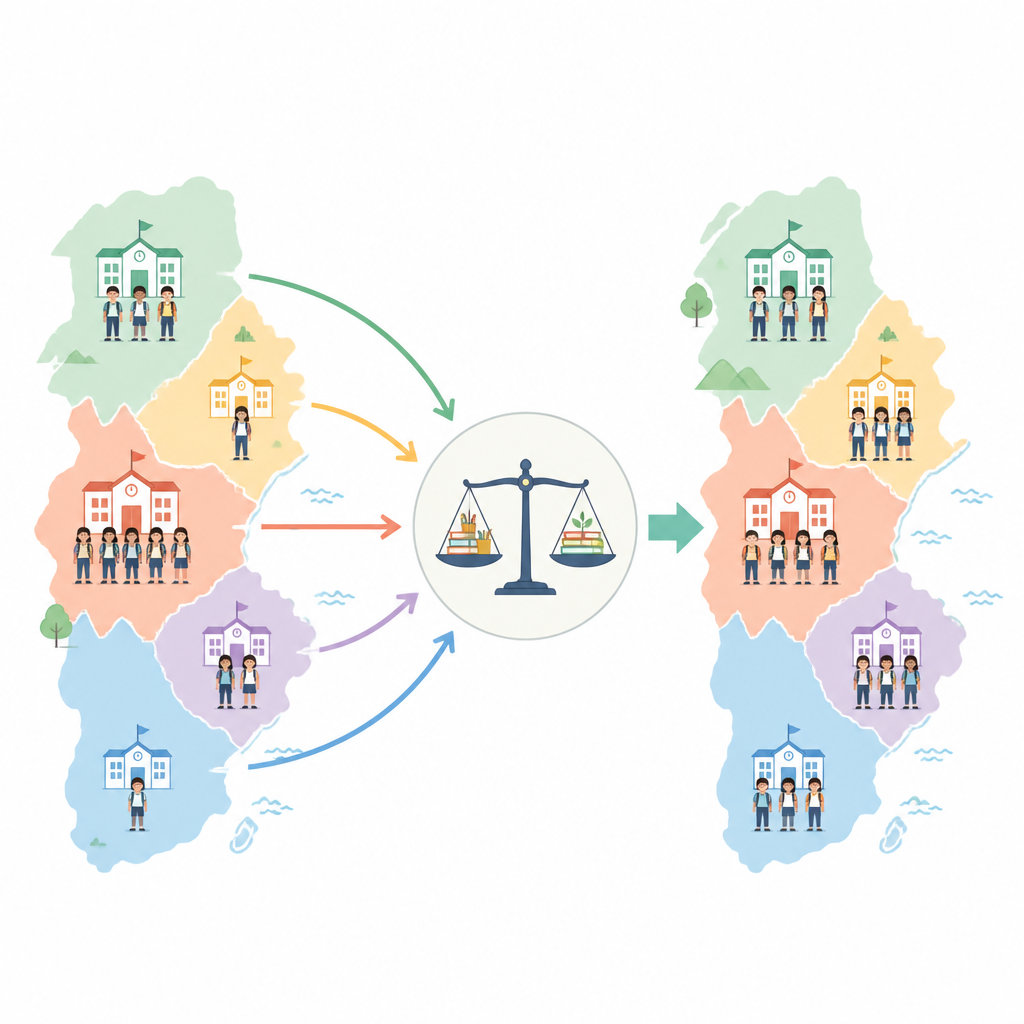
The researchers examined 16 cities in Shandong from 2018 to 2023 and found clear gaps in how efficiently education resources are used. On average, the province falls short of the “frontier” of best possible use, and efficiency has slipped over time. Some cities, such as Dongying, Heze and parts of the eastern coast, use their teachers, school buildings and funds relatively well. Others, including the provincial capital Jinan and the port city Qingdao, lag behind despite strong economies. In some fast growing cities, crowded schools and diluted resources reduce the benefit that extra spending should bring. In slower growing inland areas, half empty classrooms and underused teachers show the opposite problem: resources are in place but not fully used.
How change, crisis, and scale shape results
To see how performance changes over time, the team tracked total factor productivity, a measure of how much more education “output” can be created from the same “input.” They found only slight gains overall, with strong ups and downs across years. Technological progress, such as digital tools and better management, did push the system forward. However, this was often offset by “diseconomies of scale” as schools grew too quickly or were built where there were not enough students. The COVID-19 pandemic left a clear mark: efficiency dropped sharply when teaching moved online, revealing weak digital readiness and limited flexibility in policy and school practice.
Linking schools to the local economy
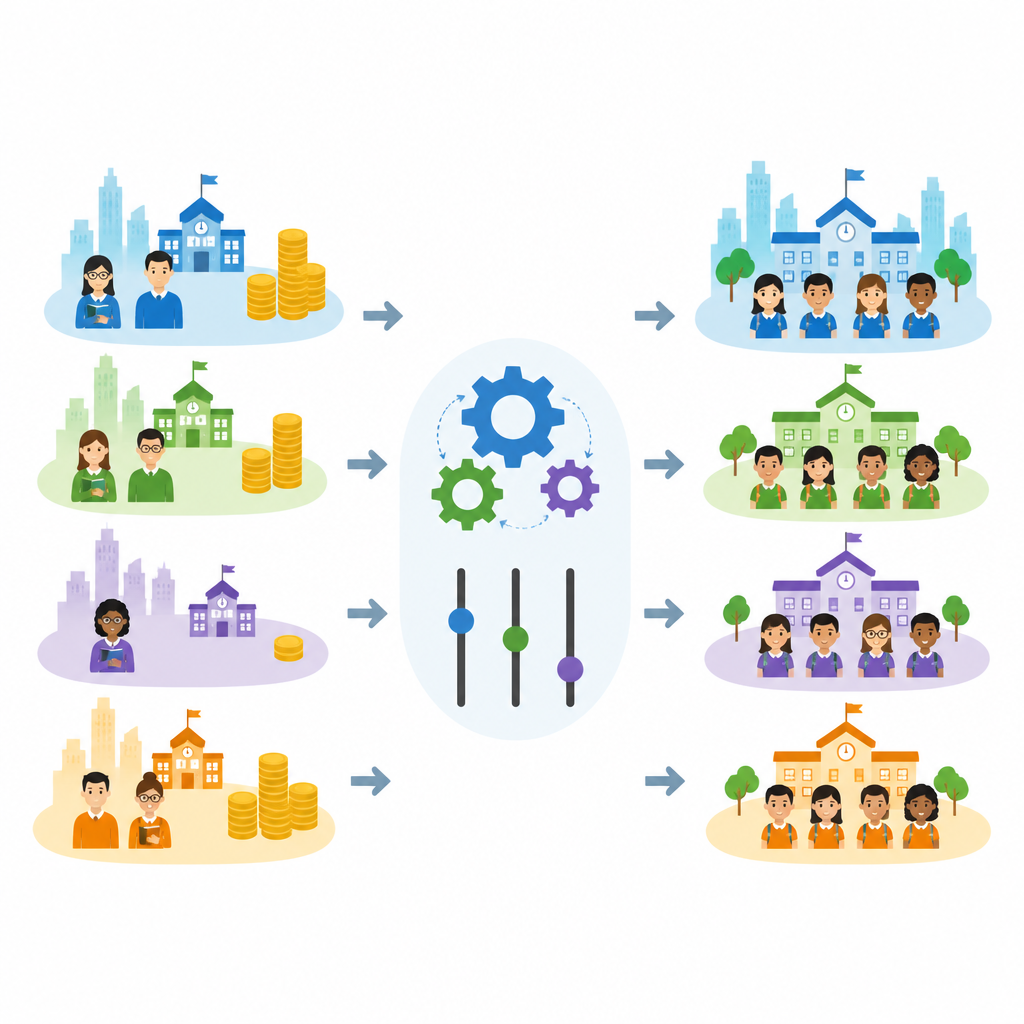
Education does not operate in isolation. The authors built a framework that looks at schools and the regional economy as two interacting systems. In stronger coastal economies, where local budgets and innovation are robust, education and the economy tend to support each other: steady funding improves schools, and better educated students later strengthen the workforce. In poorer southwest cities, both systems struggle. There, education funds are tight, good teachers are hard to keep, and local industries gain less from schooling, leading to a “low level trap” where neither side improves much. Across the province, the pattern is clear: coordination between education and economic resilience is higher in the east and lower in the southwest, and the gap is slowly widening.
Looking ahead to future funding
Because governments must plan years in advance, the study also predicts per student funding for primary and junior secondary schools up to 2030. Using a forecasting method designed for short and uneven data series, the authors expect spending per pupil to keep rising overall, with junior secondary students receiving more on average than primary students. Yet regional differences are likely to persist. Some cities are projected to see much faster growth in investment than others, which could either help close gaps or entrench them, depending on how wisely the money is used.
What this means for children and communities
In everyday terms, the study shows that simply “spending more on schools” is not enough. When money, buildings, and teachers are not matched to local needs, or when economic shocks hit areas with weak safety nets, students may still end up in overcrowded classrooms or underused schools. The authors argue for policies that adjust to each city’s conditions, improve teacher deployment, and tie extra funding to proven gains in efficiency and balance. For families in Shandong and in similar regions worldwide, the message is that fair and smart allocation of education resources depends as much on sound local planning and resilient economies as on the size of the education budget.
Citation: Xie, W., Zhao, H., Liang, X. et al. Spatiotemporal evolution and predictive analysis of educational resource allocation efficiency in Shandong Province. Humanit Soc Sci Commun 13, 660 (2026). https://doi.org/10.1057/s41599-026-06994-7
Keywords: educational resources, Shandong Province, compulsory education, regional inequality, economic resilience